SOPREMA Inc.SOPRASEAL EXPRESS G Air/Vapour Barrier MembranesENVIRONMENTAL PRODUCTDECLARATIONISO 14025:2006 and ISO 21930:2017SOPREMA is pleased to present this Environmental Product Declaration (EPD) for the SOPRASEAL EXPRESS G. This EPD was developed in compliance with ISO 14025 and ISO 21930 and has been verified by Lindita Bushi, Ph.D., Athena Sustainable Materials Institute. The LCA and the EPD were prepared by Vertima Inc. The EPD includes cradle-to-gate life cycle assessment (LCA) results. For more information about SOPREMA, visit www.soprema.ca.For any explanatory material regarding this EPD, please contact the program operator.
Page 2SOPREMA Inc. | GENERAL INFORMATION1. GENERAL INFORMATIONEPD GENERAL INFORMATIONProgram OperatorASTM International100 Barr Harbor Drive, West Conshohocken, PA 19428www.astm.orgDeclared ProductSOPRASEAL EXPRESS GEPD Registration Number EPD Date of Issue EPD Period of Validity EPD Recipient OrganizationSOPREMA Inc.1688, Jean-Berchmans-Michaud Drummondville (Quebec) J2C 8E9 Canadawww.soprema.ca/en/ PCR GENERAL INFORMATIONReference PCRWater-Resistive and Air BarriersASTM InternationalSeptember 2017 to September 2023 (validity period)The PCR review was conducted by:Thomas P. Gloria (chair)Industrial Ecology Consultantst.gloria@industrial-ecology.comGraham Finch RDH Builiding Science, Inc.Paul H. Shipp USG CorporationThis LCA and EPD were prepared by:Chantal Lavigne, M.A ScVertima Inc.www.vertima.caThis EPD and LCA were independently verified in accordance with ISO 14025:2006, ISO 14040:2006, ISO 14044:2006 and ISO 21930:2017, as well as the ASTM International PCR “Water-Resistive and Air Barriers.”InternalX External_____________________________ Lindita Bushi, Ph.D.Athena Sustainable Materials InstituteEPD Type/Scope and Declared UnitProduct specific cradle-to-gate EPD with declared unit of 1 m2 of membraneYear of Reported Manufacturer Primary Data2021Geographical ScopeNorth AmericaLCA SoftwareOpenLCA v.1.11.0LCI DatabasesEcoinvent 3.9.1 and US LCILCIA MethodologyTRACI 2.1, CED LHV v1.0 and HHV v.1.01EPD 510July 20, 2023July 19, 2028
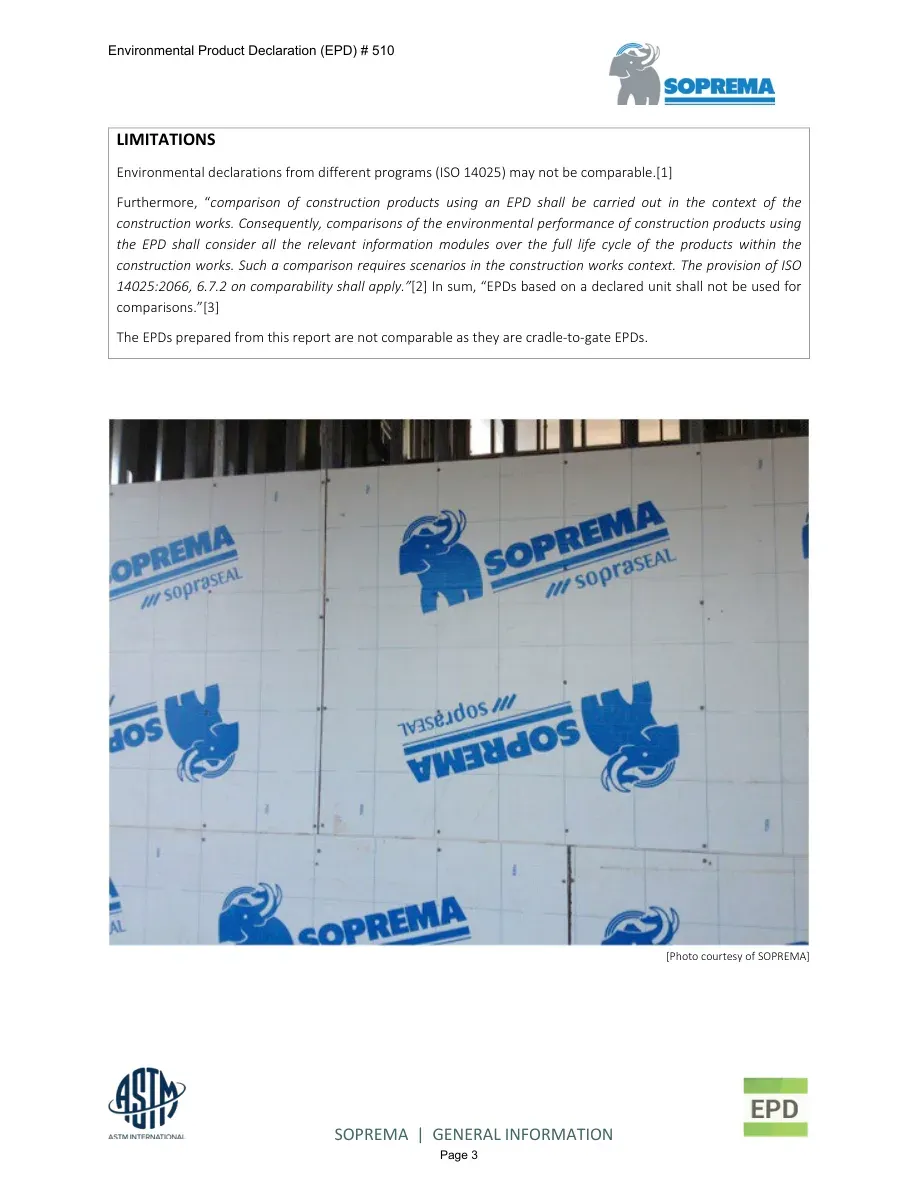
Environmental Product Declaration (EPD) # 510 SOPREMA | GENERAL INFORMATION Page 3 LIMITATIONS Environmental declarations from different programs (ISO 14025) may not be comparable.[1] Furthermore, “comparison of construction products using an EPD shall be carried out in the context of the construction works. Consequently, comparisons of the environmental performance of construction products using the EPD shall consider all the relevant information modules over the full life cycle of the products within the construction works. Such a comparison requires scenarios in the construction works context. The provision of ISO 14025:2066, 6.7.2 on comparability shall apply.”[2] In sum, “EPDs based on a declared unit shall not be used for comparisons.”[3] The EPDs prepared from this report are not comparable as they are cradle-to-gate EPDs. [4] [Photo courtesy of SOPREMA]
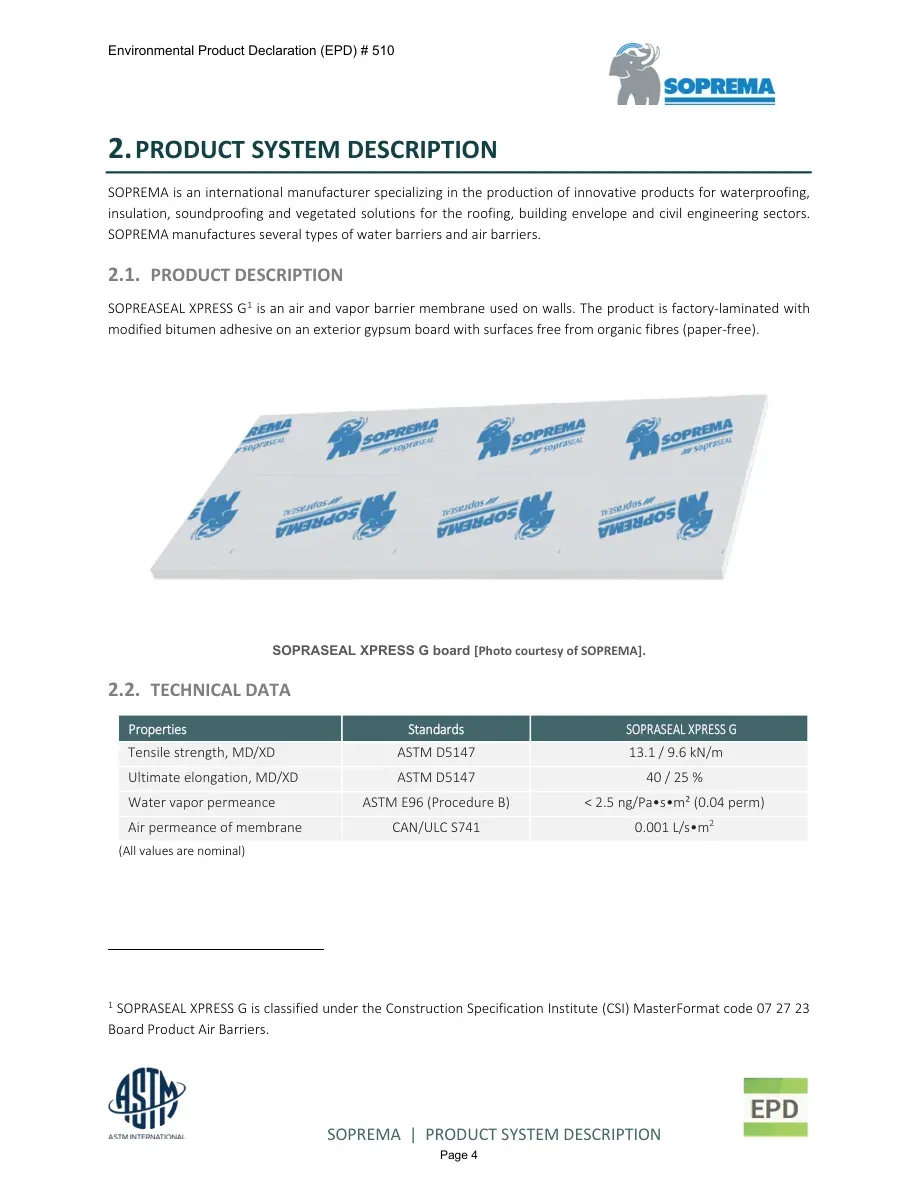
Environmental Product Declaration (EPD) # 510 SOPREMA | PRODUCT SYSTEM DESCRIPTION Page 4 2. PRODUCT SYSTEM DESCRIPTION SOPREMA is an international manufacturer specializing in the production of innovative products for waterproofing, insulation, soundproofing and vegetated solutions for the roofing, building envelope and civil engineering sectors. SOPREMA manufactures several types of water barriers and air barriers. 2.1. PRODUCT DESCRIPTION SOPREASEAL XPRESS G1 is an air and vapor barrier membrane used on walls. The product is factory-laminated with modified bitumen adhesive on an exterior gypsum board with surfaces free from organic fibres (paper-free). SOPRASEAL XPRESS G board [Photo courtesy of SOPREMA]. 2.2. TECHNICAL DATA Properties Standards SOPRASEAL XPRESS G Tensile strength, MD/XD ASTM D5147 13.1 / 9.6 kN/m Ultimate elongation, MD/XD ASTM D5147 40 / 25 % Water vapor permeance ASTM E96 (Procedure B) < 2.5 ng/Pa•s•m² (0.04 perm) Air permeance of membrane CAN/ULC S741 0.001 L/s•m2 (All values are nominal) 1 SOPRASEAL XPRESS G is classified under the Construction Specification Institute (CSI) MasterFormat code 07 27 23 Board Product Air Barriers.
Environmental Product Declaration (EPD) # 510 SOPREMA | PRODUCT SYSTEM DESCRIPTION Page 5 2.3. PROPERTIES OF DECLARED PRODUCT AS DELIVERED Specifications SOPRASEAL XPRESS G Thickness Membrane Gypsum board 1.2 mm (47 mil) 12.7 mm (1/2 in) Dimensions 1.2 m x 2.44 m (4 x 8 ft) Weight 31.6 kg (69.7 lb) Surface Tri-laminated woven polyethylene More details are available at https://www.soprema.ca/en/products-systems/sopraseal-xpress-g (All values are nominal) 2.4. MATERIAL COMPOSITION Component/Material SOPRASEAL XPRESS G Gypsum board 89.2% SBS-modified bitumen mixture 9.4% Tri-laminated woven polyethylene 1.3% Thermofusible plastic film 0.1% TOTAL 100.0% 2.5. MANUFACTURING Manufacturing of the SOPRASEAL XPRESS G is a two-step process: first, the membrane is prepared and then it is laminated to the gypsum board (see figures below). Manufacturing SBS-modified bitumen air barrier sheet materials involves the deposition of a thin layer of SBS-modified asphalt between a high-strength facer and a polypropylene burn-off film. The SBS-modified asphalt is produced by mixing the appropriate proportions of polymer (SBS), asphalt (also called bitumen), and oil. The product is cooled, wound into rolls, and packaged for shipment to the laminating facility. The membrane is then heat-laminated on a rigid gypsum substrate.
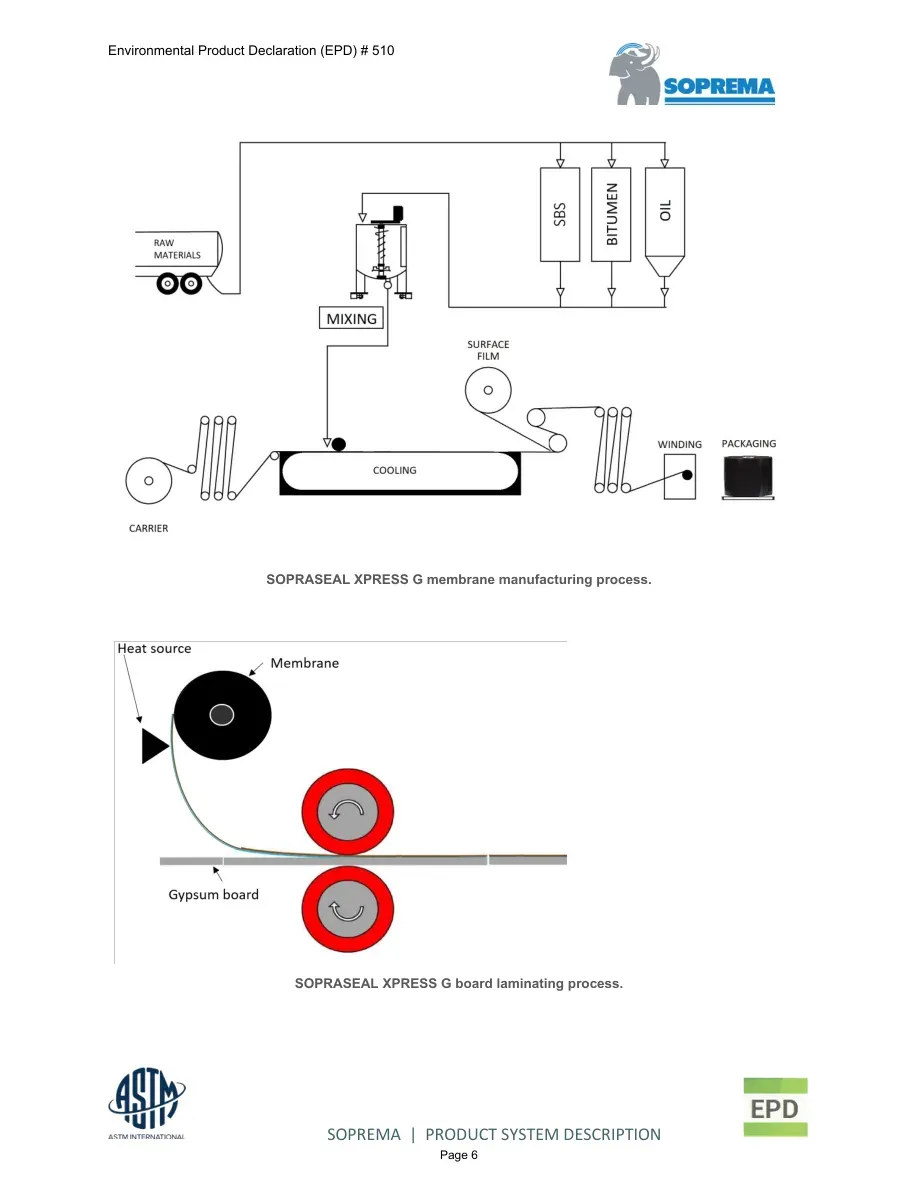
Environmental Product Declaration (EPD) # 510 SOPREMA | PRODUCT SYSTEM DESCRIPTION Page 6 SOPRASEAL XPRESS G membrane manufacturing process. SOPRASEAL XPRESS G board laminating process.
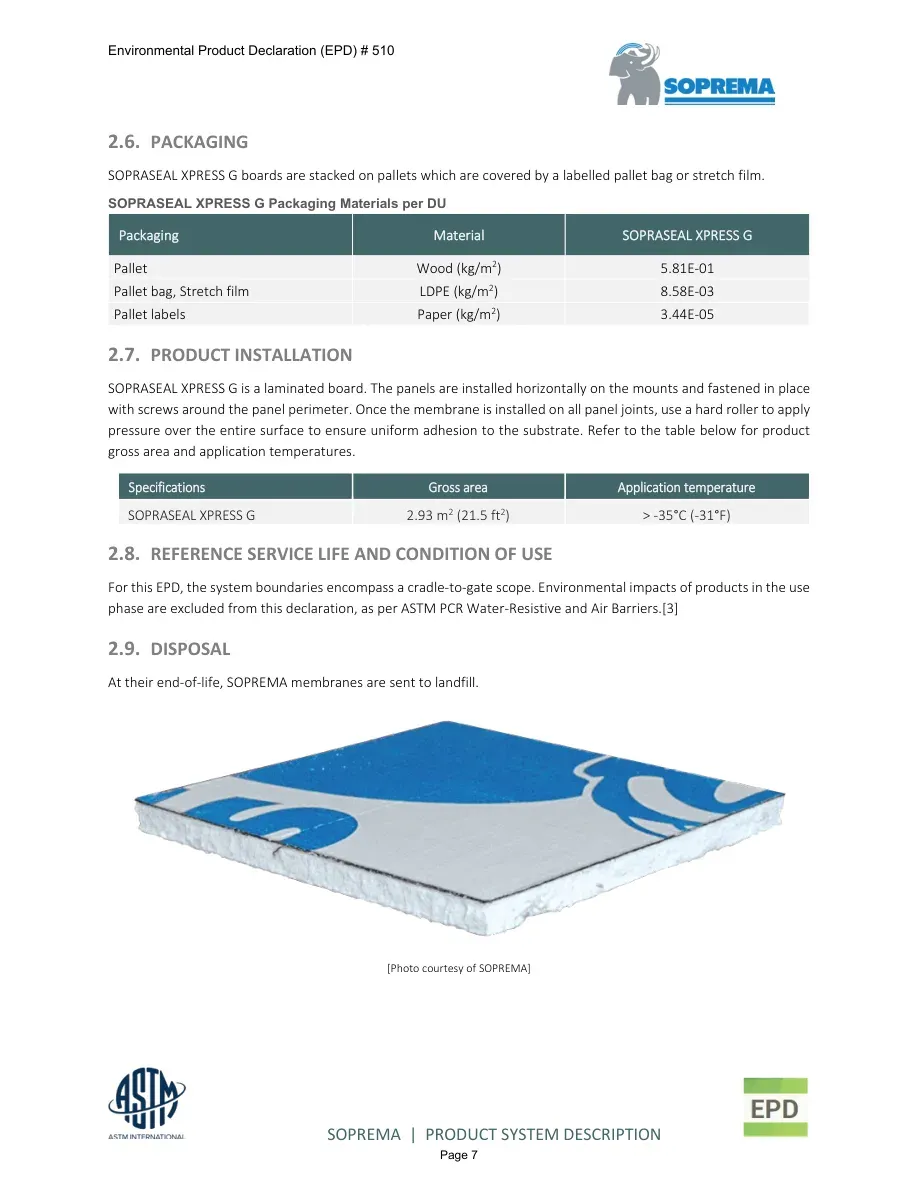
Environmental Product Declaration (EPD) # 510 SOPREMA | PRODUCT SYSTEM DESCRIPTION Page 7 2.6. PACKAGING SOPRASEAL XPRESS G boards are stacked on pallets which are covered by a labelled pallet bag or stretch film. SOPRASEAL XPRESS G Packaging Materials per DU Packaging Material SOPRASEAL XPRESS G Pallet Wood (kg/m2) 5.81E-01 Pallet bag, Stretch film LDPE (kg/m2) 8.58E-03 Pallet labels Paper (kg/m2) 3.44E-05 2.7. PRODUCT INSTALLATION SOPRASEAL XPRESS G is a laminated board. The panels are installed horizontally on the mounts and fastened in place with screws around the panel perimeter. Once the membrane is installed on all panel joints, use a hard roller to apply pressure over the entire surface to ensure uniform adhesion to the substrate. Refer to the table below for product gross area and application temperatures. Specifications Gross area Application temperature SOPRASEAL XPRESS G 2.93 m2 (21.5 ft2) > -35°C (-31°F) 2.8. REFERENCE SERVICE LIFE AND CONDITION OF USE For this EPD, the system boundaries encompass a cradle-to-gate scope. Environmental impacts of products in the use phase are excluded from this declaration, as per ASTM PCR Water-Resistive and Air Barriers.[3] 2.9. DISPOSAL At their end-of-life, SOPREMA membranes are sent to landfill. [Photo courtesy of SOPREMA]
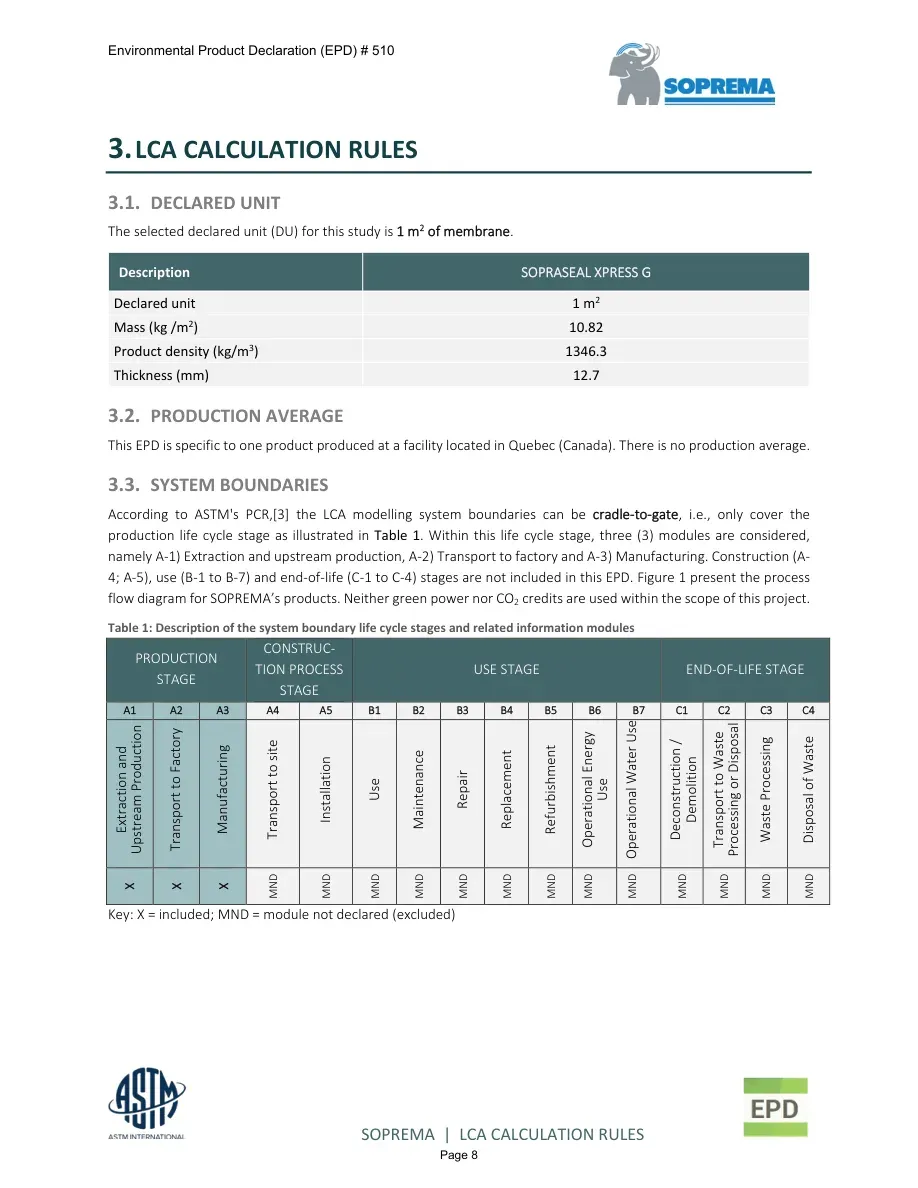
Environmental Product Declaration (EPD) # 510 SOPREMA | LCA CALCULATION RULES Page 8 3. LCA CALCULATION RULES 3.1. DECLARED UNIT The selected declared unit (DU) for this study is 1 m2 of membrane. Description SOPRASEAL XPRESS G Declared unit 1 m2 Mass (kg /m2) 10.82 Product density (kg/m3) 1346.3 Thickness (mm) 12.7 3.2. PRODUCTION AVERAGE This EPD is specific to one product produced at a facility located in Quebec (Canada). There is no production average. 3.3. SYSTEM BOUNDARIES According to ASTM's PCR,[3] the LCA modelling system boundaries can be cradle-to-gate, i.e., only cover the production life cycle stage as illustrated in Table 1. Within this life cycle stage, three (3) modules are considered, namely A-1) Extraction and upstream production, A-2) Transport to factory and A-3) Manufacturing. Construction (A-4; A-5), use (B-1 to B-7) and end-of-life (C-1 to C-4) stages are not included in this EPD. Figure 1 present the process flow diagram for SOPREMA’s products. Neither green power nor CO2 credits are used within the scope of this project. Table 1: Description of the system boundary life cycle stages and related information modules PRODUCTION STAGE CONSTRUC-TION PROCESS STAGE USE STAGE END-OF-LIFE STAGE A1 A2 A3 A4 A5 B1 B2 B3 B4 B5 B6 B7 C1 C2 C3 C4 Extraction and Upstream Production Transport to Factory Manufacturing Transport to site Installation Use Maintenance Repair Replacement Refurbishment Operational Energy Use Operational Water Use Deconstruction / Demolition Transport to Waste Processing or Disposal Waste Processing Disposal of Waste X X X MND MND MND MND MND MND MND MND MND MND MND MND MND Key: X = included; MND = module not declared (excluded)
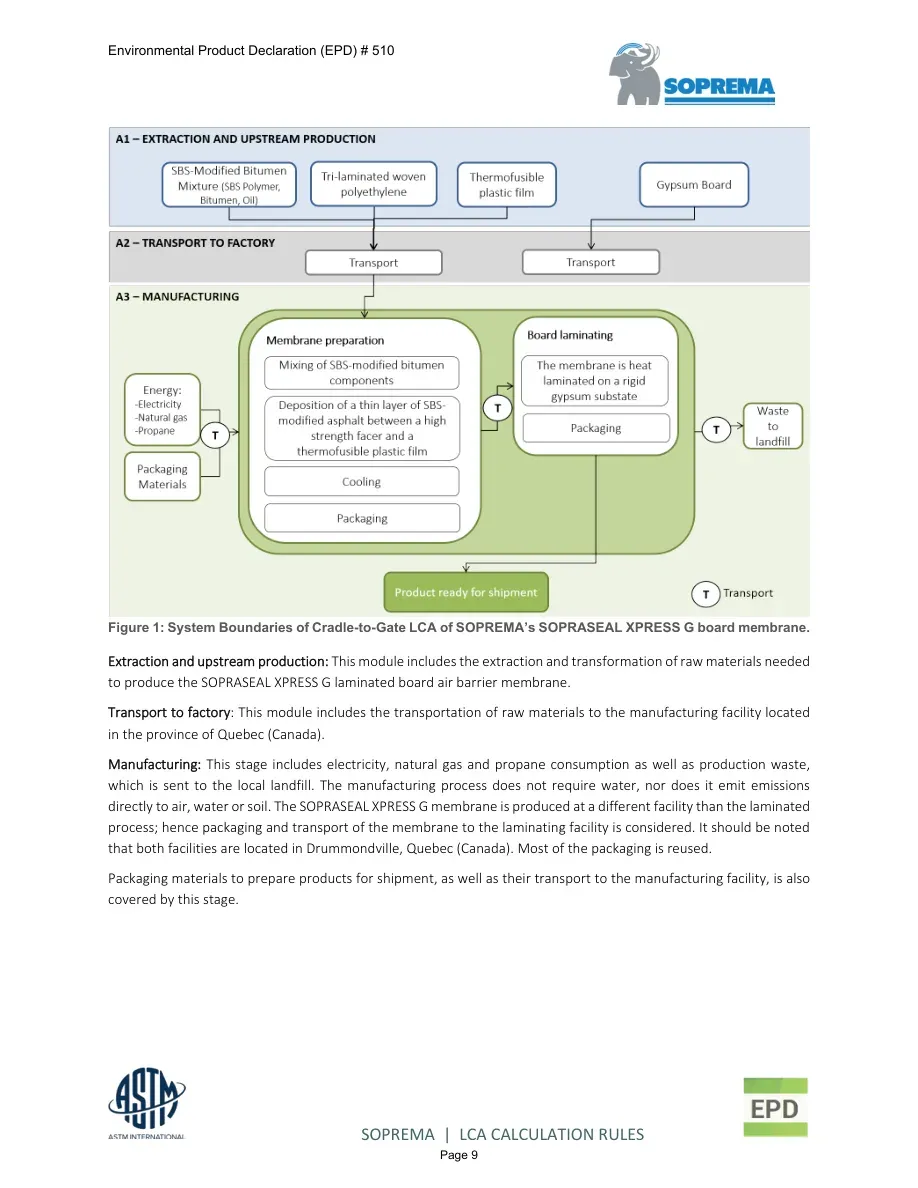
Environmental Product Declaration (EPD) # 510 SOPREMA | LCA CALCULATION RULES Page 9 Figure 1: System Boundaries of Cradle-to-Gate LCA of SOPREMA’s SOPRASEAL XPRESS G board membrane. Extraction and upstream production: This module includes the extraction and transformation of raw materials needed to produce the SOPRASEAL XPRESS G laminated board air barrier membrane. Transport to factory: This module includes the transportation of raw materials to the manufacturing facility located in the province of Quebec (Canada). Manufacturing: This stage includes electricity, natural gas and propane consumption as well as production waste, which is sent to the local landfill. The manufacturing process does not require water, nor does it emit emissions directly to air, water or soil. The SOPRASEAL XPRESS G membrane is produced at a different facility than the laminated process; hence packaging and transport of the membrane to the laminating facility is considered. It should be noted that both facilities are located in Drummondville, Quebec (Canada). Most of the packaging is reused. Packaging materials to prepare products for shipment, as well as their transport to the manufacturing facility, is also covered by this stage.
Environmental Product Declaration (EPD) # 510 SOPREMA | LCA CALCULATION RULES Page 10 3.4. CUT-OFF CRITERIA According to ISO 21930:2017, cut-off rules shall not be applied to hide data. All data shall be included. In the case of insufficient data, the cut-off criteria shall be 1% of energy or 1% of total mass input and 1% of environmental impacts of the unit process. The total cut-off input flows per modules shall be a maximum of 5% energy, mass and environmental impacts. No known flows are deliberately excluded from this EPD. For this EPD, no data on the construction, maintenance or dismantling of the capital assets, daily transport of employees, office work, business trips or other employee activities were included in the model. The model only takes into account the processes associated with infrastructure that are already included in the ecoinvent unit processes. 3.5. ALLOCATION Allocation, if required, shall follow the requirements and guidance of ISO 14044:2006, Section 4.3.4.[3,4] Energy data was provided for the entire manufacturing plants; thus, mass allocation was used to assign the share of energy consumed in the factory to the product under study. Waste processing of the material flows undergoing recycling processes are included up to the system boundary of the end-of-waste state.[2] In other words, a cut-off approach was used as further processing of the recycled material is part of raw material preparation of another product system (open-loop recycling). [Photo courtesy of SOPREMA]
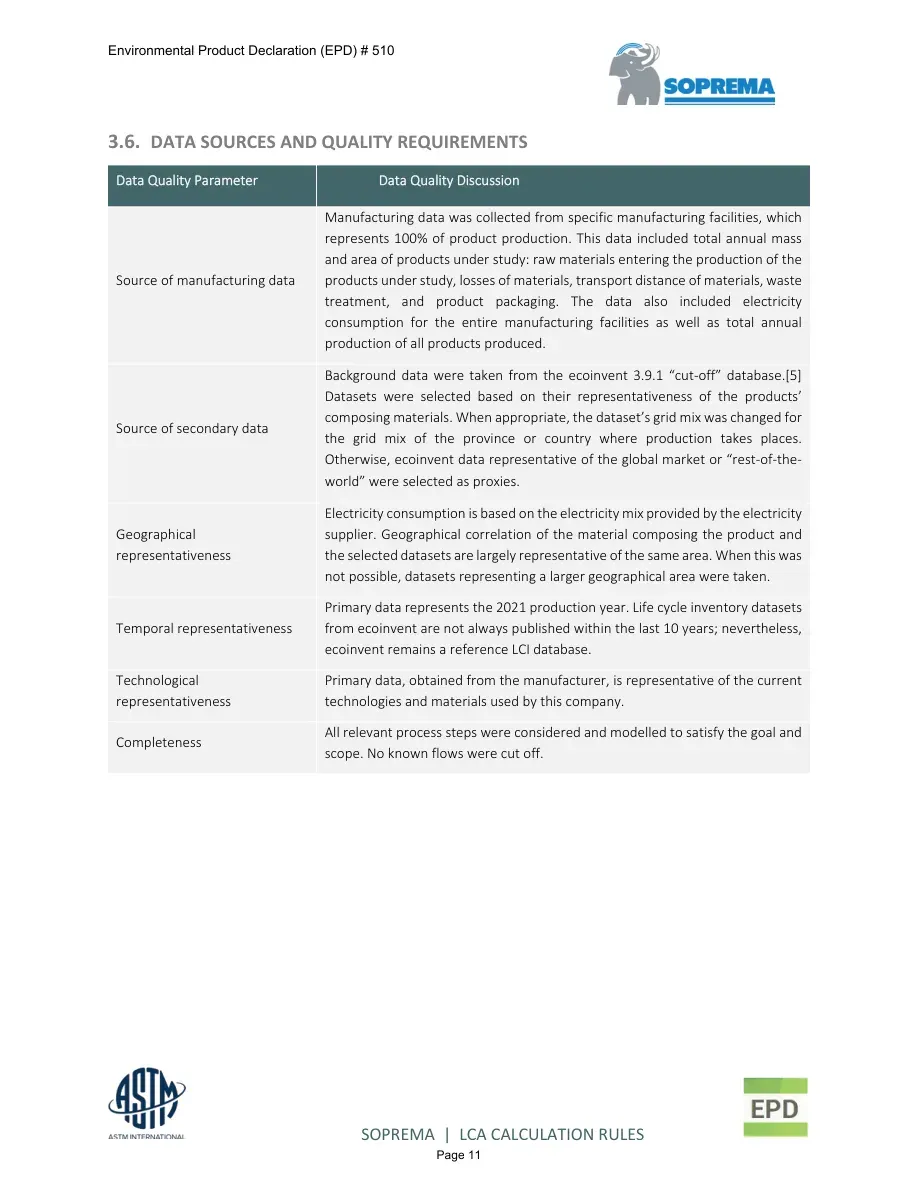
Environmental Product Declaration (EPD) # 510 SOPREMA | LCA CALCULATION RULES Page 11 3.6. DATA SOURCES AND QUALITY REQUIREMENTS Data Quality Parameter Data Quality Discussion Source of manufacturing data Manufacturing data was collected from specific manufacturing facilities, which represents 100% of product production. This data included total annual mass and area of products under study: raw materials entering the production of the products under study, losses of materials, transport distance of materials, waste treatment, and product packaging. The data also included electricity consumption for the entire manufacturing facilities as well as total annual production of all products produced. Source of secondary data Background data were taken from the ecoinvent 3.9.1 “cut-off” database.[5] Datasets were selected based on their representativeness of the products’ composing materials. When appropriate, the dataset’s grid mix was changed for the grid mix of the province or country where production takes places. Otherwise, ecoinvent data representative of the global market or “rest-of-the-world” were selected as proxies. Geographical representativeness Electricity consumption is based on the electricity mix provided by the electricity supplier. Geographical correlation of the material composing the product and the selected datasets are largely representative of the same area. When this was not possible, datasets representing a larger geographical area were taken. Temporal representativeness Primary data represents the 2021 production year. Life cycle inventory datasets from ecoinvent are not always published within the last 10 years; nevertheless, ecoinvent remains a reference LCI database. Technological representativeness Primary data, obtained from the manufacturer, is representative of the current technologies and materials used by this company. Completeness All relevant process steps were considered and modelled to satisfy the goal and scope. No known flows were cut off.
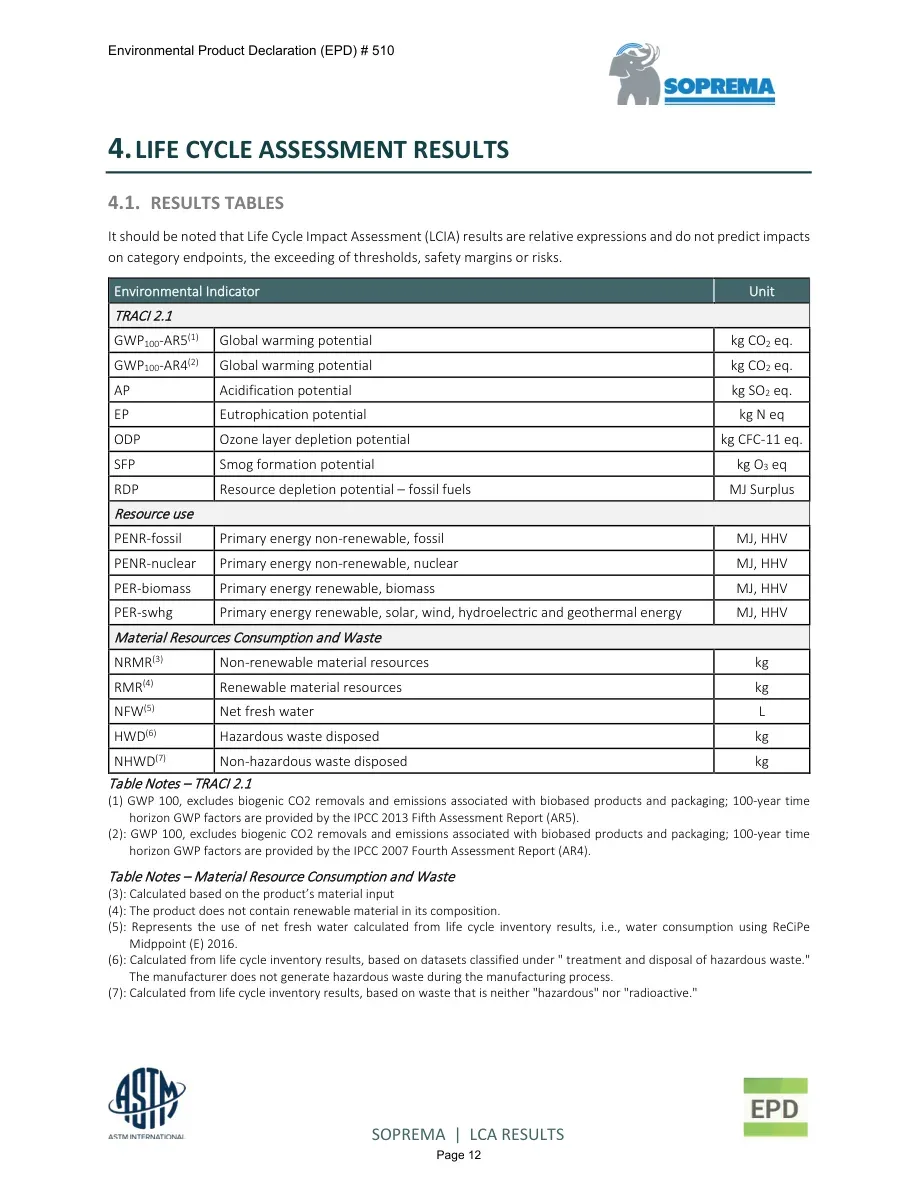
Environmental Product Declaration (EPD) # 510 SOPREMA | LCA RESULTS Page 12 4. LIFE CYCLE ASSESSMENT RESULTS 4.1. RESULTS TABLES It should be noted that Life Cycle Impact Assessment (LCIA) results are relative expressions and do not predict impacts on category endpoints, the exceeding of thresholds, safety margins or risks. Environmental Indicator Unit TRACI 2.1 GWP100-AR5(1) Global warming potential kg CO2 eq. GWP100-AR4(2) Global warming potential kg CO2 eq. AP Acidification potential kg SO2 eq. EP Eutrophication potential kg N eq ODP Ozone layer depletion potential kg CFC-11 eq. SFP Smog formation potential kg O3 eq RDP Resource depletion potential – fossil fuels MJ Surplus Resource use PENR-fossil Primary energy non-renewable, fossil MJ, HHV PENR-nuclear Primary energy non-renewable, nuclear MJ, HHV PER-biomass Primary energy renewable, biomass MJ, HHV PER-swhg Primary energy renewable, solar, wind, hydroelectric and geothermal energy MJ, HHV Material Resources Consumption and Waste NRMR(3) Non-renewable material resources kg RMR(4) Renewable material resources kg NFW(5) Net fresh water L HWD(6) Hazardous waste disposed kg NHWD(7) Non-hazardous waste disposed kg Table Notes – TRACI 2.1 (1) GWP 100, excludes biogenic CO2 removals and emissions associated with biobased products and packaging; 100-year time horizon GWP factors are provided by the IPCC 2013 Fifth Assessment Report (AR5). (2): GWP 100, excludes biogenic CO2 removals and emissions associated with biobased products and packaging; 100-year time horizon GWP factors are provided by the IPCC 2007 Fourth Assessment Report (AR4). Table Notes – Material Resource Consumption and Waste (3): Calculated based on the product’s material input (4): The product does not contain renewable material in its composition. (5): Represents the use of net fresh water calculated from life cycle inventory results, i.e., water consumption using ReCiPe Midppoint (E) 2016. (6): Calculated from life cycle inventory results, based on datasets classified under " treatment and disposal of hazardous waste." The manufacturer does not generate hazardous waste during the manufacturing process. (7): Calculated from life cycle inventory results, based on waste that is neither "hazardous" nor "radioactive."
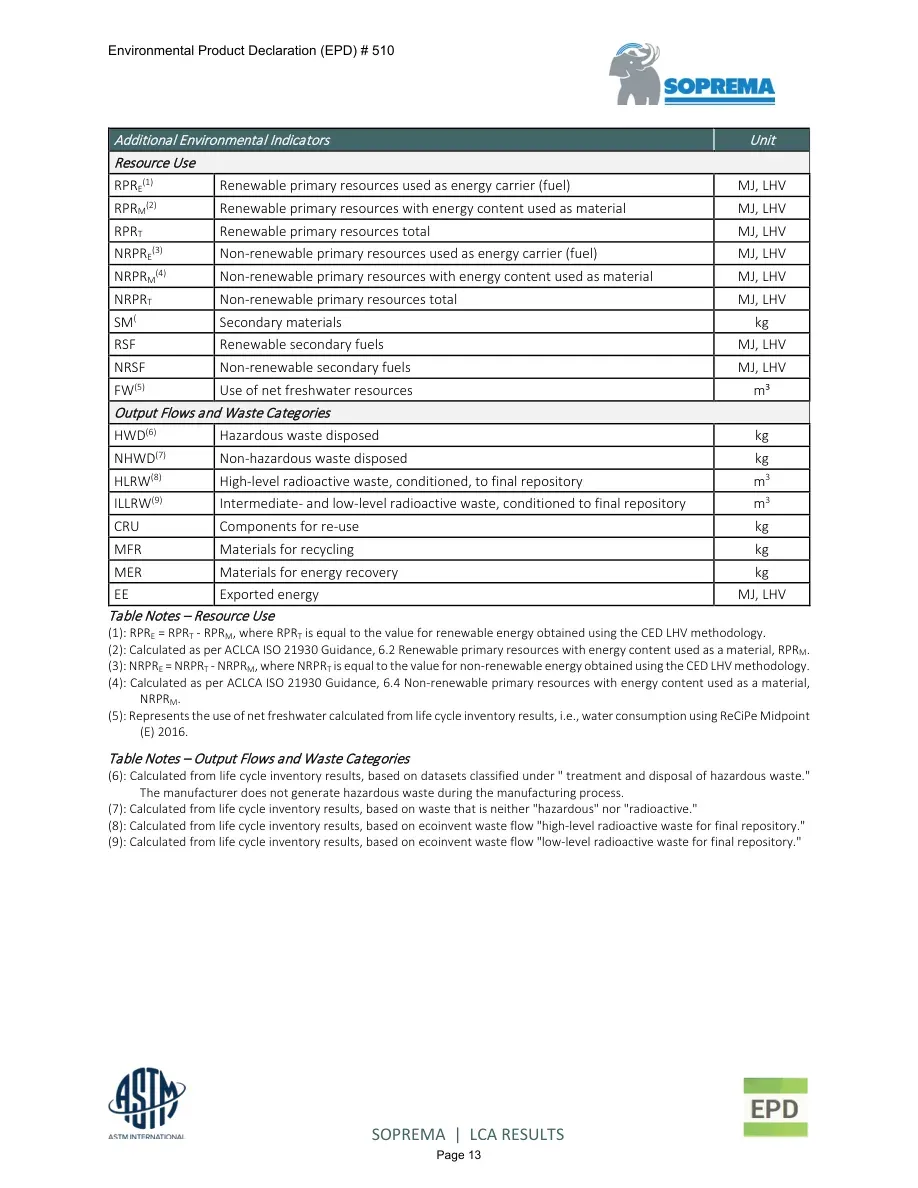
Environmental Product Declaration (EPD) # 510 SOPREMA | LCA RESULTS Page 13 Additional Environmental Indicators Unit Resource Use RPRE(1) Renewable primary resources used as energy carrier (fuel) MJ, LHV RPRM(2) Renewable primary resources with energy content used as material MJ, LHV RPRT Renewable primary resources total MJ, LHV NRPRE(3) Non-renewable primary resources used as energy carrier (fuel) MJ, LHV NRPRM(4) Non-renewable primary resources with energy content used as material MJ, LHV NRPRT Non-renewable primary resources total MJ, LHV SM( Secondary materials kg RSF Renewable secondary fuels MJ, LHV NRSF Non-renewable secondary fuels MJ, LHV FW(5) Use of net freshwater resources m³ Output Flows and Waste Categories HWD(6) Hazardous waste disposed kg NHWD(7) Non-hazardous waste disposed kg HLRW(8) High-level radioactive waste, conditioned, to final repository m3 ILLRW(9) Intermediate- and low-level radioactive waste, conditioned to final repository m3 CRU Components for re-use kg MFR Materials for recycling kg MER Materials for energy recovery kg EE Exported energy MJ, LHV Table Notes – Resource Use (1): RPRE = RPRT - RPRM, where RPRT is equal to the value for renewable energy obtained using the CED LHV methodology. (2): Calculated as per ACLCA ISO 21930 Guidance, 6.2 Renewable primary resources with energy content used as a material, RPRM. (3): NRPRE = NRPRT - NRPRM, where NRPRT is equal to the value for non-renewable energy obtained using the CED LHV methodology. (4): Calculated as per ACLCA ISO 21930 Guidance, 6.4 Non-renewable primary resources with energy content used as a material, NRPRM. (5): Represents the use of net freshwater calculated from life cycle inventory results, i.e., water consumption using ReCiPe Midpoint (E) 2016. Table Notes – Output Flows and Waste Categories (6): Calculated from life cycle inventory results, based on datasets classified under " treatment and disposal of hazardous waste." The manufacturer does not generate hazardous waste during the manufacturing process. (7): Calculated from life cycle inventory results, based on waste that is neither "hazardous" nor "radioactive." (8): Calculated from life cycle inventory results, based on ecoinvent waste flow "high-level radioactive waste for final repository." (9): Calculated from life cycle inventory results, based on ecoinvent waste flow "low-level radioactive waste for final repository."
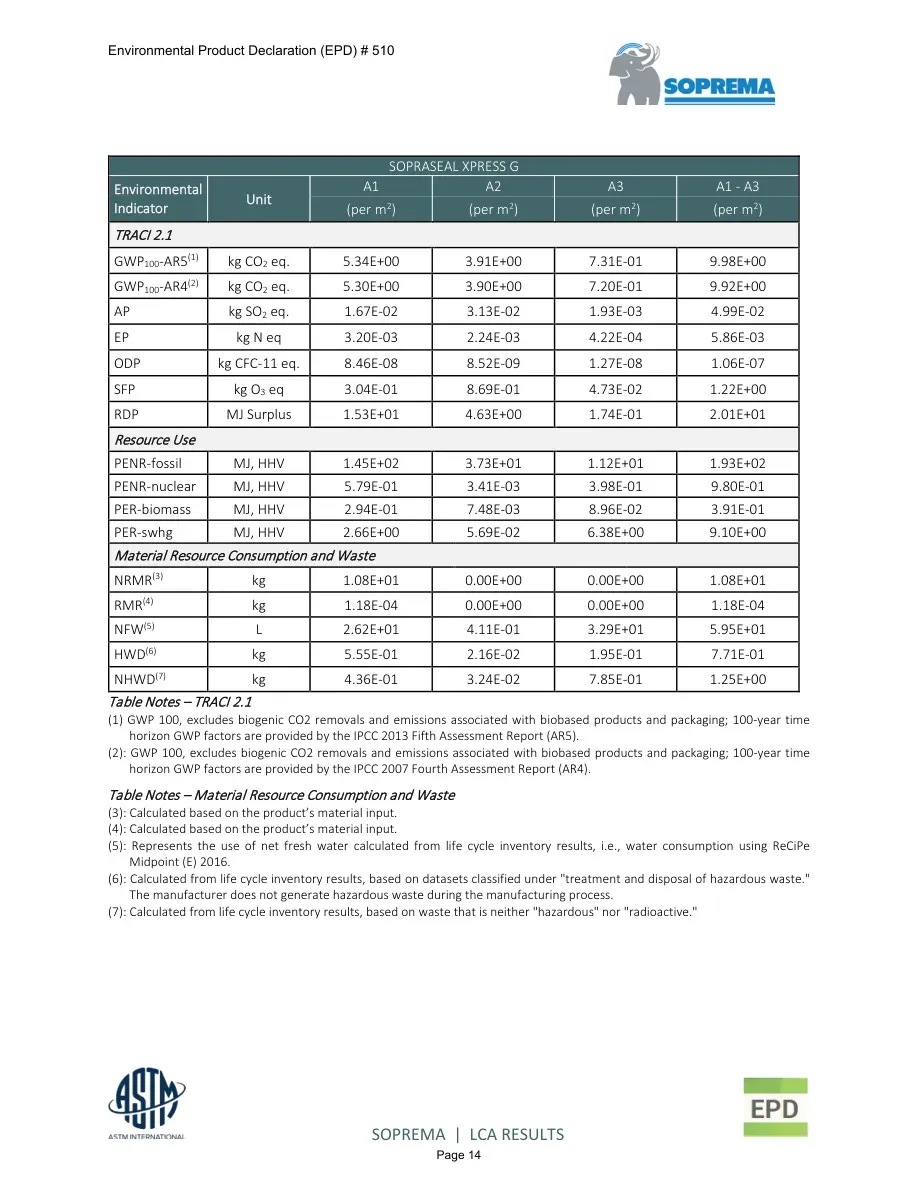
Environmental Product Declaration (EPD) # 510 SOPREMA | LCA RESULTS Page 14 SOPRASEAL XPRESS G Environmental Indicator Unit A1 A2 A3 A1 - A3 (per m2) (per m2) (per m2) (per m2) TRACI 2.1 GWP100-AR5(1) kg CO2 eq. 5.34E+00 3.91E+00 7.31E-01 9.98E+00 GWP100-AR4(2) kg CO2 eq. 5.30E+00 3.90E+00 7.20E-01 9.92E+00 AP kg SO2 eq. 1.67E-02 3.13E-02 1.93E-03 4.99E-02 EP kg N eq 3.20E-03 2.24E-03 4.22E-04 5.86E-03 ODP kg CFC-11 eq. 8.46E-08 8.52E-09 1.27E-08 1.06E-07 SFP kg O3 eq 3.04E-01 8.69E-01 4.73E-02 1.22E+00 RDP MJ Surplus 1.53E+01 4.63E+00 1.74E-01 2.01E+01 Resource Use PENR-fossil MJ, HHV 1.45E+02 3.73E+01 1.12E+01 1.93E+02 PENR-nuclear MJ, HHV 5.79E-01 3.41E-03 3.98E-01 9.80E-01 PER-biomass MJ, HHV 2.94E-01 7.48E-03 8.96E-02 3.91E-01 PER-swhg MJ, HHV 2.66E+00 5.69E-02 6.38E+00 9.10E+00 Material Resource Consumption and Waste NRMR(3) kg 1.08E+01 0.00E+00 0.00E+00 1.08E+01 RMR(4) kg 1.18E-04 0.00E+00 0.00E+00 1.18E-04 NFW(5) L 2.62E+01 4.11E-01 3.29E+01 5.95E+01 HWD(6) kg 5.55E-01 2.16E-02 1.95E-01 7.71E-01 NHWD(7) kg 4.36E-01 3.24E-02 7.85E-01 1.25E+00 Table Notes – TRACI 2.1 (1) GWP 100, excludes biogenic CO2 removals and emissions associated with biobased products and packaging; 100-year time horizon GWP factors are provided by the IPCC 2013 Fifth Assessment Report (AR5). (2): GWP 100, excludes biogenic CO2 removals and emissions associated with biobased products and packaging; 100-year time horizon GWP factors are provided by the IPCC 2007 Fourth Assessment Report (AR4). Table Notes – Material Resource Consumption and Waste (3): Calculated based on the product’s material input. (4): Calculated based on the product’s material input. (5): Represents the use of net fresh water calculated from life cycle inventory results, i.e., water consumption using ReCiPe Midpoint (E) 2016. (6): Calculated from life cycle inventory results, based on datasets classified under "treatment and disposal of hazardous waste." The manufacturer does not generate hazardous waste during the manufacturing process. (7): Calculated from life cycle inventory results, based on waste that is neither "hazardous" nor "radioactive."
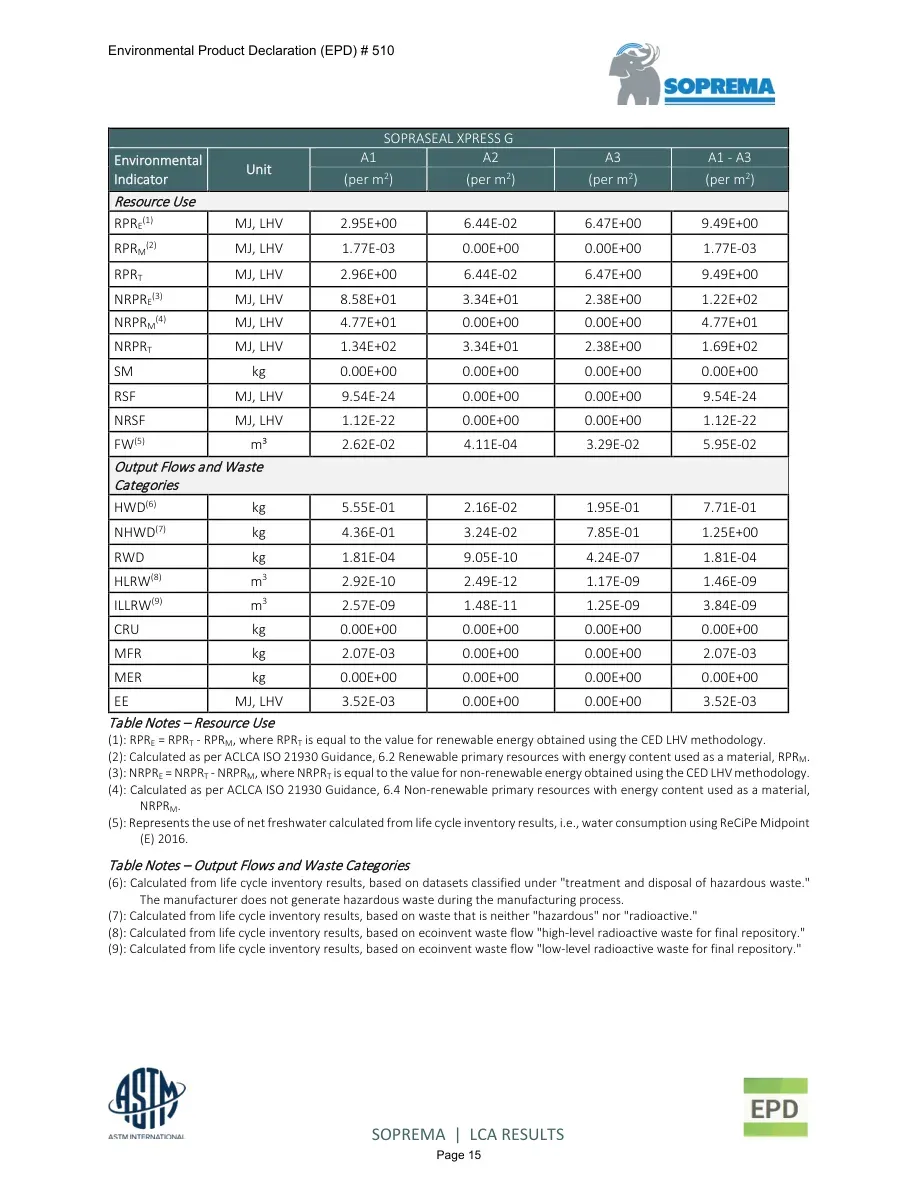
Environmental Product Declaration (EPD) # 510 SOPREMA | LCA RESULTS Page 15 SOPRASEAL XPRESS G Environmental Indicator Unit A1 A2 A3 A1 - A3 (per m2) (per m2) (per m2) (per m2) Resource Use RPRE(1) MJ, LHV 2.95E+00 6.44E-02 6.47E+00 9.49E+00 RPRM(2) MJ, LHV 1.77E-03 0.00E+00 0.00E+00 1.77E-03 RPRT MJ, LHV 2.96E+00 6.44E-02 6.47E+00 9.49E+00 NRPRE(3) MJ, LHV 8.58E+01 3.34E+01 2.38E+00 1.22E+02 NRPRM(4) MJ, LHV 4.77E+01 0.00E+00 0.00E+00 4.77E+01 NRPRT MJ, LHV 1.34E+02 3.34E+01 2.38E+00 1.69E+02 SM kg 0.00E+00 0.00E+00 0.00E+00 0.00E+00 RSF MJ, LHV 9.54E-24 0.00E+00 0.00E+00 9.54E-24 NRSF MJ, LHV 1.12E-22 0.00E+00 0.00E+00 1.12E-22 FW(5) m³ 2.62E-02 4.11E-04 3.29E-02 5.95E-02 Output Flows and Waste Categories HWD(6) kg 5.55E-01 2.16E-02 1.95E-01 7.71E-01 NHWD(7) kg 4.36E-01 3.24E-02 7.85E-01 1.25E+00 RWD kg 1.81E-04 9.05E-10 4.24E-07 1.81E-04 HLRW(8) m3 2.92E-10 2.49E-12 1.17E-09 1.46E-09 ILLRW(9) m3 2.57E-09 1.48E-11 1.25E-09 3.84E-09 CRU kg 0.00E+00 0.00E+00 0.00E+00 0.00E+00 MFR kg 2.07E-03 0.00E+00 0.00E+00 2.07E-03 MER kg 0.00E+00 0.00E+00 0.00E+00 0.00E+00 EE MJ, LHV 3.52E-03 0.00E+00 0.00E+00 3.52E-03 Table Notes – Resource Use (1): RPRE = RPRT - RPRM, where RPRT is equal to the value for renewable energy obtained using the CED LHV methodology. (2): Calculated as per ACLCA ISO 21930 Guidance, 6.2 Renewable primary resources with energy content used as a material, RPRM. (3): NRPRE = NRPRT - NRPRM, where NRPRT is equal to the value for non-renewable energy obtained using the CED LHV methodology. (4): Calculated as per ACLCA ISO 21930 Guidance, 6.4 Non-renewable primary resources with energy content used as a material, NRPRM. (5): Represents the use of net freshwater calculated from life cycle inventory results, i.e., water consumption using ReCiPe Midpoint (E) 2016. Table Notes – Output Flows and Waste Categories (6): Calculated from life cycle inventory results, based on datasets classified under "treatment and disposal of hazardous waste." The manufacturer does not generate hazardous waste during the manufacturing process. (7): Calculated from life cycle inventory results, based on waste that is neither "hazardous" nor "radioactive." (8): Calculated from life cycle inventory results, based on ecoinvent waste flow "high-level radioactive waste for final repository." (9): Calculated from life cycle inventory results, based on ecoinvent waste flow "low-level radioactive waste for final repository."
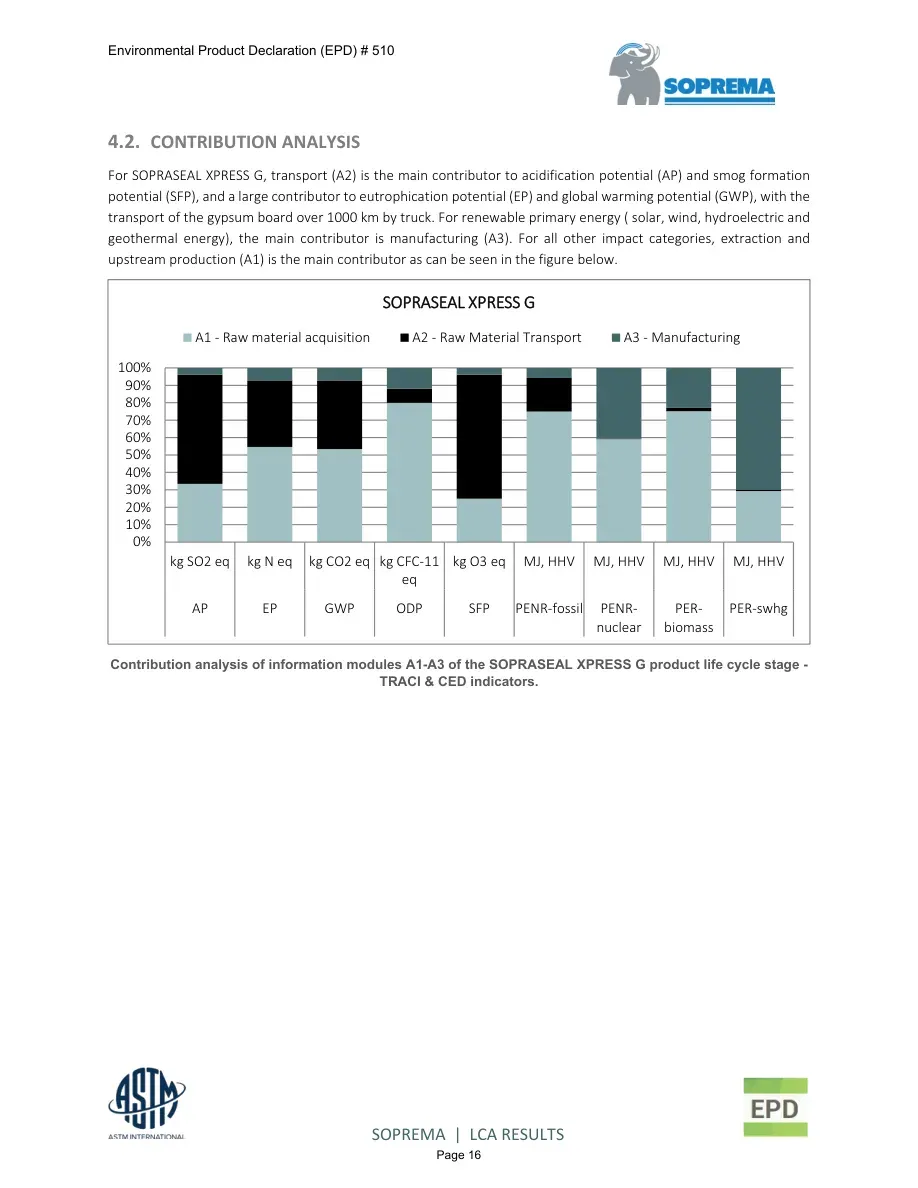
Environmental Product Declaration (EPD) # 510 SOPREMA | LCA RESULTS Page 16 4.2. CONTRIBUTION ANALYSIS For SOPRASEAL XPRESS G, transport (A2) is the main contributor to acidification potential (AP) and smog formation potential (SFP), and a large contributor to eutrophication potential (EP) and global warming potential (GWP), with the transport of the gypsum board over 1000 km by truck. For renewable primary energy ( solar, wind, hydroelectric and geothermal energy), the main contributor is manufacturing (A3). For all other impact categories, extraction and upstream production (A1) is the main contributor as can be seen in the figure below. Contribution analysis of information modules A1-A3 of the SOPRASEAL XPRESS G product life cycle stage - TRACI & CED indicators. 0%10%20%30%40%50%60%70%80%90%100%kg SO2 eqkg N eqkg CO2 eq kg CFC-11eqkg O3 eqMJ, HHVMJ, HHVMJ, HHVMJ, HHVAPEPGWPODPSFPPENR-fossilPENR-nuclearPER-biomassPER-swhgSOPRASEAL XPRESS GA1 - Raw material acquisitionA2 - Raw Material TransportA3 - Manufacturing
Environmental Product Declaration (EPD) # 510 SOPREMA | ADDITIONAL ENVIRONMENTAL INFORMATION Page 17 5. ADDITIONAL ENVIRONMENTAL INFORMATION 5.1. REGULATED HAZARDOUS SUBSTANCES There are no ingredients present in the SOPRASEAL XPRESS G which, within the current knowledge and in the applicable concentrations, are classified as hazardous to health or the environment and hence require reporting in the product safety data sheet. 5.2. DANGEROUS SUBSTANCES SOPREMA’s SOPRASEAL XPRESS G is not expected to release dangerous substances during normal use. 5.3. FURTHER INFORMATION SOPREMA has also published a Health Product Declaration® for the SOPRASEAL XPRESS G. More details are available on the HPDC public repository: https://www.hpd-collaborative.org/hpd-public-repository/. Additional product information can be found on SOPREMA’s website: (https://www.soprema.ca/en/products-systems/building-components/walls/air-and-vapour-barrier). 6. REFERENCES[6][7] [1] International Organization for Standardization (ISO), “ISO 14025 Environmental labels and declarations - Type III environmental declarations - Principles and procedures,” 2006. [2] International Organization for Standardization (ISO), “ISO 21930:2017(E) Sustainability in buildings and civil engineering works — Core rules for environmental product declarations of construction products and services,” 2017. [3] ASTM International, “Water-Resistive and Air Barriers PCR,” 2017[Online]. Available: https://www.nsf.org/standards-development/product-category-rules. [4] International Organization for Standardization (ISO), “ISO 14044:2006/AMD1:2017/AMD 2:2020 Environmental management - Life cycle assessment - Requirements and guidelines,” 2006. [5] F. R. et al., “Overview and Methodology. ecoinvent report No. 1,” Dübendorf, 2007. [6] ASTM International, “ASTM Program Operator Rules. Version: 8.0, Revised 04/29/20,” 2020[Online]. Available: www.astm.org. [7] Vertima, “Life Cycle Assessment of SOPREMA’s Air Barriers,” 2023.
1688, Jean-Berchmans-Michaud Drummondville (Quebec) J2C 8E9 Canada www.soprema.ca 310 Quadral Dr. Wadsworth, OH 44281 USA www.soprema.us
