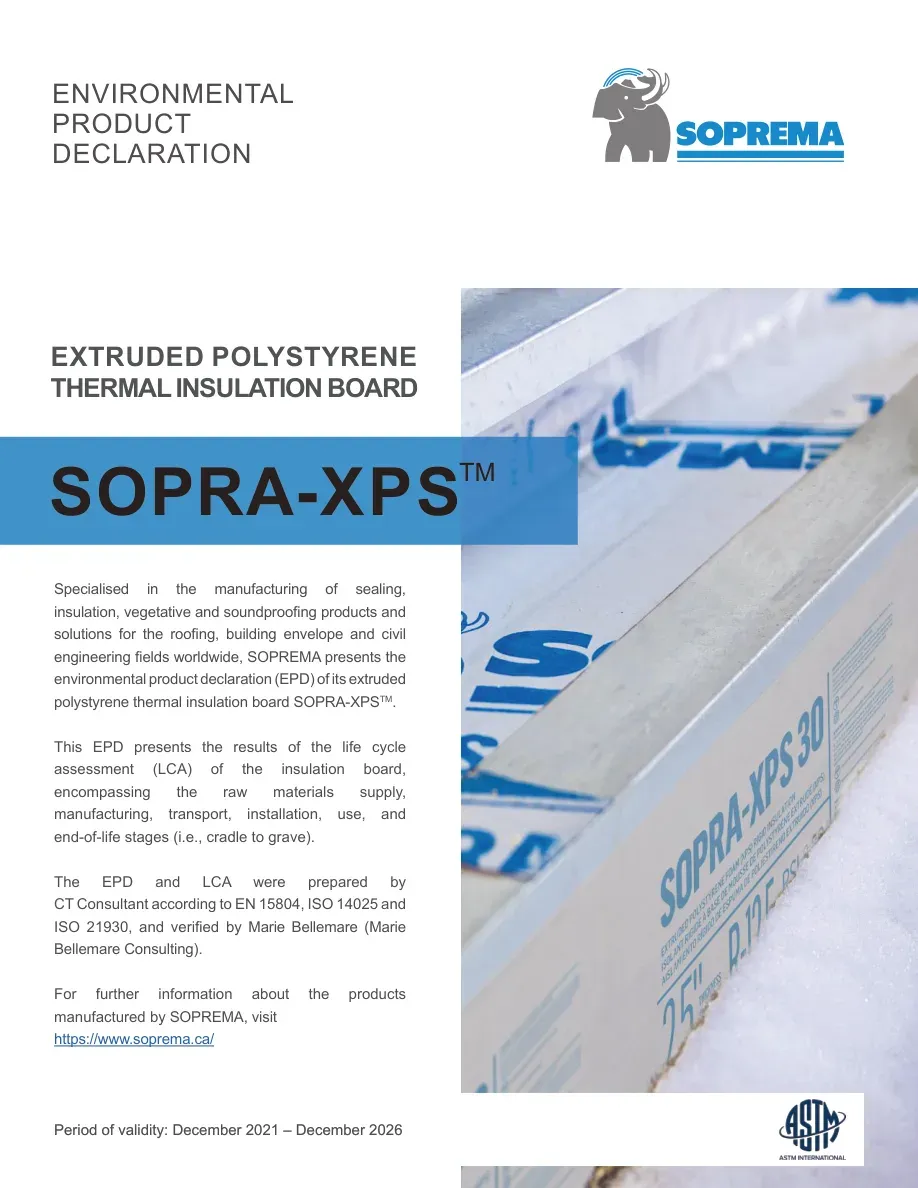
ENVIRONMENTAL PRODUCT DECLARATIONEXTRUDED POLYSTYRENE THERMAL INSULATION BOARDSOPRA-XPS Specialised in the manufacturing of sealing, insulation, vegetative and soundproofing products and solutions for the roofing, building envelope and civil engineering fields worldwide, SOPREMA presents the environmental product declaration (EPD) of its extruded polystyrene thermal insulation board SOPRA-XPSTM.This EPD presents the results of the life cycle assessment (LCA) of the insulation board, encompassing the raw materials supply, manufacturing, transport, installation, use, and end-of-life stages (i.e., cradle to grave).The EPD and LCA were prepared by CT Consultant according to EN 15804, ISO 14025 and ISO 21930, and verified by Marie Bellemare (Marie Bellemare Consulting).For further information about the products manufactured by SOPREMA, visit https://www.soprema.ca/Period of validity: December 2021 – December 2026TM
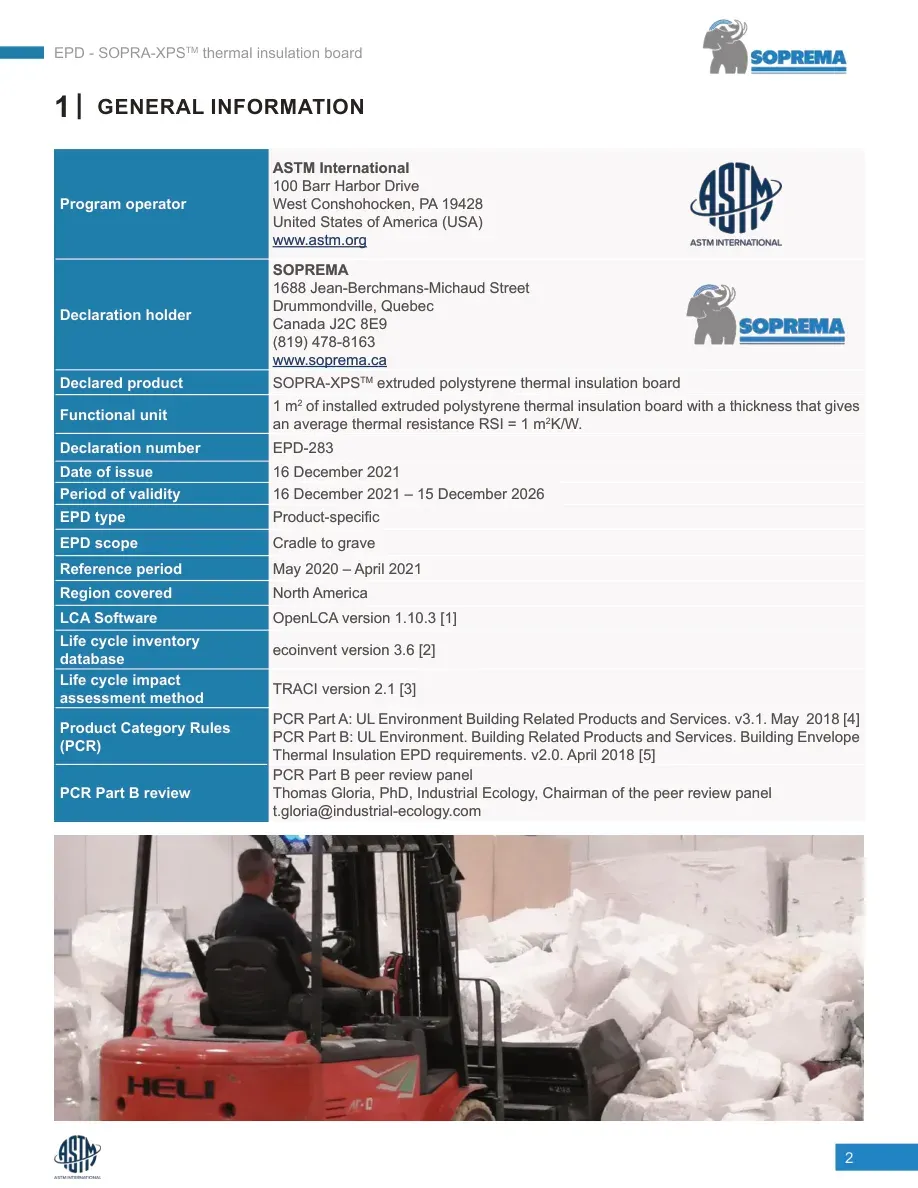
EPD - SOPRA-XPSTM thermal insulation board2GENERAL INFORMATION1Program operatorASTM International100 Barr Harbor DriveWest Conshohocken, PA 19428United States of America (USA)www.astm.orgDeclaration holderSOPREMA1688 Jean-Berchmans-Michaud StreetDrummondville, QuebecCanada J2C 8E9(819) 478-8163www.soprema.caDeclared productSOPRA-XPSTM extruded polystyrene thermal insulation boardFunctional unit1 m2 of installed extruded polystyrene thermal insulation board with a thickness that gives an average thermal resistance RSI = 1 m2K/W. Declaration numberEPD-283Date of issue16 December 2021Period of validity16 December 2021 – 15 December 2026EPD typeProduct-specificEPD scopeCradle to graveReference periodMay 2020 – April 2021Region coveredNorth AmericaLCA SoftwareOpenLCA version 1.10.3 [1]Life cycle inventory databaseecoinvent version 3.6 [2]Life cycle impact assessment methodTRACI version 2.1 [3]Product Category Rules (PCR)PCR Part A: UL Environment Building Related Products and Services. v3.1. May 2018 [4]PCR Part B: UL Environment. Building Related Products and Services. Building Envelope Thermal Insulation EPD requirements. v2.0. April 2018 [5]PCR Part B reviewPCR Part B peer review panelThomas Gloria, PhD, Industrial Ecology, Chairman of the peer review panelt.gloria@industrial-ecology.com
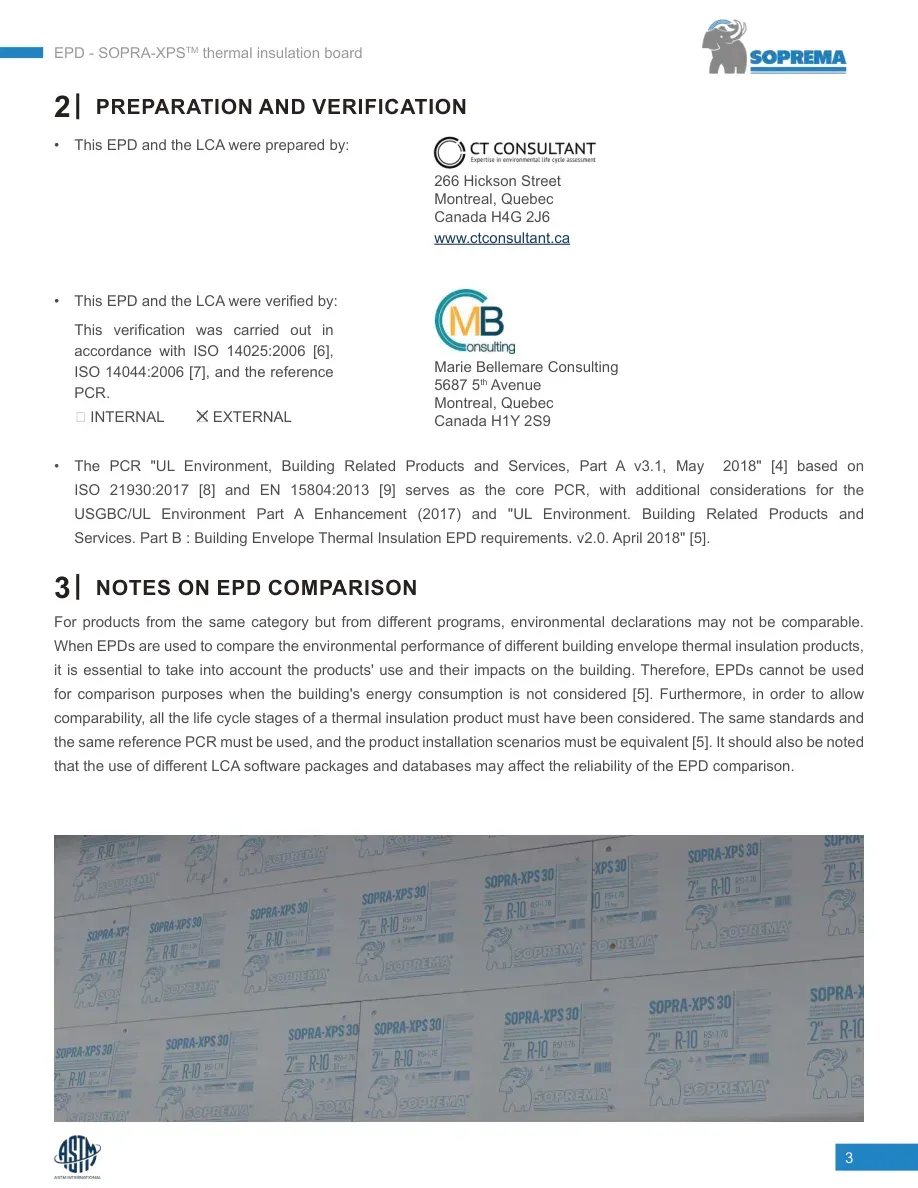
EPD - SOPRA-XPSTM thermal insulation board3PREPARATION AND VERIFICATION23• This EPD and the LCA were prepared by:☐ INTERNAL ☒ EXTERNALFor products from the same category but from different programs, environmental declarations may not be comparable. When EPDs are used to compare the environmental performance of different building envelope thermal insulation products, it is essential to take into account the products' use and their impacts on the building. Therefore, EPDs cannot be used for comparison purposes when the building's energy consumption is not considered [5]. Furthermore, in order to allow comparability, all the life cycle stages of a thermal insulation product must have been considered. The same standards and the same reference PCR must be used, and the product installation scenarios must be equivalent [5]. It should also be noted that the use of different LCA software packages and databases may affect the reliability of the EPD comparison.NOTES ON EPD COMPARISON266 Hickson StreetMontreal, QuebecCanada H4G 2J6www.ctconsultant.ca• The PCR "UL Environment, Building Related Products and Services, Part A v3.1, May 2018" [4] based on ISO 21930:2017 [8] and EN 15804:2013 [9] serves as the core PCR, with additional considerations for the USGBC/UL Environment Part A Enhancement (2017) and "UL Environment. Building Related Products and Services. Part B : Building Envelope Thermal Insulation EPD requirements. v2.0. April 2018" [5].Marie Bellemare Consulting5687 5th AvenueMontreal, QuebecCanada H1Y 2S9• This EPD and the LCA were verified by:This verification was carried out in accordance with ISO 14025:2006 [6], ISO 14044:2006 [7], and the reference PCR.
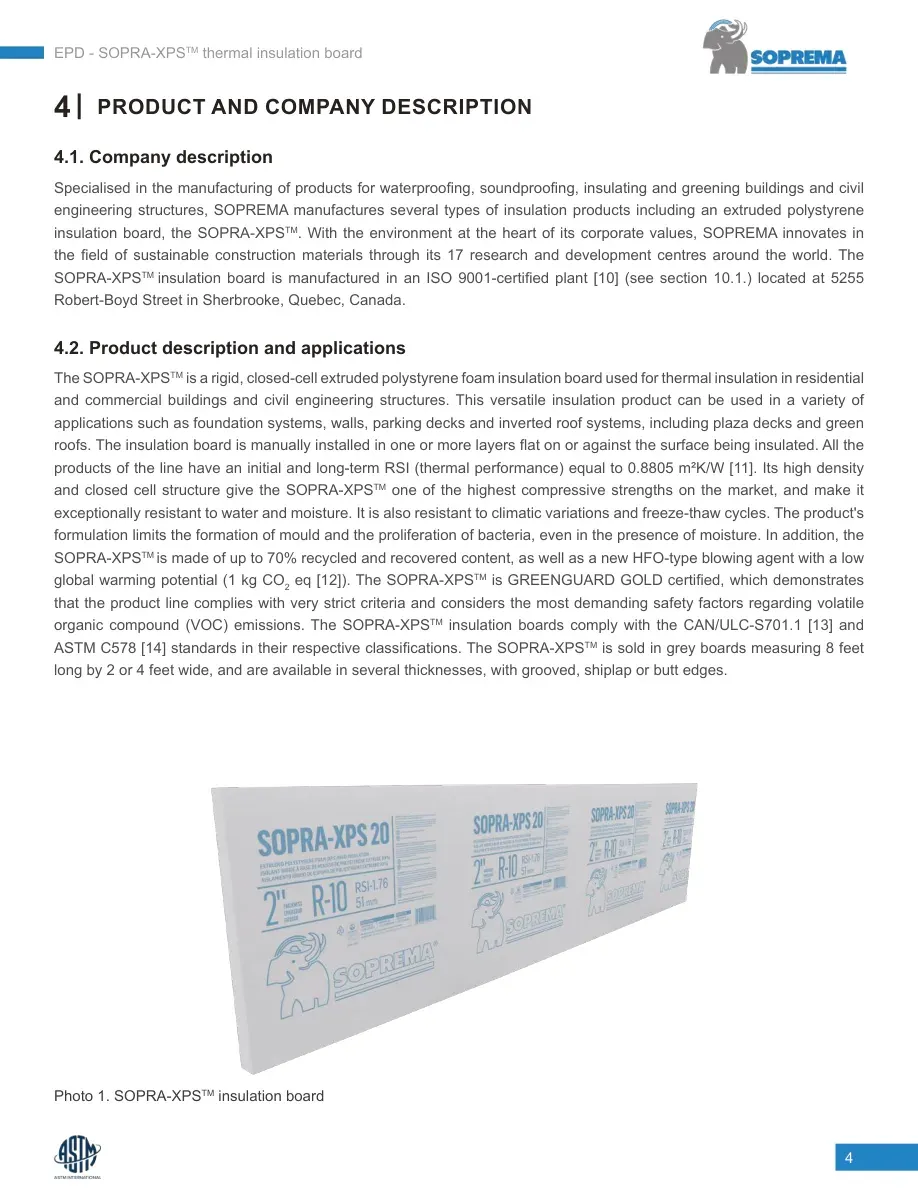
EPD - SOPRA-XPSTM thermal insulation board44.1. Company descriptionSpecialised in the manufacturing of products for waterproofing, soundproofing, insulating and greening buildings and civil engineering structures, SOPREMA manufactures several types of insulation products including an extruded polystyrene insulation board, the SOPRA-XPSTM. With the environment at the heart of its corporate values, SOPREMA innovates in the field of sustainable construction materials through its 17 research and development centres around the world. The SOPRA-XPSTM insulation board is manufactured in an ISO 9001-certified plant [10] (see section 10.1.) located at 5255 Robert-Boyd Street in Sherbrooke, Quebec, Canada.4.2. Product description and applicationsThe SOPRA-XPSTM is a rigid, closed-cell extruded polystyrene foam insulation board used for thermal insulation in residential and commercial buildings and civil engineering structures. This versatile insulation product can be used in a variety of applications such as foundation systems, walls, parking decks and inverted roof systems, including plaza decks and green roofs. The insulation board is manually installed in one or more layers flat on or against the surface being insulated. All the products of the line have an initial and long-term RSI (thermal performance) equal to 0.8805 m²K/W [11]. Its high density and closed cell structure give the SOPRA-XPSTM one of the highest compressive strengths on the market, and make it exceptionally resistant to water and moisture. It is also resistant to climatic variations and freeze-thaw cycles. The product's formulation limits the formation of mould and the proliferation of bacteria, even in the presence of moisture. In addition, the SOPRA-XPSTM is made of up to 70% recycled and recovered content, as well as a new HFO-type blowing agent with a low global warming potential (1 kg CO2 eq [12]). The SOPRA-XPSTM is GREENGUARD GOLD certified, which demonstrates that the product line complies with very strict criteria and considers the most demanding safety factors regarding volatile organic compound (VOC) emissions. The SOPRA-XPSTM insulation boards comply with the CAN/ULC-S701.1 [13] and ASTM C578 [14] standards in their respective classifications. The SOPRA-XPSTM is sold in grey boards measuring 8 feet long by 2 or 4 feet wide, and are available in several thicknesses, with grooved, shiplap or butt edges.PRODUCT AND COMPANY DESCRIPTIONPhoto 1. SOPRA-XPSTM insulation board 4
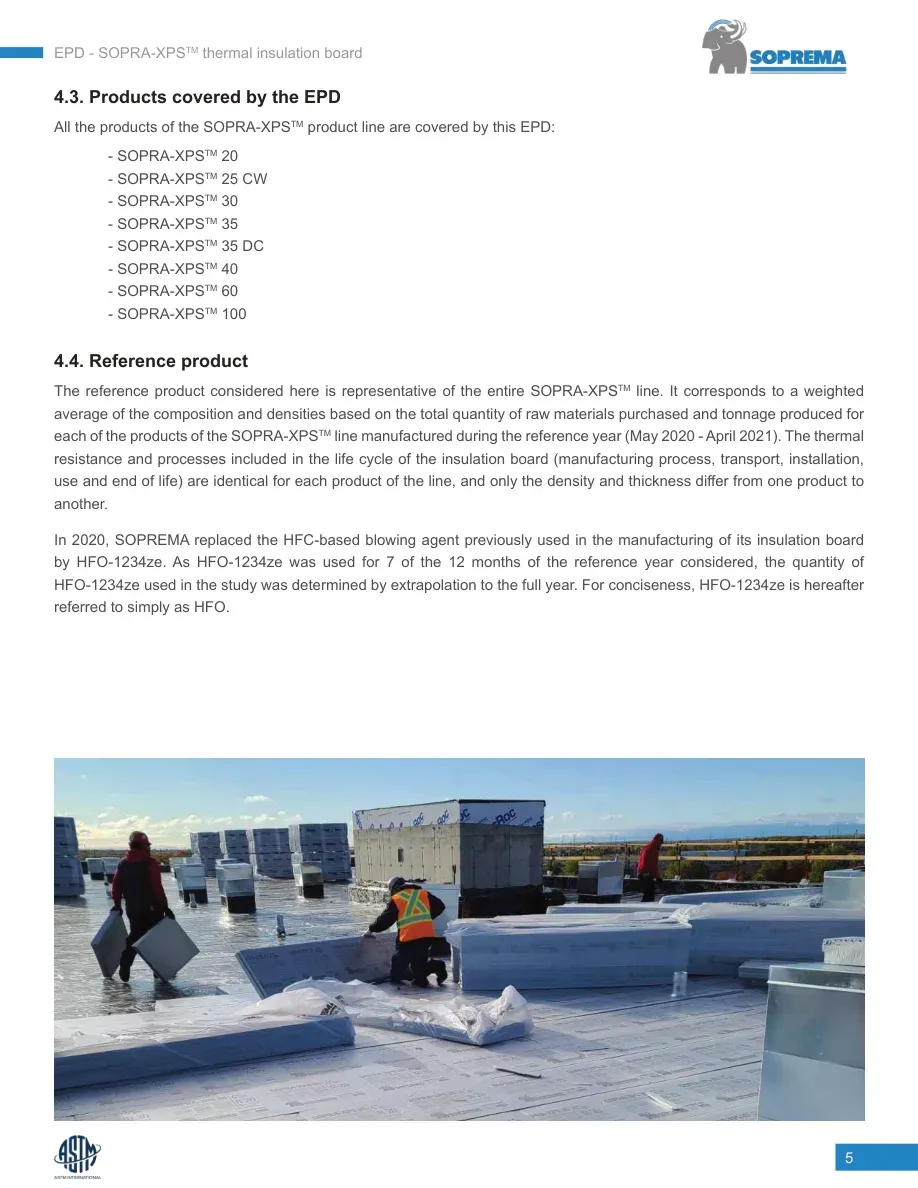
EPD - SOPRA-XPSTM thermal insulation board54.3. Products covered by the EPDAll the products of the SOPRA-XPSTM product line are covered by this EPD: - SOPRA-XPSTM 20 - SOPRA-XPSTM 25 CW - SOPRA-XPSTM 30 - SOPRA-XPSTM 35 - SOPRA-XPSTM 35 DC - SOPRA-XPSTM 40 - SOPRA-XPSTM 60 - SOPRA-XPSTM 1004.4. Reference productThe reference product considered here is representative of the entire SOPRA-XPSTM line. It corresponds to a weighted average of the composition and densities based on the total quantity of raw materials purchased and tonnage produced for each of the products of the SOPRA-XPSTM line manufactured during the reference year (May 2020 - April 2021). The thermal resistance and processes included in the life cycle of the insulation board (manufacturing process, transport, installation, use and end of life) are identical for each product of the line, and only the density and thickness differ from one product to another.In 2020, SOPREMA replaced the HFC-based blowing agent previously used in the manufacturing of its insulation board by HFO-1234ze. As HFO-1234ze was used for 7 of the 12 months of the reference year considered, the quantity of HFO-1234ze used in the study was determined by extrapolation to the full year. For conciseness, HFO-1234ze is hereafter referred to simply as HFO.
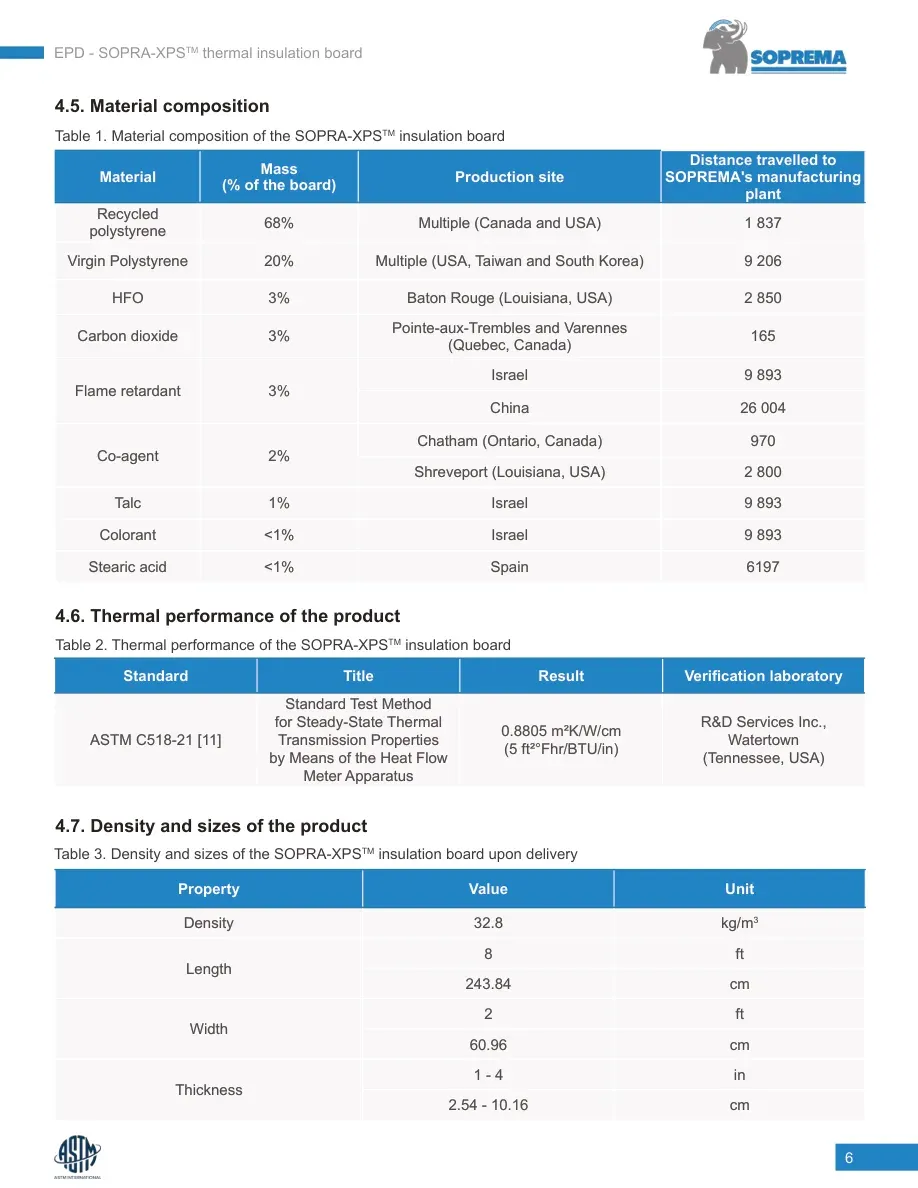
EPD - SOPRA-XPSTM thermal insulation board6Table 2. Thermal performance of the SOPRA-XPSTM insulation boardTable 3. Density and sizes of the SOPRA-XPSTM insulation board upon deliveryTable 1. Material composition of the SOPRA-XPSTM insulation board4.5. Material compositionStandardTitleResultVerification laboratoryASTM C518-21 [11]Standard Test Method for Steady-State Thermal Transmission Properties by Means of the Heat Flow Meter Apparatus0.8805 m²K/W/cm(5 ft²°Fhr/BTU/in)R&D Services Inc., Watertown (Tennessee, USA)PropertyValueUnitDensity32.8kg/m3Length8ft243.84cmWidth2ft60.96cmThickness1 - 4in2.54 - 10.16cmMaterialMass(% of the board)Production siteDistance travelled to SOPREMA's manufacturing plantRecycled polystyrene68%Multiple (Canada and USA)1 837Virgin Polystyrene20%Multiple (USA, Taiwan and South Korea)9 206HFO3%Baton Rouge (Louisiana, USA)2 850Carbon dioxide3%Pointe-aux-Trembles and Varennes(Quebec, Canada)165Flame retardant3%Israel9 893China26 004Co-agent2%Chatham (Ontario, Canada)970Shreveport (Louisiana, USA)2 800Talc1%Israel9 893Colorant<1%Israel9 893Stearic acid<1%Spain61974.6. Thermal performance of the product4.7. Density and sizes of the product
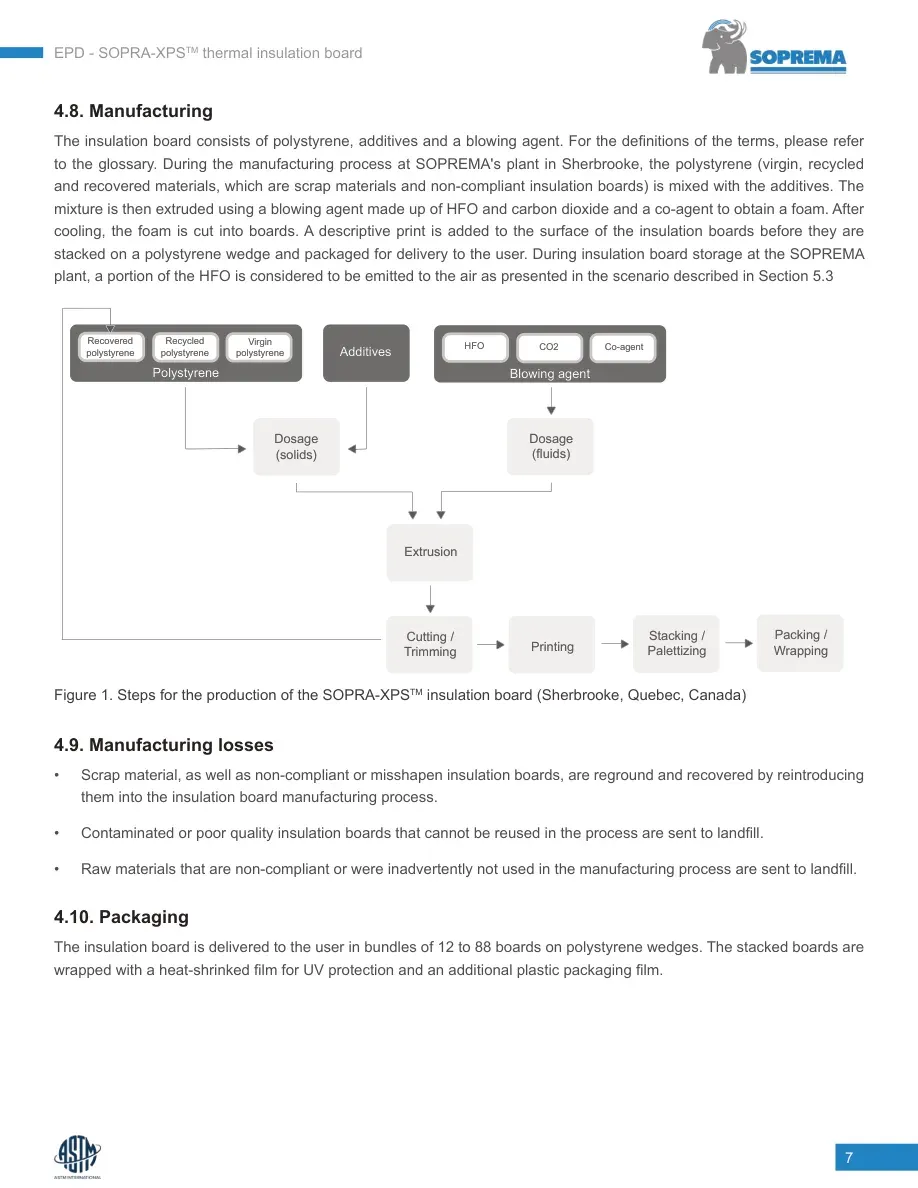
EPD - SOPRA-XPSTM thermal insulation board7Recovered polystyreneRecycledpolystyreneVirgin polystyreneAdditivesPolystyreneHFOCO2Co-agent Blowing agentDosage(solids)Dosage(fluids)ExtrusionCutting / TrimmingPrintingStacking / PalettizingPacking / WrappingFigure 1. Steps for the production of the SOPRA-XPSTM insulation board (Sherbrooke, Quebec, Canada)4.8. ManufacturingThe insulation board consists of polystyrene, additives and a blowing agent. For the definitions of the terms, please refer to the glossary. During the manufacturing process at SOPREMA's plant in Sherbrooke, the polystyrene (virgin, recycled and recovered materials, which are scrap materials and non-compliant insulation boards) is mixed with the additives. The mixture is then extruded using a blowing agent made up of HFO and carbon dioxide and a co-agent to obtain a foam. After cooling, the foam is cut into boards. A descriptive print is added to the surface of the insulation boards before they are stacked on a polystyrene wedge and packaged for delivery to the user. During insulation board storage at the SOPREMA plant, a portion of the HFO is considered to be emitted to the air as presented in the scenario described in Section 5.34.9. Manufacturing losses• Scrap material, as well as non-compliant or misshapen insulation boards, are reground and recovered by reintroducing them into the insulation board manufacturing process. • Contaminated or poor quality insulation boards that cannot be reused in the process are sent to landfill. • Raw materials that are non-compliant or were inadvertently not used in the manufacturing process are sent to landfill.4.10. PackagingThe insulation board is delivered to the user in bundles of 12 to 88 boards on polystyrene wedges. The stacked boards are wrapped with a heat-shrinked film for UV protection and an additional plastic packaging film.
EPD - SOPRA-XPSTM thermal insulation board84.11. TransportThe insulation board is delivered to the user following four transport scenarios:• Direct shipment to the user by truck-trailer;• Shipment via a distributor by truck-trailer;• Direct shipment to the user by train and trailer-truck;• Shipment via a distributor by train and trailer-truck;The transport to the user stage includes storage of the insulation board in a heated space. No specific transport to the storage space was added to the LCA model. 4.12. InstallationThe insulation board is installed manually on horizontal surfaces such as roofs, or mechanically attached with fasteners (screws or pins with plastic washers) or adhesive to walls and other surfaces. There are no insulation board losses during installation, because scraps are re-used to insulate other parts of the building. The waste generated during installation, i.e. the polystyrene wedge and the plastic packaging films, is either sent to landfill, recycling or incineration depending on the installation location according to the scenario presented in Table 2, PCR Part A [4].4.13. UseOnce installed, the insulation board does not require any maintenance, repair or replacement. Part of the HFO (blowing agent) diffuses out of the insulation board during use in the building, according to the scenario described in Section 5.3.4.14. Reference service lifeThe reference service life is considered equivalent to that of the building, set to 75 years as the default value in the PCR Part B [5].4.15. End of lifeAlthough the insulation board is recyclable and is identified as such, there is no product recovery system currently in place to enable its recycling. When the building (in which the SOPRA-XPSTM insulation board is installed) reaches its end of life, it is assumed that it is demolished without any sorting or recycling of materials. Therefore, the insulation board will be incorporated into the rest of the demolition waste and sent to a landfill site.The HFO still remaining in the polystyrene foam at its end-of-life is considered to be emitted in the years following the insulation board's landfill, according to the scenario described in Section 5.3.
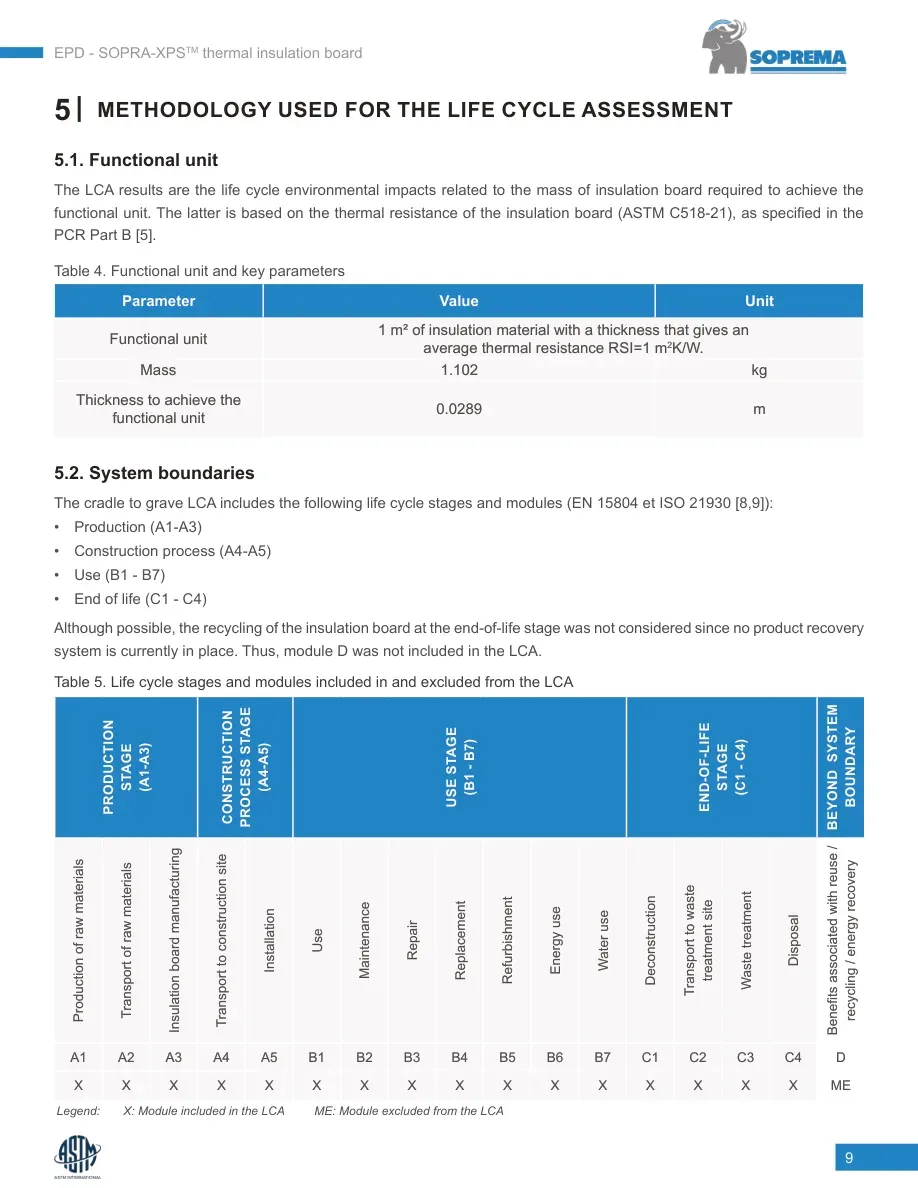
EPD - SOPRA-XPSTM thermal insulation board9METHODOLOGY USED FOR THE LIFE CYCLE ASSESSMENT5.1. Functional unitThe LCA results are the life cycle environmental impacts related to the mass of insulation board required to achieve the functional unit. The latter is based on the thermal resistance of the insulation board (ASTM C518-21), as specified in the PCR Part B [5].Table 4. Functional unit and key parametersParameterValueUnitFunctional unit1 m² of insulation material with a thickness that gives anaverage thermal resistance RSI=1 m2K/W. Mass1.102kgThickness to achieve the functional unit0.0289m5.2. System boundariesThe cradle to grave LCA includes the following life cycle stages and modules (EN 15804 et ISO 21930 [8,9]): • Production (A1-A3)• Construction process (A4-A5)• Use (B1 - B7)• End of life (C1 - C4)Although possible, the recycling of the insulation board at the end-of-life stage was not considered since no product recovery system is currently in place. Thus, module D was not included in the LCA.Table 5. Life cycle stages and modules included in and excluded from the LCAPRODUCTION STAGE(A1-A3)CONSTRUCTION PROCESS STAGE(A4-A5)USE STAGE(B1 - B7)END-OF-LIFE STAGE(C1 - C4)BEYOND SYSTEM BOUNDARYProduction of raw materialsTransport of raw materialsInsulation board manufacturingTransport to construction siteInstallationUseMaintenanceRepairReplacementRefurbishmentEnergy useWater useDeconstructionTransport to waste treatment siteWaste treatmentDisposalBenefits associated with reuse / recycling / energy recoveryA1A2A3A4A5B1B2B3B4B5B6B7C1C2C3C4DXXXXXXXXXXXXXXXXMELegend: X: Module included in the LCA ME: Module excluded from the LCA5
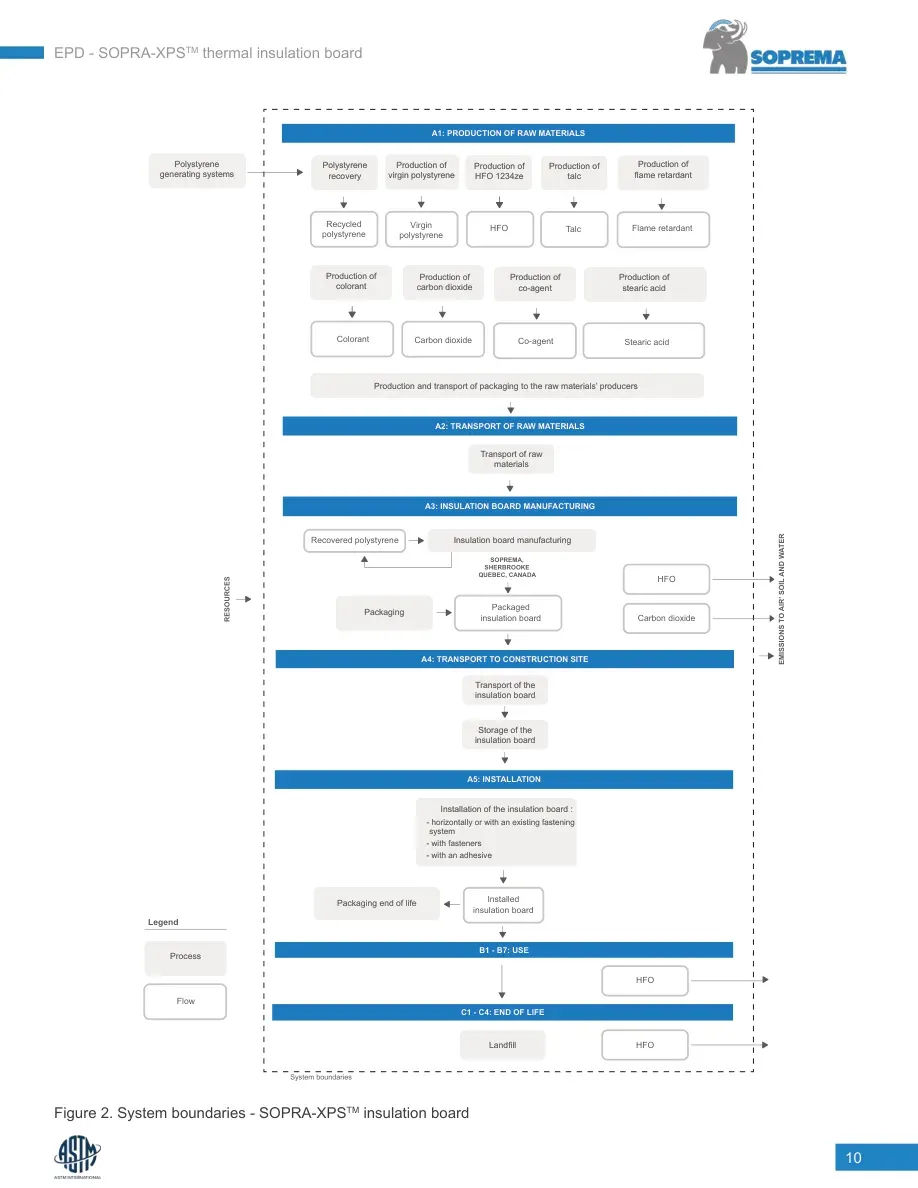
EPD - SOPRA-XPSTM thermal insulation board10Figure 2. System boundaries - SOPRA-XPSTM insulation boardSystem boundariesA2: TRANSPORT OF RAW MATERIALSA5: INSTALLATIONC1 - C4: END OF LIFEB1 - B7: USEA1: PRODUCTION OF RAW MATERIALSA3: INSULATION BOARD MANUFACTURINGPackagingInsulation board manufacturingSOPREMA,SHERBROOKEQUEBEC, CANADAA4: TRANSPORT TO CONSTRUCTION SITELandfillRESOURCESEMISSIONS TO AIR’ SOIL AND WATERFlowPackaged insulation boardPolystyrene generating systemsProduction ofHFO 1234zeProduction of virgin polystyreneVirgin polystyreneHFOProduction of talcTalcProduction of flame retardantFlame retardantInstalledinsulation boardProduction ofcolorantColorantProduction of stearic acidProduction ofcarbon dioxideCarbon dioxideStearic acidProduction of co-agentCo-agentProduction and transport of packaging to the raw materials’ producersInstallation of the insulation board :- horizontally or with an existing fastening system- with fasteners- with an adhesivePackaging end of lifeHFOHFOHFOCarbon dioxideTransport of theinsulation boardProcessRecycled polystyreneLegendPolystyrene recoveryStorage of the insulation boardRecovered polystyreneTransport of raw materials
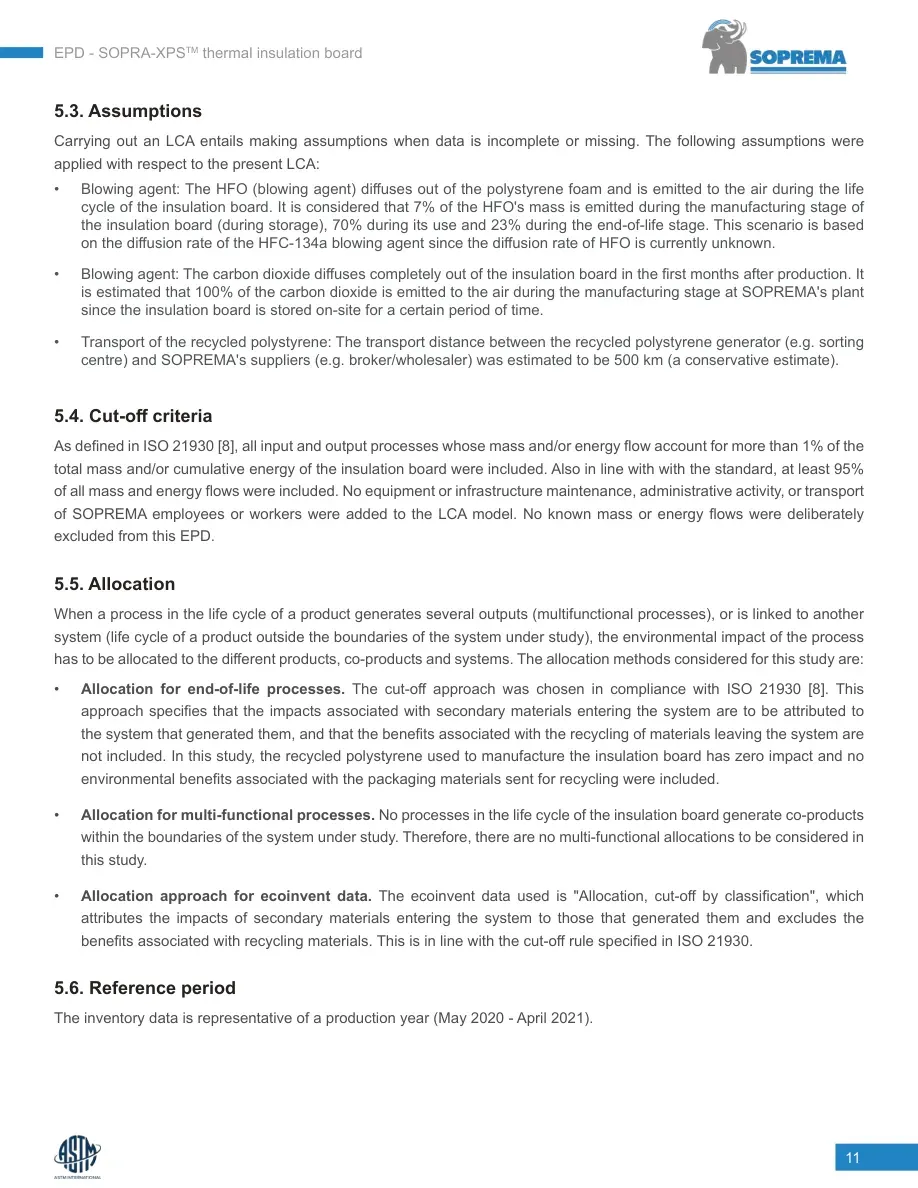
EPD - SOPRA-XPSTM thermal insulation board115.3. AssumptionsCarrying out an LCA entails making assumptions when data is incomplete or missing. The following assumptions were applied with respect to the present LCA: • Blowing agent: The HFO (blowing agent) diffuses out of the polystyrene foam and is emitted to the air during the life cycle of the insulation board. It is considered that 7% of the HFO's mass is emitted during the manufacturing stage of the insulation board (during storage), 70% during its use and 23% during the end-of-life stage. This scenario is based on the diffusion rate of the HFC-134a blowing agent since the diffusion rate of HFO is currently unknown.• Blowing agent: The carbon dioxide diffuses completely out of the insulation board in the first months after production. It is estimated that 100% of the carbon dioxide is emitted to the air during the manufacturing stage at SOPREMA's plant since the insulation board is stored on-site for a certain period of time.• Transport of the recycled polystyrene: The transport distance between the recycled polystyrene generator (e.g. sorting centre) and SOPREMA's suppliers (e.g. broker/wholesaler) was estimated to be 500 km (a conservative estimate).5.4. Cut-off criteriaAs defined in ISO 21930 [8], all input and output processes whose mass and/or energy flow account for more than 1% of the total mass and/or cumulative energy of the insulation board were included. Also in line with with the standard, at least 95% of all mass and energy flows were included. No equipment or infrastructure maintenance, administrative activity, or transport of SOPREMA employees or workers were added to the LCA model. No known mass or energy flows were deliberately excluded from this EPD.5.5. AllocationWhen a process in the life cycle of a product generates several outputs (multifunctional processes), or is linked to another system (life cycle of a product outside the boundaries of the system under study), the environmental impact of the process has to be allocated to the different products, co-products and systems. The allocation methods considered for this study are:• Allocation for end-of-life processes. The cut-off approach was chosen in compliance with ISO 21930 [8]. This approach specifies that the impacts associated with secondary materials entering the system are to be attributed to the system that generated them, and that the benefits associated with the recycling of materials leaving the system are not included. In this study, the recycled polystyrene used to manufacture the insulation board has zero impact and no environmental benefits associated with the packaging materials sent for recycling were included.• Allocation for multi-functional processes. No processes in the life cycle of the insulation board generate co-products within the boundaries of the system under study. Therefore, there are no multi-functional allocations to be considered in this study. • Allocation approach for ecoinvent data. The ecoinvent data used is "Allocation, cut-off by classification", which attributes the impacts of secondary materials entering the system to those that generated them and excludes the benefits associated with recycling materials. This is in line with the cut-off rule specified in ISO 21930. 5.6. Reference periodThe inventory data is representative of a production year (May 2020 - April 2021).
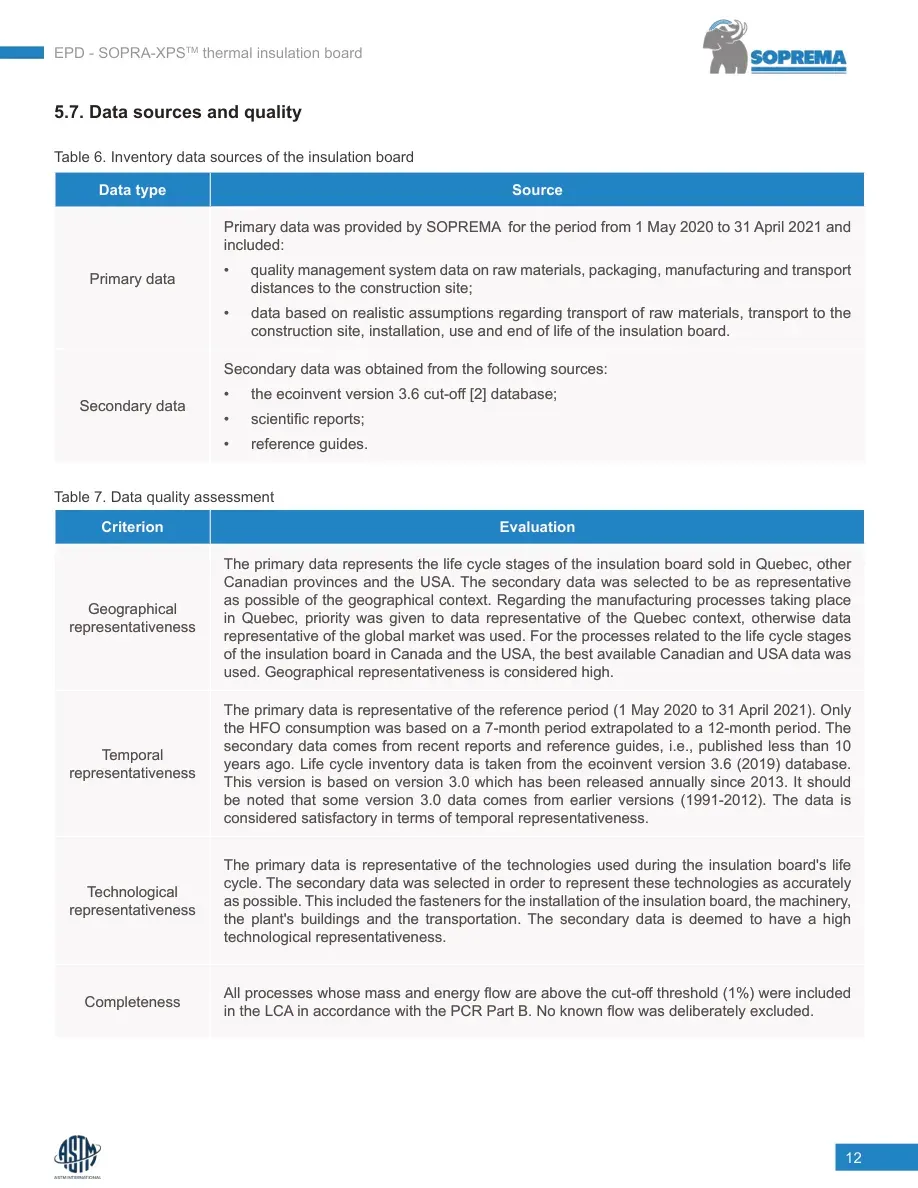
EPD - SOPRA-XPSTM thermal insulation board12Table 6. Inventory data sources of the insulation boardData typeSourcePrimary dataPrimary data was provided by SOPREMA for the period from 1 May 2020 to 31 April 2021 and included: • quality management system data on raw materials, packaging, manufacturing and transport distances to the construction site;• data based on realistic assumptions regarding transport of raw materials, transport to the construction site, installation, use and end of life of the insulation board.Secondary dataSecondary data was obtained from the following sources: • the ecoinvent version 3.6 cut-off [2] database;• scientific reports;• reference guides.CriterionEvaluationGeographical representativenessThe primary data represents the life cycle stages of the insulation board sold in Quebec, other Canadian provinces and the USA. The secondary data was selected to be as representative as possible of the geographical context. Regarding the manufacturing processes taking place in Quebec, priority was given to data representative of the Quebec context, otherwise data representative of the global market was used. For the processes related to the life cycle stages of the insulation board in Canada and the USA, the best available Canadian and USA data was used. Geographical representativeness is considered high.Temporal representativenessThe primary data is representative of the reference period (1 May 2020 to 31 April 2021). Only the HFO consumption was based on a 7-month period extrapolated to a 12-month period. The secondary data comes from recent reports and reference guides, i.e., published less than 10 years ago. Life cycle inventory data is taken from the ecoinvent version 3.6 (2019) database. This version is based on version 3.0 which has been released annually since 2013. It should be noted that some version 3.0 data comes from earlier versions (1991-2012). The data is considered satisfactory in terms of temporal representativeness.TechnologicalrepresentativenessThe primary data is representative of the technologies used during the insulation board's life cycle. The secondary data was selected in order to represent these technologies as accurately as possible. This included the fasteners for the installation of the insulation board, the machinery, the plant's buildings and the transportation. The secondary data is deemed to have a high technological representativeness.CompletenessAll processes whose mass and energy flow are above the cut-off threshold (1%) were included in the LCA in accordance with the PCR Part B. No known flow was deliberately excluded.Table 7. Data quality assessment5.7. Data sources and quality
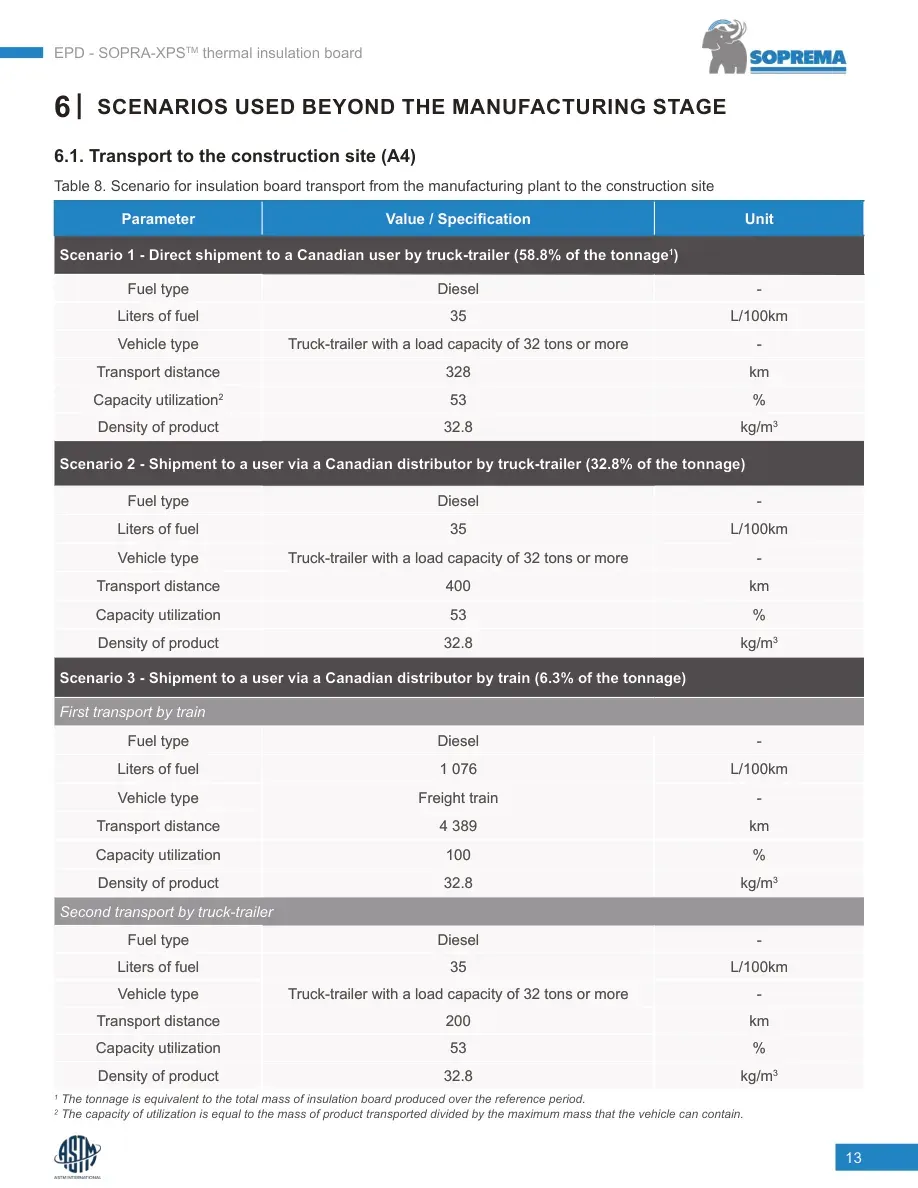
EPD - SOPRA-XPSTM thermal insulation board136.1. Transport to the construction site (A4)Table 8. Scenario for insulation board transport from the manufacturing plant to the construction siteParameterValue / SpecificationUnitScenario 1 - Direct shipment to a Canadian user by truck-trailer (58.8% of the tonnage1)Fuel typeDiesel-Liters of fuel35L/100kmVehicle typeTruck-trailer with a load capacity of 32 tons or more-Transport distance328kmCapacity utilization253%Density of product32.8kg/m3Scenario 2 - Shipment to a user via a Canadian distributor by truck-trailer (32.8% of the tonnage)Fuel typeDiesel-Liters of fuel35L/100kmVehicle typeTruck-trailer with a load capacity of 32 tons or more-Transport distance400kmCapacity utilization53%Density of product32.8kg/m3Scenario 3 - Shipment to a user via a Canadian distributor by train (6.3% of the tonnage)First transport by trainFuel typeDiesel-Liters of fuel1 076L/100kmVehicle typeFreight train-Transport distance4 389kmCapacity utilization100%Density of product32.8kg/m3Second transport by truck-trailerFuel typeDiesel-Liters of fuel35L/100kmVehicle typeTruck-trailer with a load capacity of 32 tons or more-Transport distance200kmCapacity utilization53%Density of product32.8kg/m3SCENARIOS USED BEYOND THE MANUFACTURING STAGE61 The tonnage is equivalent to the total mass of insulation board produced over the reference period.2 The capacity of utilization is equal to the mass of product transported divided by the maximum mass that the vehicle can contain.
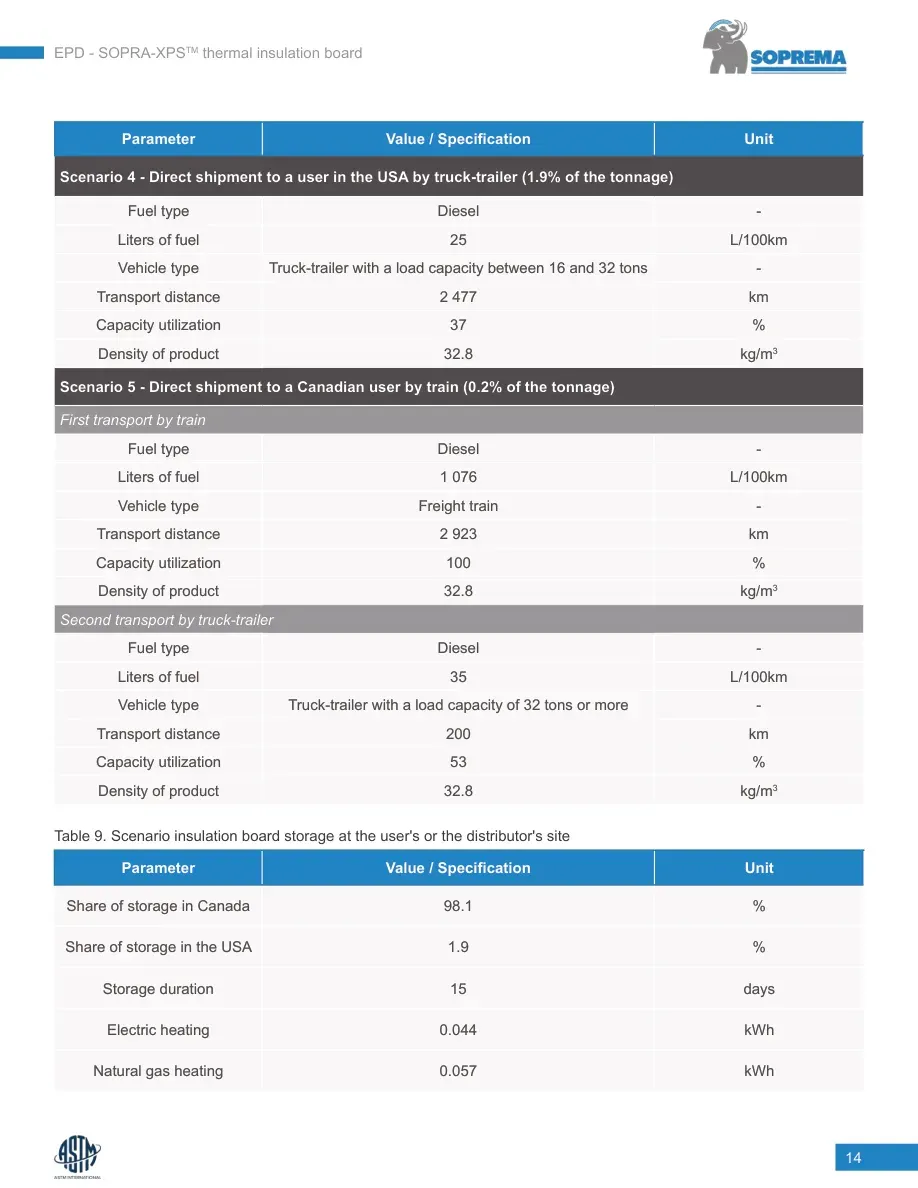
EPD - SOPRA-XPSTM thermal insulation board14ParameterValue / SpecificationUnitScenario 4 - Direct shipment to a user in the USA by truck-trailer (1.9% of the tonnage)Fuel typeDiesel-Liters of fuel25L/100kmVehicle typeTruck-trailer with a load capacity between 16 and 32 tons-Transport distance2 477kmCapacity utilization37%Density of product32.8kg/m3Scenario 5 - Direct shipment to a Canadian user by train (0.2% of the tonnage)First transport by trainFuel typeDiesel-Liters of fuel1 076L/100kmVehicle typeFreight train-Transport distance2 923kmCapacity utilization100%Density of product32.8kg/m3Second transport by truck-trailerFuel typeDiesel-Liters of fuel35L/100kmVehicle typeTruck-trailer with a load capacity of 32 tons or more-Transport distance200kmCapacity utilization53%Density of product32.8kg/m3ParameterValue / SpecificationUnitShare of storage in Canada98.1%Share of storage in the USA1.9%Storage duration15daysElectric heating0.044kWhNatural gas heating0.057kWhTable 9. Scenario insulation board storage at the user's or the distributor's site
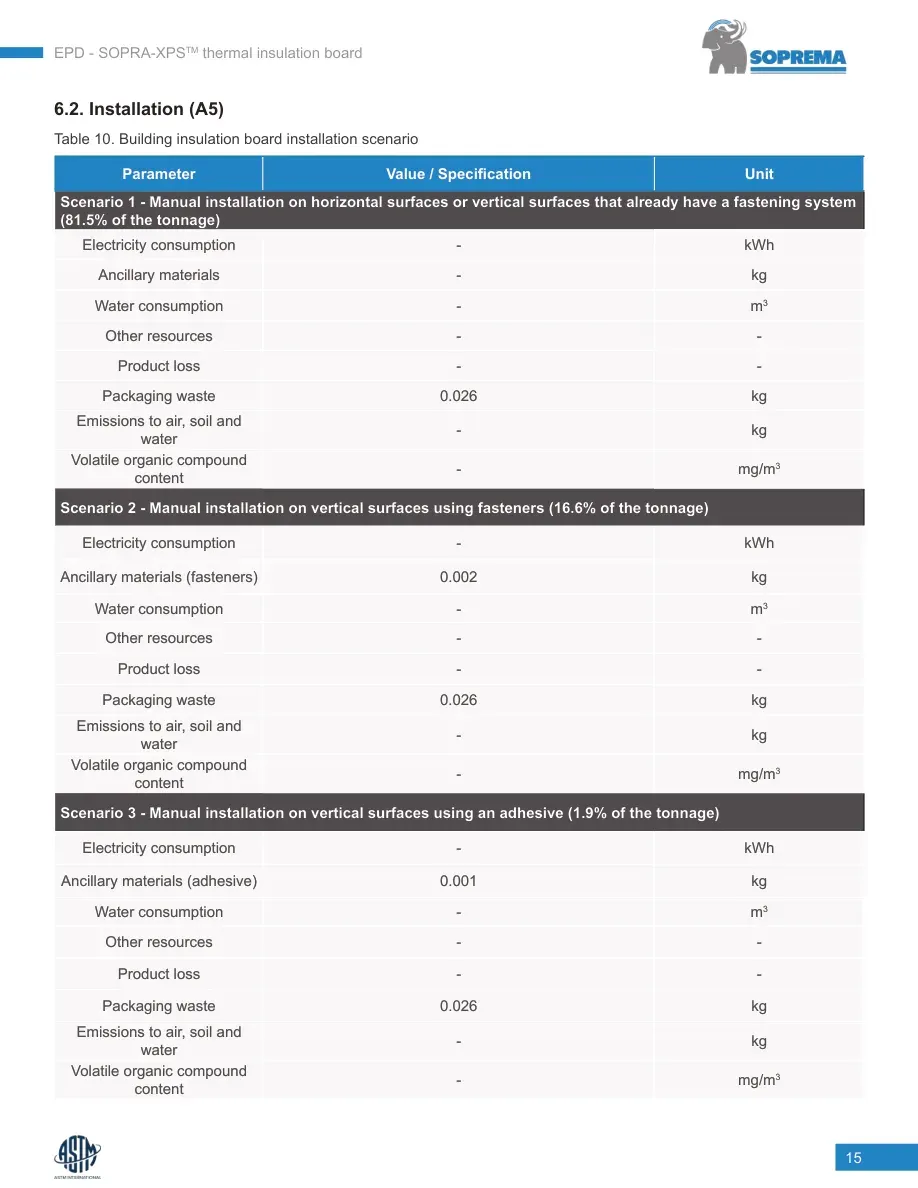
EPD - SOPRA-XPSTM thermal insulation board15ParameterValue / SpecificationUnitScenario 1 - Manual installation on horizontal surfaces or vertical surfaces that already have a fastening system (81.5% of the tonnage)Electricity consumption-kWhAncillary materials-kgWater consumption-m3Other resources--Product loss--Packaging waste0.026kgEmissions to air, soil and water-kgVolatile organic compound content-mg/m3Scenario 2 - Manual installation on vertical surfaces using fasteners (16.6% of the tonnage)Electricity consumption-kWhAncillary materials (fasteners)0.002kgWater consumption-m3Other resources--Product loss--Packaging waste0.026kgEmissions to air, soil and water-kgVolatile organic compound content-mg/m3Scenario 3 - Manual installation on vertical surfaces using an adhesive (1.9% of the tonnage)Electricity consumption-kWhAncillary materials (adhesive)0.001kgWater consumption-m3Other resources--Product loss--Packaging waste0.026kgEmissions to air, soil and water-kgVolatile organic compound content-mg/m36.2. Installation (A5)Table 10. Building insulation board installation scenario
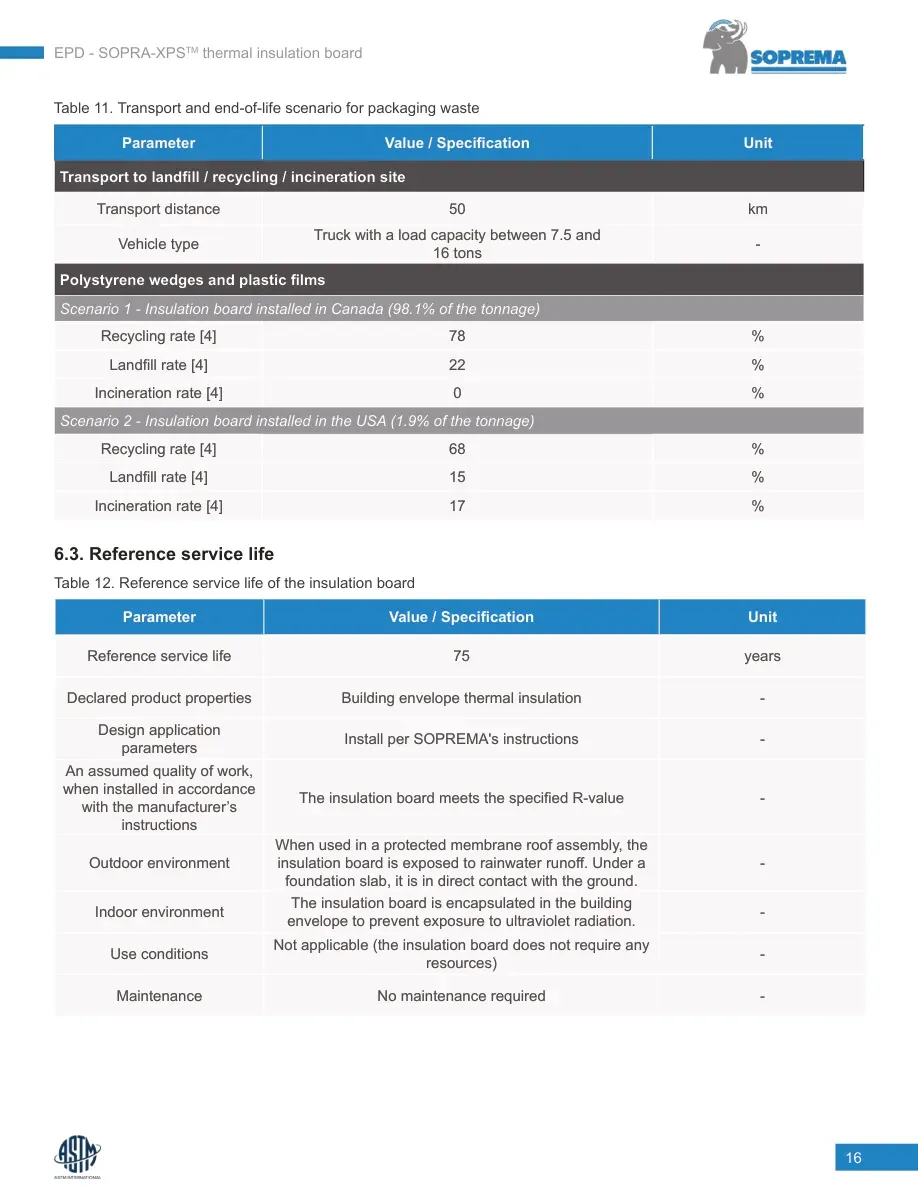
EPD - SOPRA-XPSTM thermal insulation board166.3. Reference service lifeTable 12. Reference service life of the insulation boardParameterValue / SpecificationUnitReference service life75yearsDeclared product propertiesBuilding envelope thermal insulation-Design application parametersInstall per SOPREMA's instructions-An assumed quality of work, when installed in accordance with the manufacturer’s instructionsThe insulation board meets the specified R-value-Outdoor environmentWhen used in a protected membrane roof assembly, the insulation board is exposed to rainwater runoff. Under a foundation slab, it is in direct contact with the ground.-Indoor environmentThe insulation board is encapsulated in the building envelope to prevent exposure to ultraviolet radiation.-Use conditionsNot applicable (the insulation board does not require any resources)-MaintenanceNo maintenance required-ParameterValue / SpecificationUnitTransport to landfill / recycling / incineration siteTransport distance50kmVehicle typeTruck with a load capacity between 7.5 and 16 tons-Polystyrene wedges and plastic filmsScenario 1 - Insulation board installed in Canada (98.1% of the tonnage)Recycling rate [4]78%Landfill rate [4]22%Incineration rate [4]0%Scenario 2 - Insulation board installed in the USA (1.9% of the tonnage)Recycling rate [4]68%Landfill rate [4]15%Incineration rate [4]17%Table 11. Transport and end-of-life scenario for packaging waste
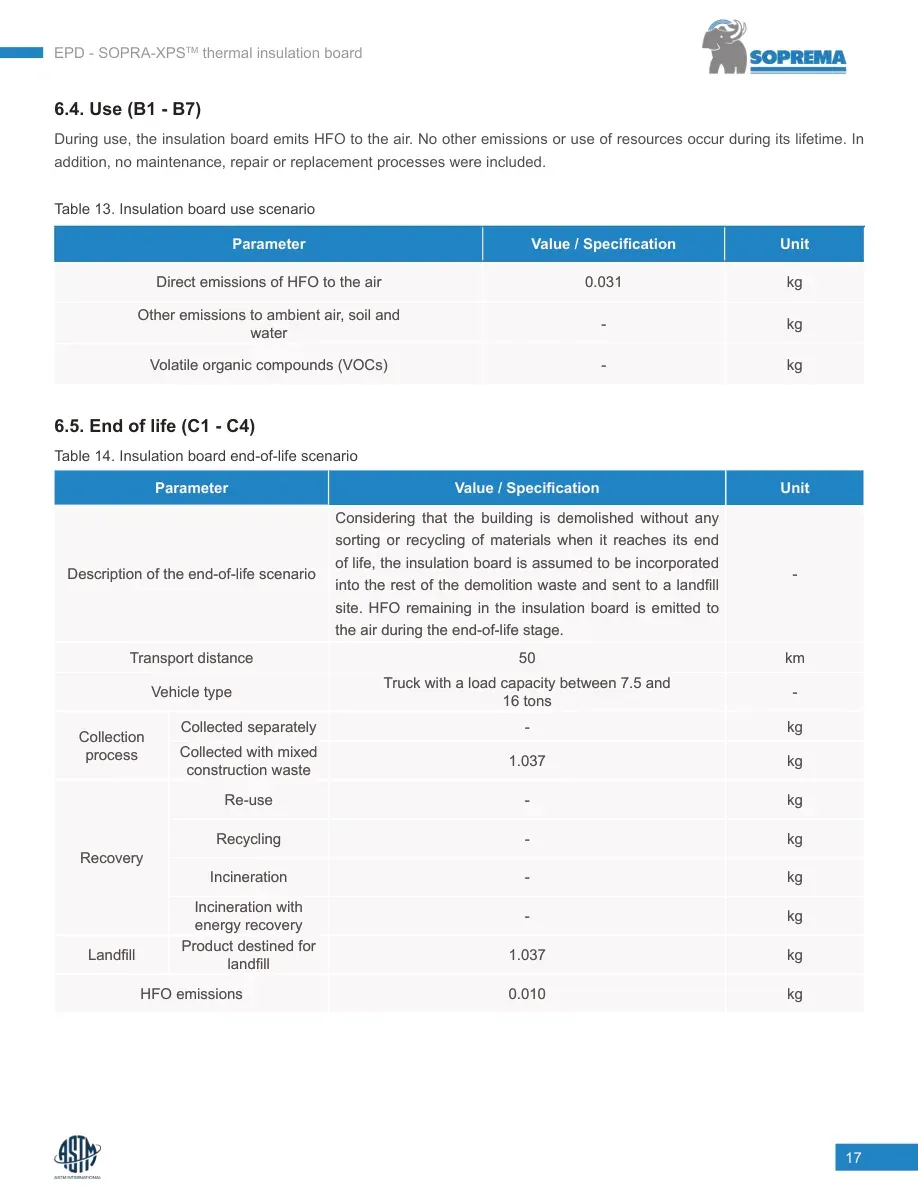
EPD - SOPRA-XPSTM thermal insulation board176.4. Use (B1 - B7)During use, the insulation board emits HFO to the air. No other emissions or use of resources occur during its lifetime. In addition, no maintenance, repair or replacement processes were included.Table 13. Insulation board use scenarioParameterValue / SpecificationUnitDirect emissions of HFO to the air0.031kgOther emissions to ambient air, soil andwater-kgVolatile organic compounds (VOCs)-kg6.5. End of life (C1 - C4)Table 14. Insulation board end-of-life scenarioParameterValue / SpecificationUnitDescription of the end-of-life scenarioConsidering that the building is demolished without any sorting or recycling of materials when it reaches its end of life, the insulation board is assumed to be incorporated into the rest of the demolition waste and sent to a landfill site. HFO remaining in the insulation board is emitted to the air during the end-of-life stage.-Transport distance50kmVehicle typeTruck with a load capacity between 7.5 and 16 tons-Collection processCollected separately-kg Collected with mixed construction waste1.037kg RecoveryRe-use- kg Recycling- kg Incineration-kgIncineration with energy recovery - kg LandfillProduct destined for landfill1.037kg HFO emissions0.010kg
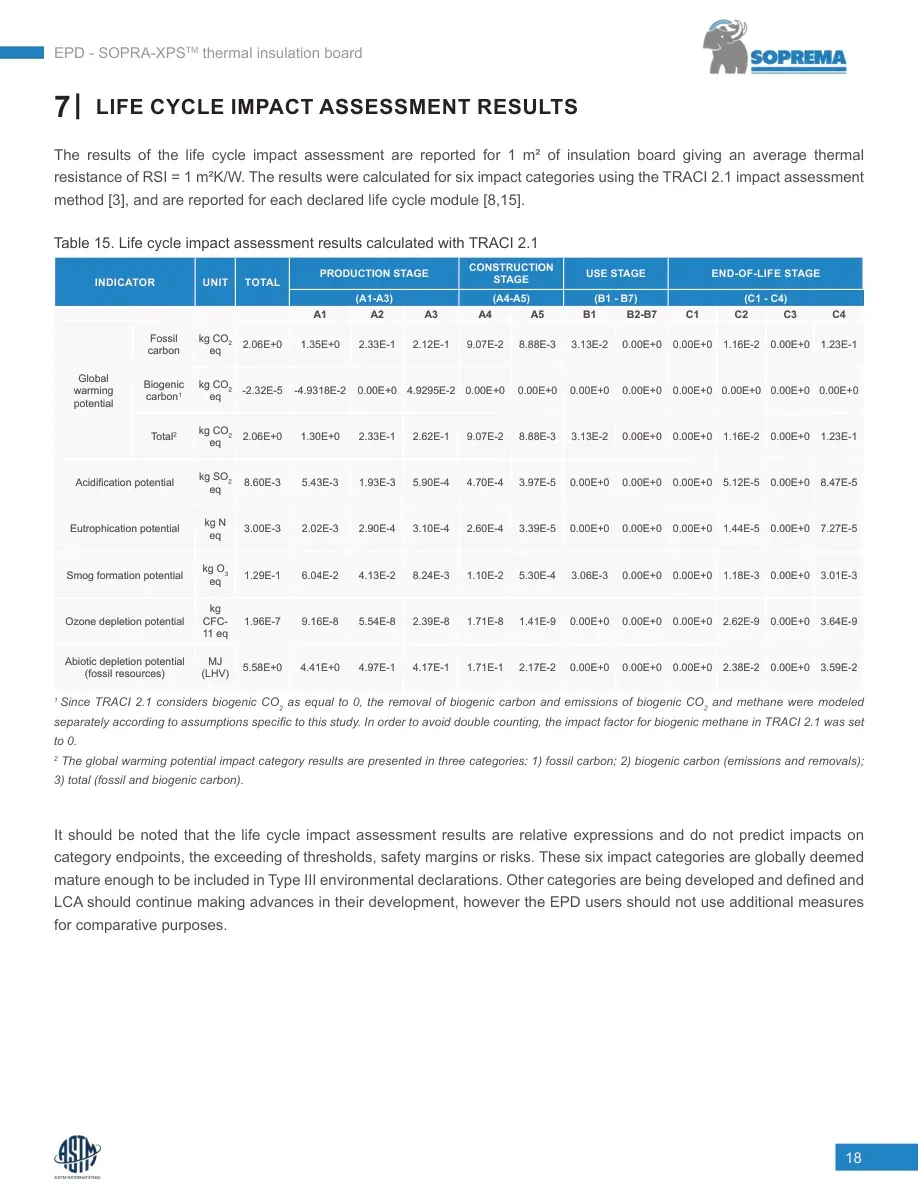
EPD - SOPRA-XPSTM thermal insulation board18INDICATORUNITTOTALPRODUCTION STAGECONSTRUCTION STAGEUSE STAGEEND-OF-LIFE STAGE(A1-A3)(A4-A5)(B1 - B7)(C1 - C4)A1A2A3A4A5B1B2-B7C1C2C3C4Global warming potentialFossil carbonkg CO2 eq2.06E+01.35E+02.33E-12.12E-19.07E-28.88E-33.13E-20.00E+00.00E+01.16E-20.00E+01.23E-1Biogenic carbon1kg CO2 eq-2.32E-5-4.9318E-20.00E+04.9295E-20.00E+00.00E+00.00E+00.00E+00.00E+00.00E+00.00E+00.00E+0Total2kg CO2 eq2.06E+01.30E+02.33E-12.62E-19.07E-28.88E-33.13E-20.00E+00.00E+01.16E-20.00E+01.23E-1Acidification potentialkg SO2 eq8.60E-35.43E-31.93E-35.90E-44.70E-43.97E-50.00E+00.00E+00.00E+05.12E-50.00E+08.47E-5Eutrophication potentialkg N eq3.00E-32.02E-32.90E-43.10E-42.60E-43.39E-50.00E+00.00E+00.00E+01.44E-50.00E+07.27E-5Smog formation potentialkg O3 eq1.29E-16.04E-24.13E-28.24E-31.10E-25.30E-43.06E-30.00E+00.00E+01.18E-30.00E+03.01E-3Ozone depletion potentialkg CFC-11 eq1.96E-79.16E-85.54E-82.39E-81.71E-81.41E-90.00E+00.00E+00.00E+02.62E-90.00E+03.64E-9Abiotic depletion potential (fossil resources)MJ (LHV)5.58E+04.41E+04.97E-14.17E-11.71E-12.17E-20.00E+00.00E+00.00E+02.38E-20.00E+03.59E-21 Since TRACI 2.1 considers biogenic CO2 as equal to 0, the removal of biogenic carbon and emissions of biogenic CO2 and methane were modeled separately according to assumptions specific to this study. In order to avoid double counting, the impact factor for biogenic methane in TRACI 2.1 was set to 0.2 The global warming potential impact category results are presented in three categories: 1) fossil carbon; 2) biogenic carbon (emissions and removals); 3) total (fossil and biogenic carbon).Table 15. Life cycle impact assessment results calculated with TRACI 2.1The results of the life cycle impact assessment are reported for 1 m² of insulation board giving an average thermal resistance of RSI = 1 m²K/W. The results were calculated for six impact categories using the TRACI 2.1 impact assessment method [3], and are reported for each declared life cycle module [8,15].It should be noted that the life cycle impact assessment results are relative expressions and do not predict impacts on category endpoints, the exceeding of thresholds, safety margins or risks. These six impact categories are globally deemed mature enough to be included in Type III environmental declarations. Other categories are being developed and defined and LCA should continue making advances in their development, however the EPD users should not use additional measures for comparative purposes.LIFE CYCLE IMPACT ASSESSMENT RESULTS7
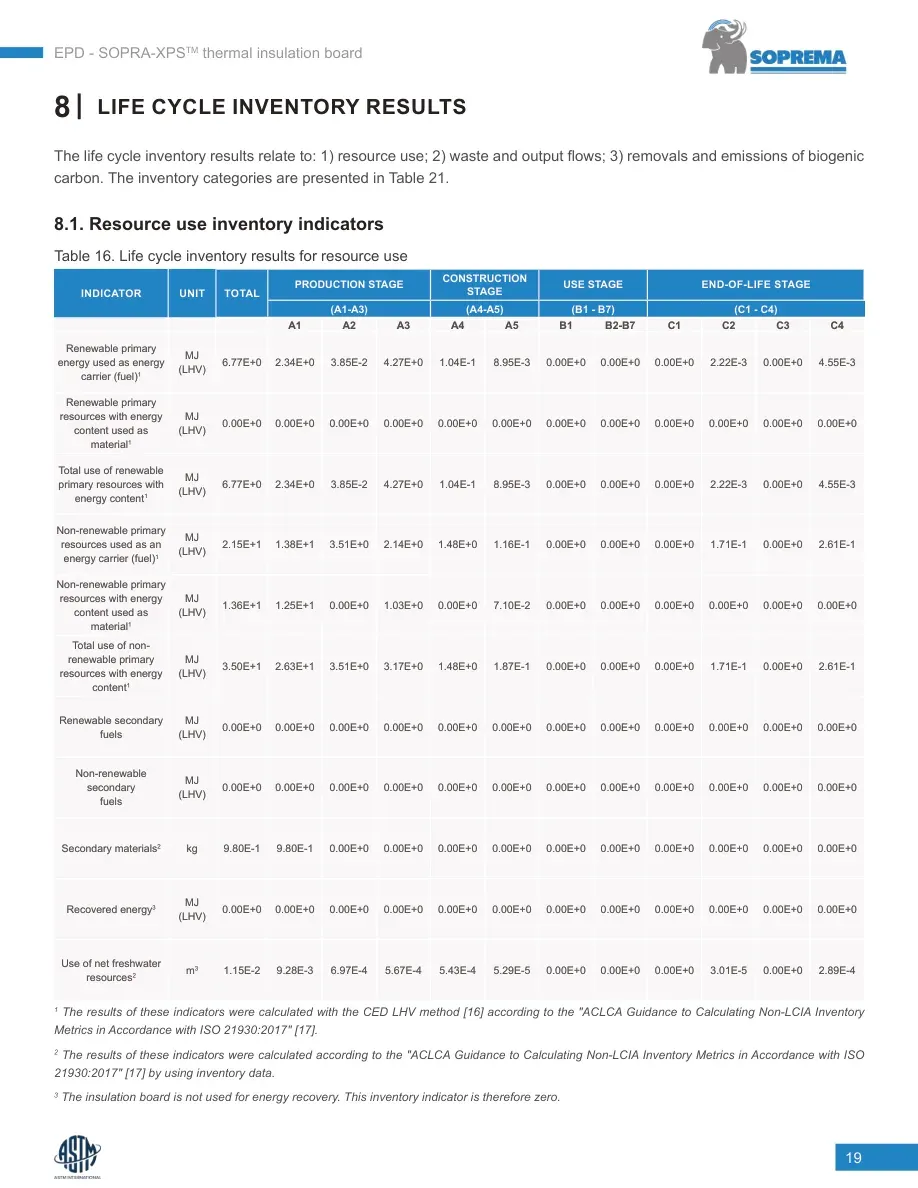
EPD - SOPRA-XPSTM thermal insulation board198.1. Resource use inventory indicatorsINDICATORUNITTOTALPRODUCTION STAGECONSTRUCTION STAGEUSE STAGEEND-OF-LIFE STAGE(A1-A3)(A4-A5)(B1 - B7)(C1 - C4)A1A2A3A4A5B1B2-B7C1C2C3C4Renewable primary energy used as energy carrier (fuel)1MJ (LHV)6.77E+02.34E+03.85E-24.27E+01.04E-18.95E-30.00E+00.00E+00.00E+02.22E-30.00E+04.55E-3Renewable primary resources with energy content used as material1MJ (LHV)0.00E+00.00E+00.00E+00.00E+00.00E+00.00E+00.00E+00.00E+00.00E+00.00E+00.00E+00.00E+0Total use of renewable primary resources with energy content1MJ (LHV)6.77E+02.34E+03.85E-24.27E+01.04E-18.95E-30.00E+00.00E+00.00E+02.22E-30.00E+04.55E-3Non-renewable primaryresources used as an energy carrier (fuel)1MJ (LHV)2.15E+11.38E+13.51E+02.14E+01.48E+01.16E-10.00E+00.00E+00.00E+01.71E-10.00E+02.61E-1Non-renewable primaryresources with energy content used as material1MJ (LHV)1.36E+11.25E+10.00E+01.03E+00.00E+07.10E-20.00E+00.00E+00.00E+00.00E+00.00E+00.00E+0Total use of non-renewable primary resources with energy content1MJ (LHV)3.50E+12.63E+13.51E+03.17E+01.48E+01.87E-10.00E+00.00E+00.00E+01.71E-10.00E+02.61E-1Renewable secondary fuelsMJ (LHV)0.00E+00.00E+00.00E+00.00E+00.00E+00.00E+00.00E+00.00E+00.00E+00.00E+00.00E+00.00E+0Non-renewable secondaryfuelsMJ (LHV)0.00E+00.00E+00.00E+00.00E+00.00E+00.00E+00.00E+00.00E+00.00E+00.00E+00.00E+00.00E+0Secondary materials2kg9.80E-19.80E-10.00E+00.00E+00.00E+00.00E+00.00E+00.00E+00.00E+00.00E+00.00E+00.00E+0Recovered energy3MJ (LHV)0.00E+00.00E+00.00E+00.00E+00.00E+00.00E+00.00E+00.00E+00.00E+00.00E+00.00E+00.00E+0Use of net freshwater resources2m31.15E-29.28E-36.97E-45.67E-45.43E-45.29E-50.00E+00.00E+00.00E+03.01E-50.00E+02.89E-41 The results of these indicators were calculated with the CED LHV method [16] according to the "ACLCA Guidance to Calculating Non-LCIA Inventory Metrics in Accordance with ISO 21930:2017" [17]. 2 The results of these indicators were calculated according to the "ACLCA Guidance to Calculating Non-LCIA Inventory Metrics in Accordance with ISO 21930:2017" [17] by using inventory data.3 The insulation board is not used for energy recovery. This inventory indicator is therefore zero. The life cycle inventory results relate to: 1) resource use; 2) waste and output flows; 3) removals and emissions of biogenic carbon. The inventory categories are presented in Table 21.Table 16. Life cycle inventory results for resource useLIFE CYCLE INVENTORY RESULTS8
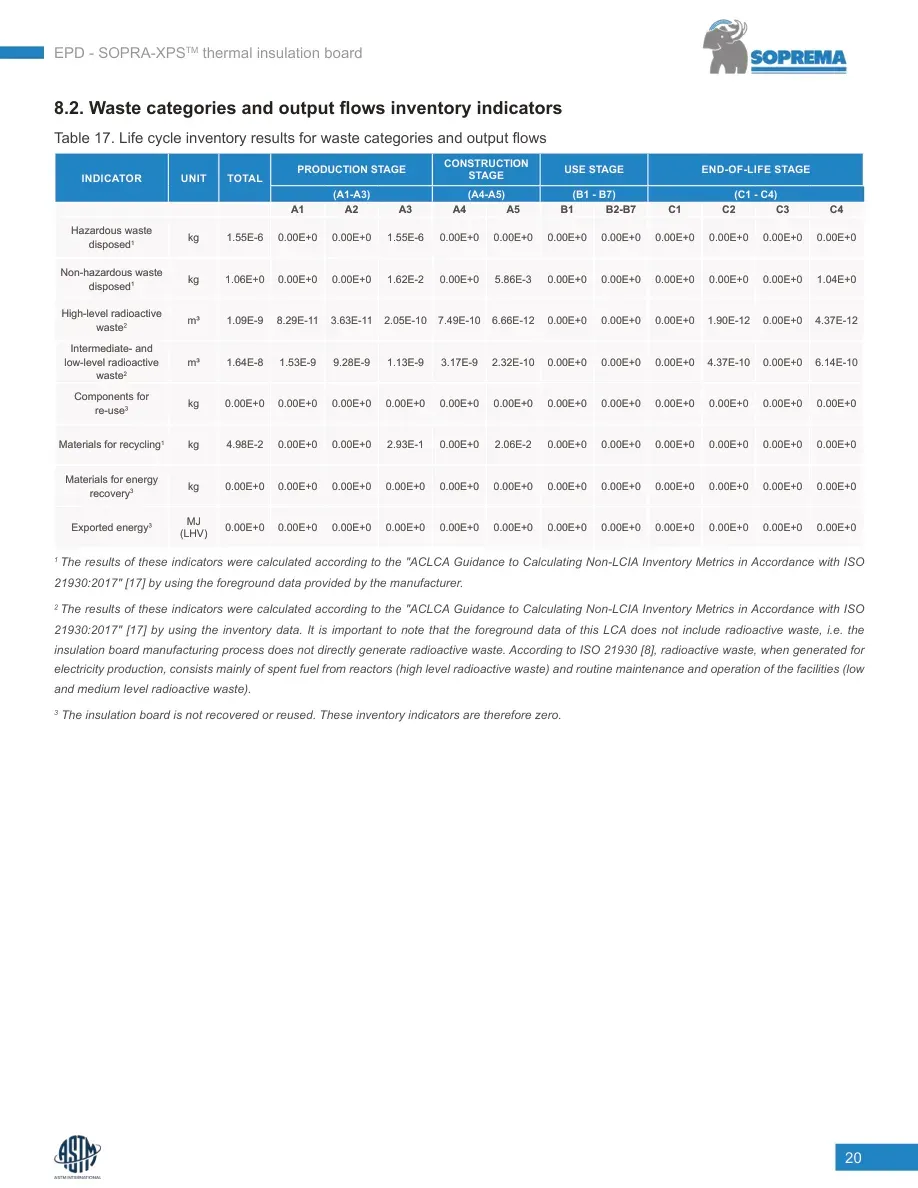
EPD - SOPRA-XPSTM thermal insulation board20INDICATORUNITTOTALPRODUCTION STAGECONSTRUCTION STAGEUSE STAGEEND-OF-LIFE STAGE(A1-A3)(A4-A5)(B1 - B7)(C1 - C4)A1A2A3A4A5B1B2-B7C1C2C3C4Hazardous waste disposed1kg1.55E-60.00E+00.00E+01.55E-60.00E+00.00E+00.00E+00.00E+00.00E+00.00E+00.00E+00.00E+0Non-hazardous waste disposed1kg1.06E+00.00E+00.00E+01.62E-20.00E+05.86E-30.00E+00.00E+00.00E+00.00E+00.00E+01.04E+0High-level radioactive waste2m³1.09E-98.29E-113.63E-112.05E-107.49E-106.66E-120.00E+00.00E+00.00E+01.90E-120.00E+04.37E-12Intermediate- and low-level radioactive waste2m³1.64E-81.53E-99.28E-91.13E-93.17E-92.32E-100.00E+00.00E+00.00E+04.37E-100.00E+06.14E-10Components for re-use3kg0.00E+00.00E+00.00E+00.00E+00.00E+00.00E+00.00E+00.00E+00.00E+00.00E+00.00E+00.00E+0Materials for recycling1kg4.98E-20.00E+00.00E+02.93E-10.00E+02.06E-20.00E+00.00E+00.00E+00.00E+00.00E+00.00E+0Materials for energy recovery3kg0.00E+00.00E+00.00E+00.00E+00.00E+00.00E+00.00E+00.00E+00.00E+00.00E+00.00E+00.00E+0Exported energy3MJ (LHV)0.00E+00.00E+00.00E+00.00E+00.00E+00.00E+00.00E+00.00E+00.00E+00.00E+00.00E+00.00E+01 The results of these indicators were calculated according to the "ACLCA Guidance to Calculating Non-LCIA Inventory Metrics in Accordance with ISO 21930:2017" [17] by using the foreground data provided by the manufacturer.2 The results of these indicators were calculated according to the "ACLCA Guidance to Calculating Non-LCIA Inventory Metrics in Accordance with ISO 21930:2017" [17] by using the inventory data. It is important to note that the foreground data of this LCA does not include radioactive waste, i.e. the insulation board manufacturing process does not directly generate radioactive waste. According to ISO 21930 [8], radioactive waste, when generated for electricity production, consists mainly of spent fuel from reactors (high level radioactive waste) and routine maintenance and operation of the facilities (low and medium level radioactive waste).3 The insulation board is not recovered or reused. These inventory indicators are therefore zero.8.2. Waste categories and output flows inventory indicatorsTable 17. Life cycle inventory results for waste categories and output flows
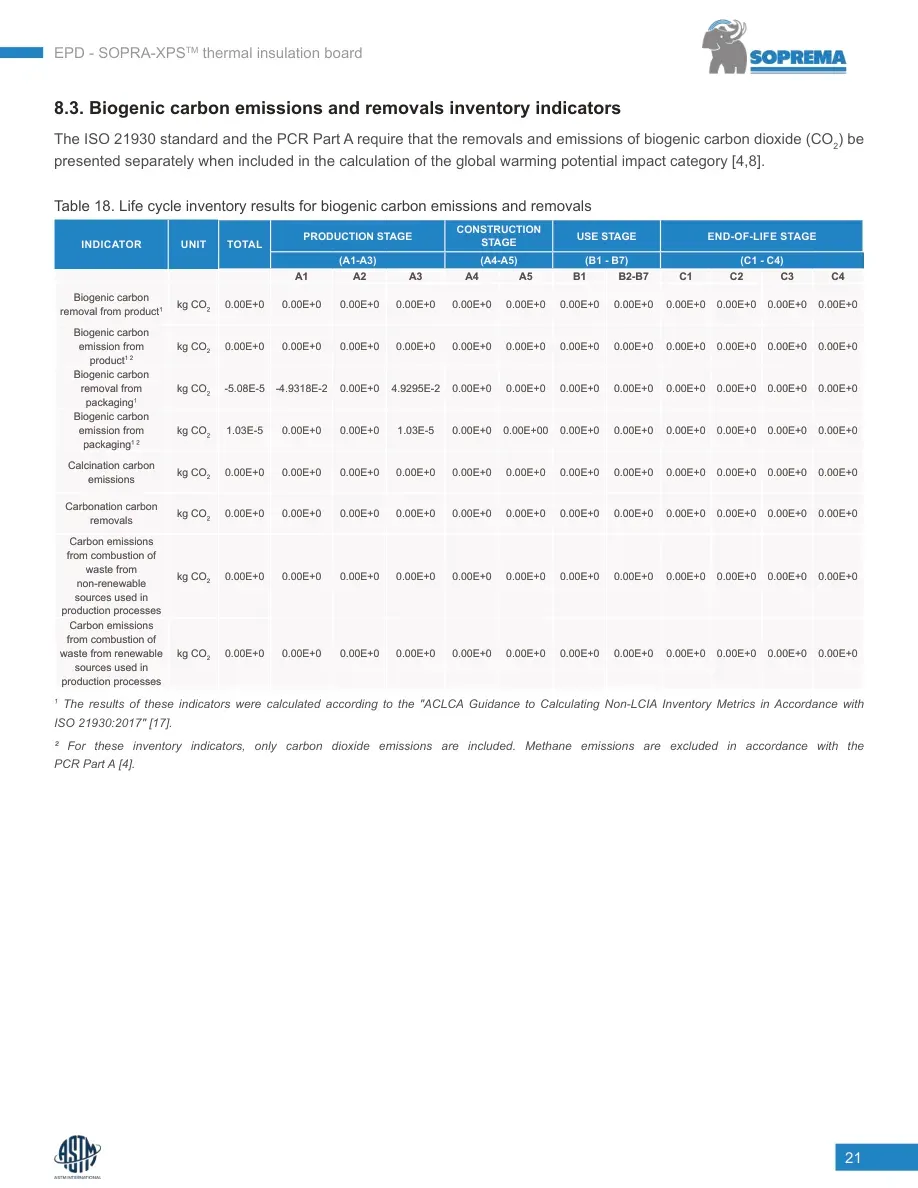
EPD - SOPRA-XPSTM thermal insulation board218.3. Biogenic carbon emissions and removals inventory indicatorsThe ISO 21930 standard and the PCR Part A require that the removals and emissions of biogenic carbon dioxide (CO2) be presented separately when included in the calculation of the global warming potential impact category [4,8].INDICATORUNITTOTALPRODUCTION STAGECONSTRUCTION STAGEUSE STAGEEND-OF-LIFE STAGE(A1-A3)(A4-A5)(B1 - B7)(C1 - C4)A1A2A3A4A5B1B2-B7C1C2C3C4Biogenic carbon removal from product1kg CO20.00E+00.00E+00.00E+00.00E+00.00E+00.00E+00.00E+00.00E+00.00E+00.00E+00.00E+00.00E+0Biogenic carbon emission from product1 2kg CO20.00E+00.00E+00.00E+00.00E+00.00E+00.00E+00.00E+00.00E+00.00E+00.00E+00.00E+00.00E+0Biogenic carbon removal from packaging1kg CO2-5.08E-5-4.9318E-20.00E+04.9295E-20.00E+00.00E+00.00E+00.00E+00.00E+00.00E+00.00E+00.00E+0Biogenic carbon emission from packaging1 2kg CO21.03E-50.00E+00.00E+01.03E-50.00E+00.00E+000.00E+00.00E+00.00E+00.00E+00.00E+00.00E+0Calcination carbon emissionskg CO20.00E+00.00E+00.00E+00.00E+00.00E+00.00E+00.00E+00.00E+00.00E+00.00E+00.00E+00.00E+0Carbonation carbon removalskg CO20.00E+00.00E+00.00E+00.00E+00.00E+00.00E+00.00E+00.00E+00.00E+00.00E+00.00E+00.00E+0Carbon emissions from combustion of waste from non-renewable sources used in production processeskg CO20.00E+00.00E+00.00E+00.00E+00.00E+00.00E+00.00E+00.00E+00.00E+00.00E+00.00E+00.00E+0Carbon emissions from combustion of waste from renewable sources used in production processeskg CO20.00E+00.00E+00.00E+00.00E+00.00E+00.00E+00.00E+00.00E+00.00E+00.00E+00.00E+00.00E+01 The results of these indicators were calculated according to the "ACLCA Guidance to Calculating Non-LCIA Inventory Metrics in Accordance with ISO 21930:2017" [17].² For these inventory indicators, only carbon dioxide emissions are included. Methane emissions are excluded in accordance with the PCR Part A [4].Table 18. Life cycle inventory results for biogenic carbon emissions and removals
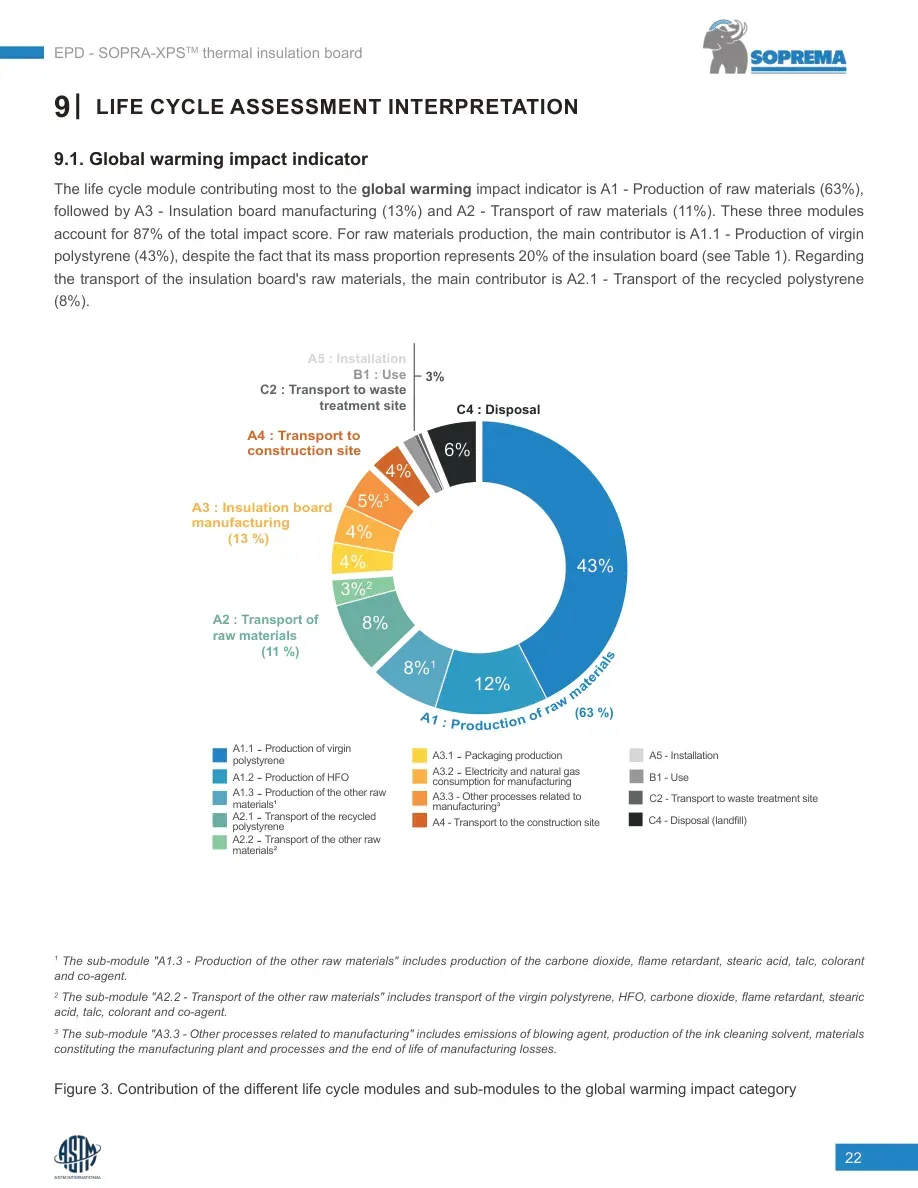
EPD - SOPRA-XPSTM thermal insulation board22LIFE CYCLE ASSESSMENT INTERPRETATION9Figure 3. Contribution of the different life cycle modules and sub-modules to the global warming impact category9.1. Global warming impact indicatorThe life cycle module contributing most to the global warming impact indicator is A1 - Production of raw materials (63%), followed by A3 - Insulation board manufacturing (13%) and A2 - Transport of raw materials (11%). These three modules account for 87% of the total impact score. For raw materials production, the main contributor is A1.1 - Production of virgin polystyrene (43%), despite the fact that its mass proportion represents 20% of the insulation board (see Table 1). Regarding the transport of the insulation board's raw materials, the main contributor is A2.1 - Transport of the recycled polystyrene (8%).25%A1.1 - Production of virginpolystyreneA1.2 - Production of HFOA1.3 - Production of the other rawmaterials¹A3.1 - Packaging productionA3.2 - Electricity and natural gas consumption for manufacturingA3.3 - Other processes related to manufacturing³A4 - Transport to the construction siteA5 - InstallationB1 - UseC2 - Transport to waste treatment siteA2.1 - Transport of the recycled polystyreneA2.2 - Transport of the other rawmaterials²C4 - Disposal (landfill)A1 : Production of raw materialsA2 : Transport ofraw materials (11 %)A5 : InstallationB1 : UseC2 : Transport to wastetreatment siteA3 : Insulation boardmanufacturing (13 %)A4 : Transport to construction site3%C4 : Disposal43%12%8%18%3%24%4%6%4%5%3(63 %)1 The sub-module "A1.3 - Production of the other raw materials" includes production of the carbone dioxide, flame retardant, stearic acid, talc, colorant and co-agent.2 The sub-module "A2.2 - Transport of the other raw materials" includes transport of the virgin polystyrene, HFO, carbone dioxide, flame retardant, stearic acid, talc, colorant and co-agent.3 The sub-module "A3.3 - Other processes related to manufacturing" includes emissions of blowing agent, production of the ink cleaning solvent, materials constituting the manufacturing plant and processes and the end of life of manufacturing losses.
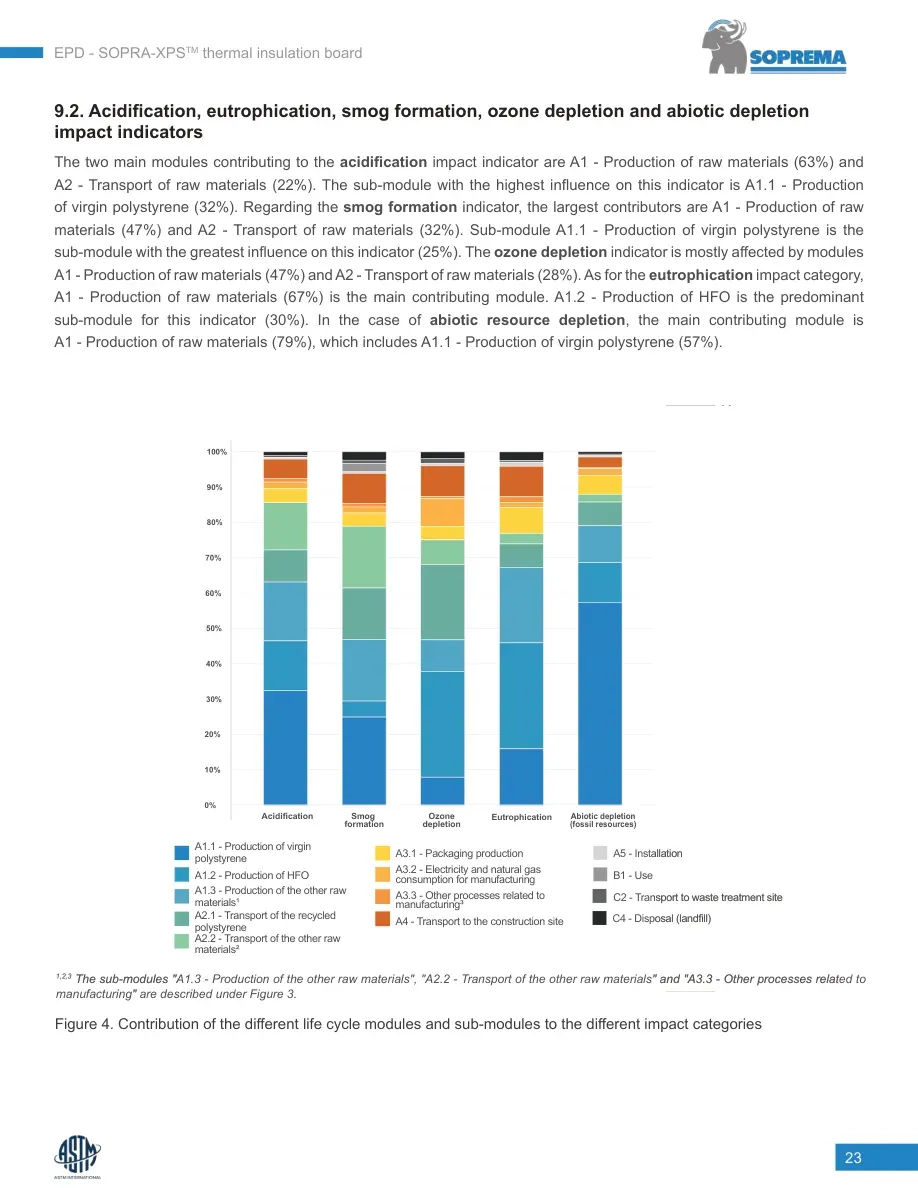
EPD - SOPRA-XPSTM thermal insulation board239.2. Acidification, eutrophication, smog formation, ozone depletion and abiotic depletion impact indicatorsThe two main modules contributing to the acidification impact indicator are A1 - Production of raw materials (63%) and A2 - Transport of raw materials (22%). The sub-module with the highest influence on this indicator is A1.1 - Production of virgin polystyrene (32%). Regarding the smog formation indicator, the largest contributors are A1 - Production of raw materials (47%) and A2 - Transport of raw materials (32%). Sub-module A1.1 - Production of virgin polystyrene is the sub-module with the greatest influence on this indicator (25%). The ozone depletion indicator is mostly affected by modules A1 - Production of raw materials (47%) and A2 - Transport of raw materials (28%). As for the eutrophication impact category, A1 - Production of raw materials (67%) is the main contributing module. A1.2 - Production of HFO is the predominant sub-module for this indicator (30%). In the case of abiotic resource depletion, the main contributing module is A1 - Production of raw materials (79%), which includes A1.1 - Production of virgin polystyrene (57%).OzonedepletionAbiotic depletion(fossil resources)AcidificationEutrophicationSmog formation30%40%50%dcbA0%10%20%80%90%100%60%70%A1.1 - Production of virginpolystyreneA1.2 - Production of HFOA1.3 - Production of the other rawmaterials¹A3.1 - Packaging productionA3.2 - Electricity and natural gas consumption for manufacturingA3.3 - Other processes related to manufacturing³A4 - Transport to the construction siteA5 - InstallationB1 - UseC2 - Transport to waste treatment siteA2.1 - Transport of the recycled polystyreneA2.2 - Transport of the other rawmaterials²C4 - Disposal (landfill)Figure 4. Contribution of the different life cycle modules and sub-modules to the different impact categories1,2,3 The sub-modules "A1.3 - Production of the other raw materials", "A2.2 - Transport of the other raw materials" and "A3.3 - Other processes related to manufacturing" are described under Figure 3.
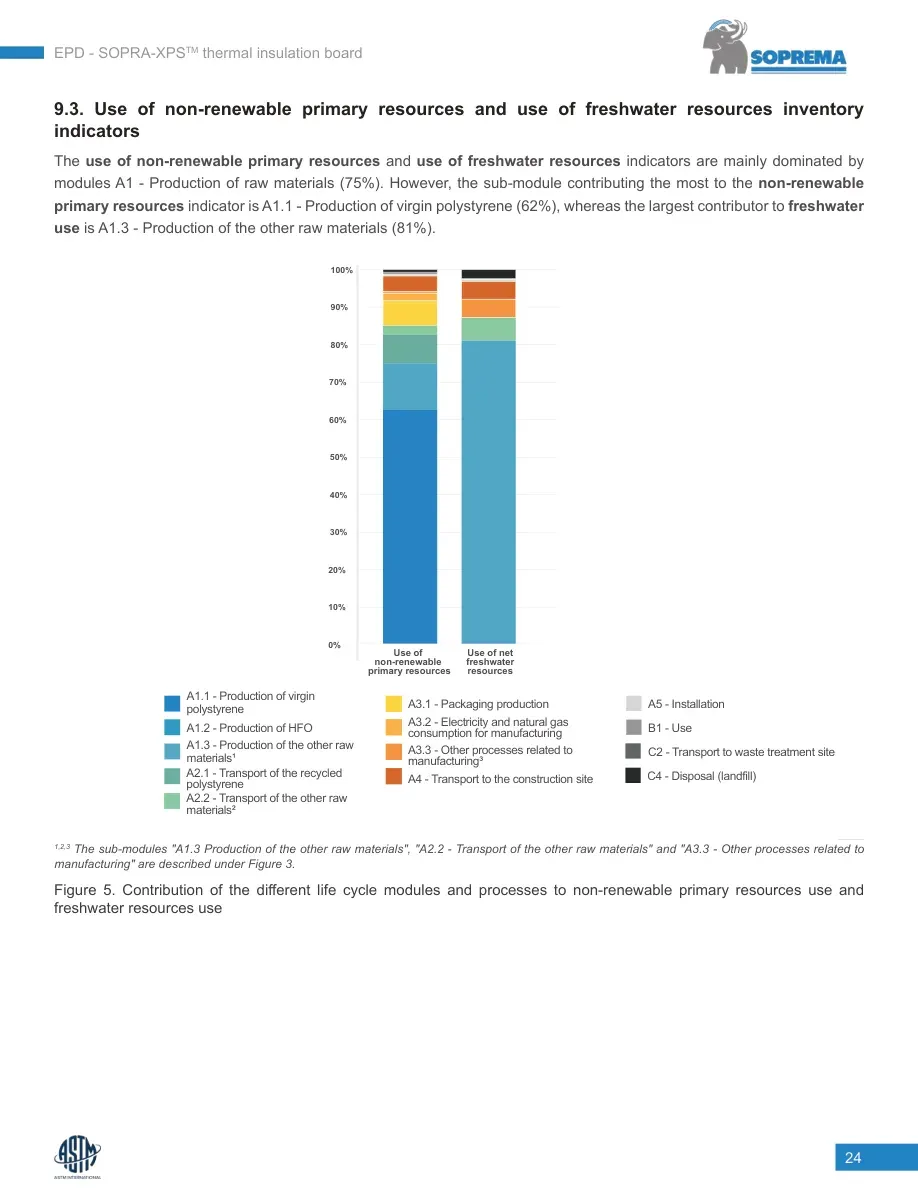
EPD - SOPRA-XPSTM thermal insulation board249.3. Use of non-renewable primary resources and use of freshwater resources inventory indicatorsThe use of non-renewable primary resources and use of freshwater resources indicators are mainly dominated by modules A1 - Production of raw materials (75%). However, the sub-module contributing the most to the non-renewable primary resources indicator is A1.1 - Production of virgin polystyrene (62%), whereas the largest contributor to freshwater use is A1.3 - Production of the other raw materials (81%).30%40%50%0%10%20%80%90%100%60%70%Use of non-renewable primary resourcesUse of netfreshwaterresourcesA1.1 - Production of virginpolystyreneA1.2 - Production of HFOA1.3 - Production of the other rawmaterials¹A3.1 - Packaging productionA3.2 - Electricity and natural gas consumption for manufacturingA3.3 - Other processes related to manufacturing³A4 - Transport to the construction siteA5 - InstallationB1 - UseC2 - Transport to waste treatment siteA2.1 - Transport of the recycled polystyreneA2.2 - Transport of the other rawmaterials²C4 - Disposal (landfill)Figure 5. Contribution of the different life cycle modules and processes to non-renewable primary resources use and freshwater resources use1,2,3 The sub-modules "A1.3 Production of the other raw materials", "A2.2 - Transport of the other raw materials" and "A3.3 - Other processes related to manufacturing" are described under Figure 3.
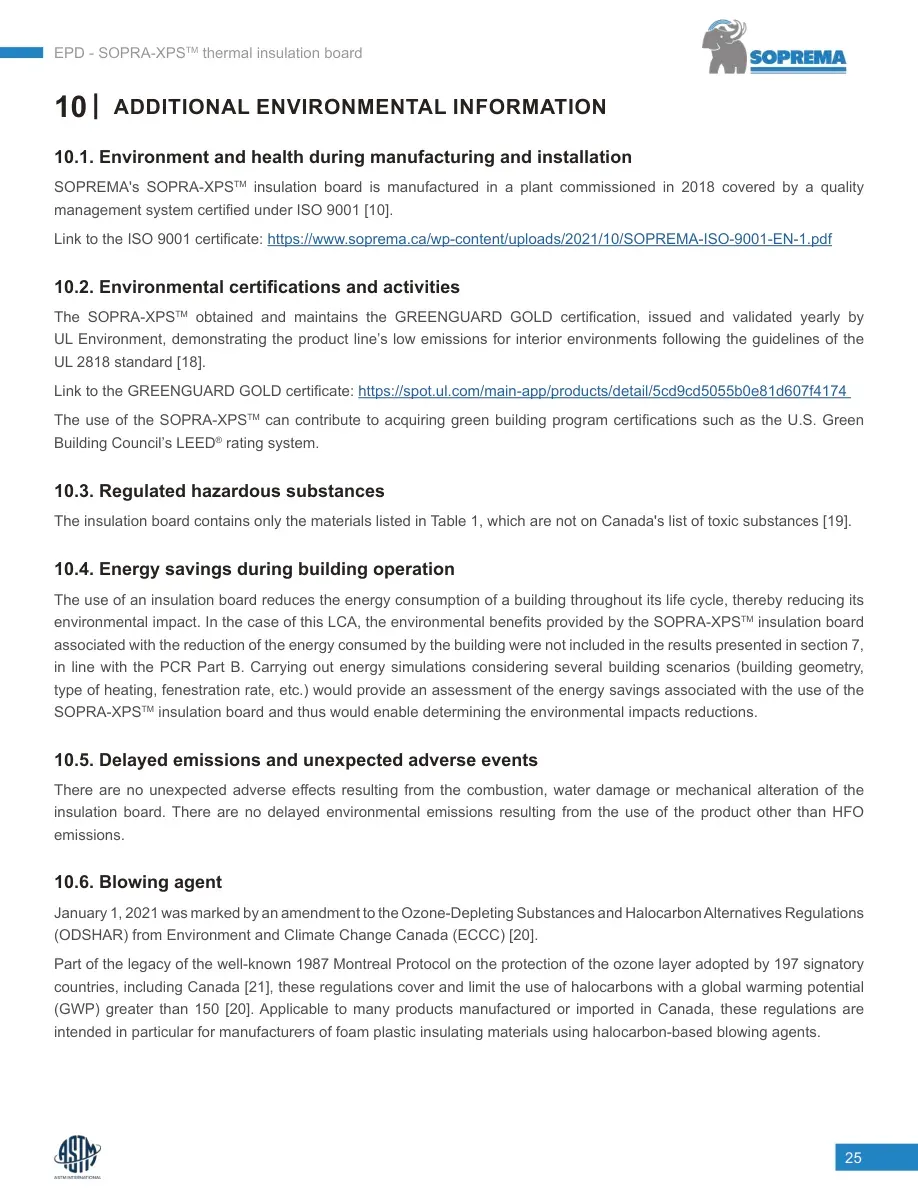
EPD - SOPRA-XPSTM thermal insulation board2510.1. Environment and health during manufacturing and installationSOPREMA's SOPRA-XPSTM insulation board is manufactured in a plant commissioned in 2018 covered by a quality management system certified under ISO 9001 [10].Link to the ISO 9001 certificate: https://www.soprema.ca/wp-content/uploads/2021/10/SOPREMA-ISO-9001-EN-1.pdf10.2. Environmental certifications and activitiesThe SOPRA-XPSTM obtained and maintains the GREENGUARD GOLD certification, issued and validated yearly by UL Environment, demonstrating the product line’s low emissions for interior environments following the guidelines of the UL 2818 standard [18]. Link to the GREENGUARD GOLD certificate: https://spot.ul.com/main-app/products/detail/5cd9cd5055b0e81d607f4174 The use of the SOPRA-XPSTM can contribute to acquiring green building program certifications such as the U.S. Green Building Council’s LEED® rating system.10.3. Regulated hazardous substancesThe insulation board contains only the materials listed in Table 1, which are not on Canada's list of toxic substances [19].10.4. Energy savings during building operationThe use of an insulation board reduces the energy consumption of a building throughout its life cycle, thereby reducing its environmental impact. In the case of this LCA, the environmental benefits provided by the SOPRA-XPSTM insulation board associated with the reduction of the energy consumed by the building were not included in the results presented in section 7, in line with the PCR Part B. Carrying out energy simulations considering several building scenarios (building geometry, type of heating, fenestration rate, etc.) would provide an assessment of the energy savings associated with the use of the SOPRA-XPSTM insulation board and thus would enable determining the environmental impacts reductions.10.5. Delayed emissions and unexpected adverse eventsThere are no unexpected adverse effects resulting from the combustion, water damage or mechanical alteration of the insulation board. There are no delayed environmental emissions resulting from the use of the product other than HFO emissions.10.6. Blowing agentJanuary 1, 2021 was marked by an amendment to the Ozone-Depleting Substances and Halocarbon Alternatives Regulations (ODSHAR) from Environment and Climate Change Canada (ECCC) [20]. Part of the legacy of the well-known 1987 Montreal Protocol on the protection of the ozone layer adopted by 197 signatory countries, including Canada [21], these regulations cover and limit the use of halocarbons with a global warming potential (GWP) greater than 150 [20]. Applicable to many products manufactured or imported in Canada, these regulations are intended in particular for manufacturers of foam plastic insulating materials using halocarbon-based blowing agents.ADDITIONAL ENVIRONMENTAL INFORMATION10
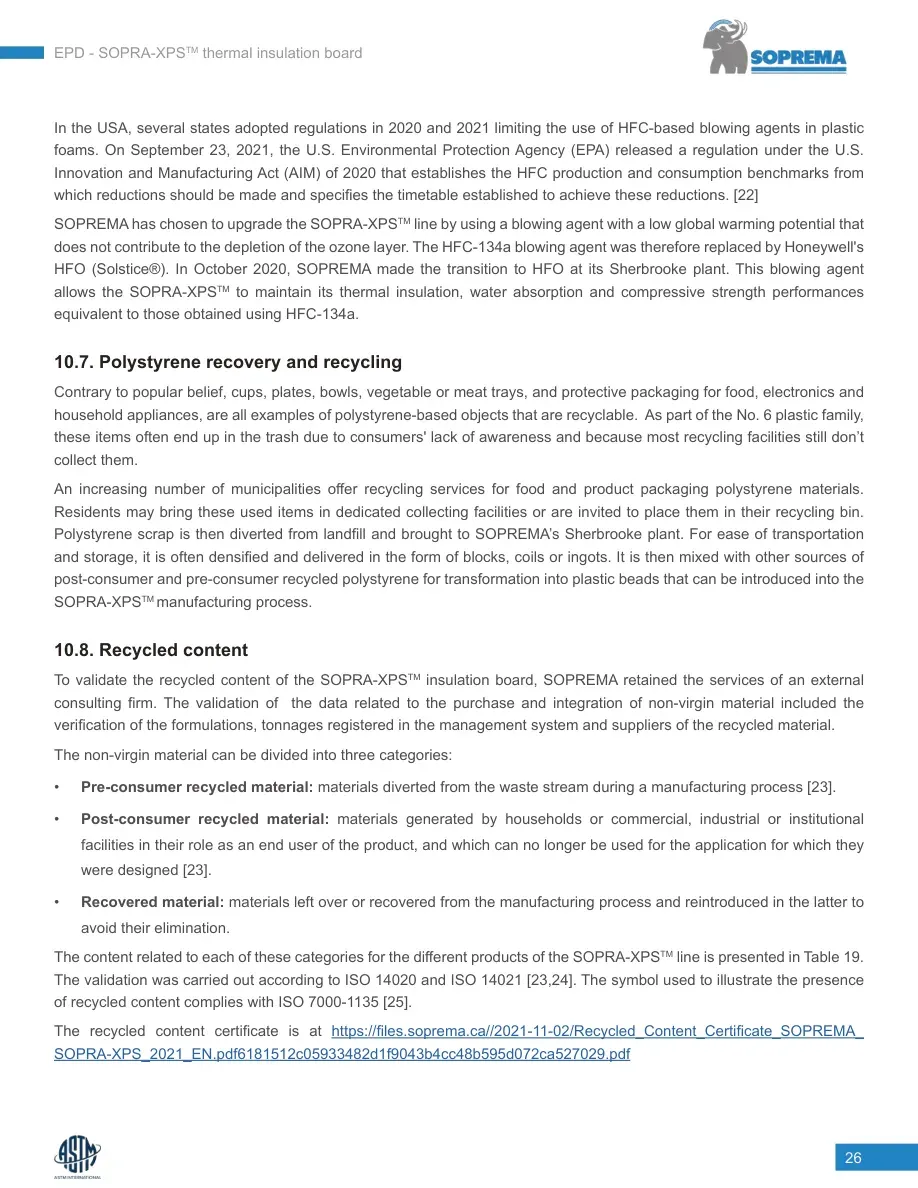
EPD - SOPRA-XPSTM thermal insulation board26In the USA, several states adopted regulations in 2020 and 2021 limiting the use of HFC-based blowing agents in plastic foams. On September 23, 2021, the U.S. Environmental Protection Agency (EPA) released a regulation under the U.S. Innovation and Manufacturing Act (AIM) of 2020 that establishes the HFC production and consumption benchmarks from which reductions should be made and specifies the timetable established to achieve these reductions. [22]SOPREMA has chosen to upgrade the SOPRA-XPSTM line by using a blowing agent with a low global warming potential that does not contribute to the depletion of the ozone layer. The HFC-134a blowing agent was therefore replaced by Honeywell's HFO (Solstice®). In October 2020, SOPREMA made the transition to HFO at its Sherbrooke plant. This blowing agent allows the SOPRA-XPSTM to maintain its thermal insulation, water absorption and compressive strength performances equivalent to those obtained using HFC-134a.10.7. Polystyrene recovery and recyclingContrary to popular belief, cups, plates, bowls, vegetable or meat trays, and protective packaging for food, electronics and household appliances, are all examples of polystyrene-based objects that are recyclable. As part of the No. 6 plastic family, these items often end up in the trash due to consumers' lack of awareness and because most recycling facilities still don’t collect them.An increasing number of municipalities offer recycling services for food and product packaging polystyrene materials. Residents may bring these used items in dedicated collecting facilities or are invited to place them in their recycling bin. Polystyrene scrap is then diverted from landfill and brought to SOPREMA’s Sherbrooke plant. For ease of transportation and storage, it is often densified and delivered in the form of blocks, coils or ingots. It is then mixed with other sources of post-consumer and pre-consumer recycled polystyrene for transformation into plastic beads that can be introduced into the SOPRA-XPSTM manufacturing process.10.8. Recycled contentTo validate the recycled content of the SOPRA-XPSTM insulation board, SOPREMA retained the services of an external consulting firm. The validation of the data related to the purchase and integration of non-virgin material included the verification of the formulations, tonnages registered in the management system and suppliers of the recycled material.The non-virgin material can be divided into three categories:• Pre-consumer recycled material: materials diverted from the waste stream during a manufacturing process [23].• Post-consumer recycled material: materials generated by households or commercial, industrial or institutional facilities in their role as an end user of the product, and which can no longer be used for the application for which they were designed [23].• Recovered material: materials left over or recovered from the manufacturing process and reintroduced in the latter to avoid their elimination.The content related to each of these categories for the different products of the SOPRA-XPSTM line is presented in Table 19. The validation was carried out according to ISO 14020 and ISO 14021 [23,24]. The symbol used to illustrate the presence of recycled content complies with ISO 7000-1135 [25].The recycled content certificate is at https://files.soprema.ca//2021-11-02/Recycled_Content_Certificate_SOPREMA_SOPRA-XPS_2021_EN.pdf6181512c05933482d1f9043b4cc48b595d072ca527029.pdf
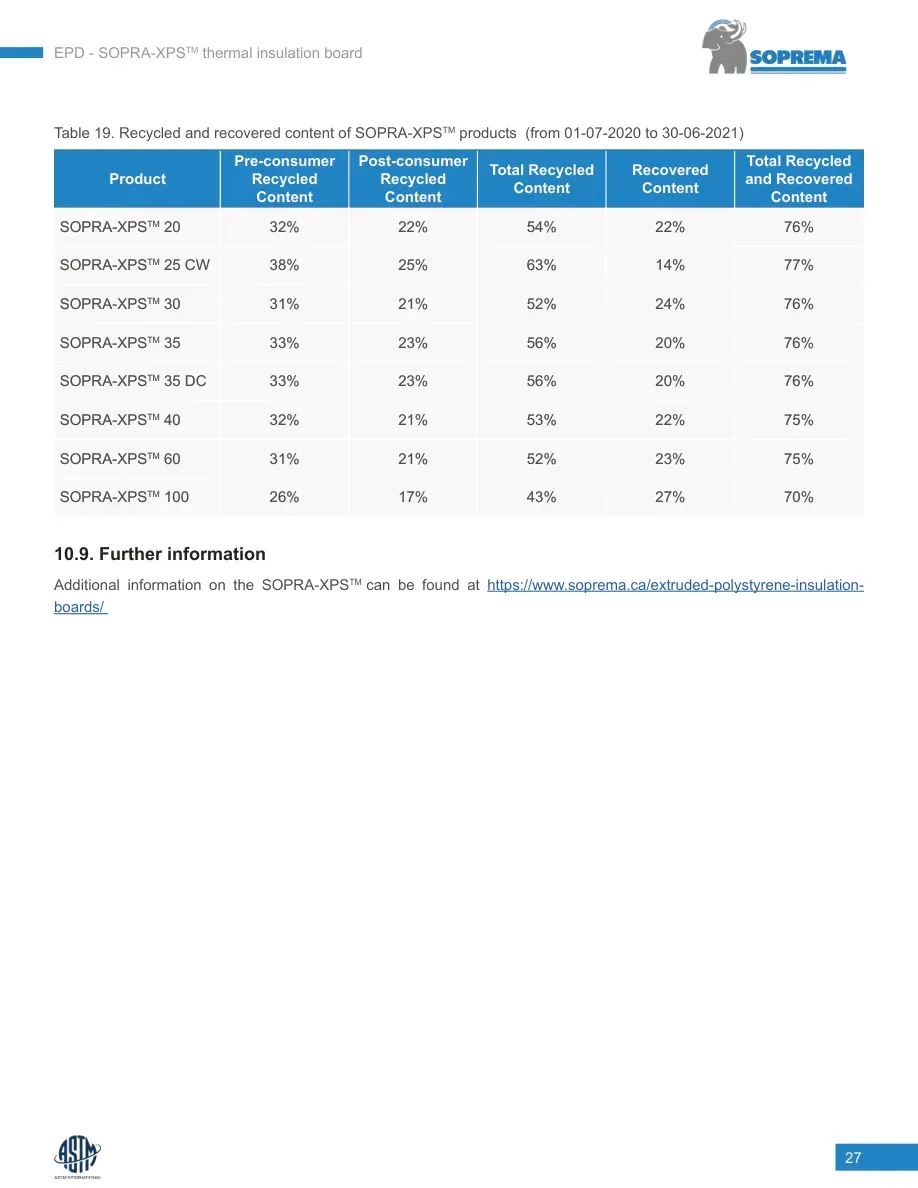
EPD - SOPRA-XPSTM thermal insulation board27Table 19. Recycled and recovered content of SOPRA-XPSTM products (from 01-07-2020 to 30-06-2021)ProductPre-consumer Recycled ContentPost-consumer Recycled ContentTotal Recycled ContentRecovered ContentTotal Recycled and Recovered ContentSOPRA-XPSTM 2032%22%54%22%76%SOPRA-XPSTM 25 CW38%25%63%14%77%SOPRA-XPSTM 3031%21%52%24%76%SOPRA-XPSTM 3533%23%56%20%76%SOPRA-XPSTM 35 DC33%23%56%20%76%SOPRA-XPSTM 4032%21%53%22%75%SOPRA-XPSTM 6031%21%52%23%75%SOPRA-XPSTM 10026%17%43%27%70%10.9. Further informationAdditional information on the SOPRA-XPSTM can be found at https://www.soprema.ca/extruded-polystyrene-insulation-boards/
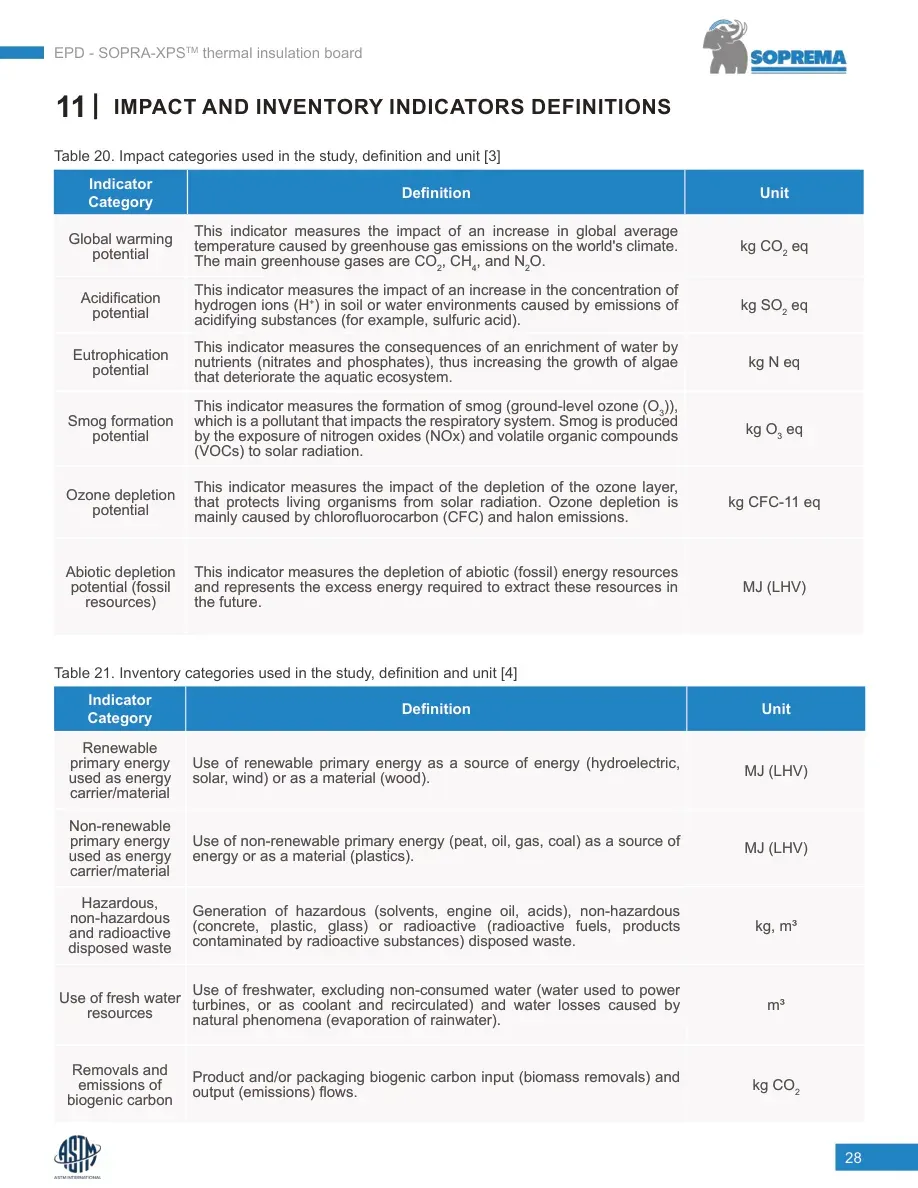
EPD - SOPRA-XPSTM thermal insulation board28Table 20. Impact categories used in the study, definition and unit [3]Indicator CategoryDefinitionUnitGlobal warming potentialThis indicator measures the impact of an increase in global average temperature caused by greenhouse gas emissions on the world's climate. The main greenhouse gases are CO2, CH4, and N2O.kg CO2 eqAcidification potentialThis indicator measures the impact of an increase in the concentration of hydrogen ions (H+) in soil or water environments caused by emissions of acidifying substances (for example, sulfuric acid).kg SO2 eqEutrophication potentialThis indicator measures the consequences of an enrichment of water by nutrients (nitrates and phosphates), thus increasing the growth of algae that deteriorate the aquatic ecosystem.kg N eqSmog formation potentialThis indicator measures the formation of smog (ground-level ozone (O3)), which is a pollutant that impacts the respiratory system. Smog is produced by the exposure of nitrogen oxides (NOx) and volatile organic compounds (VOCs) to solar radiation.kg O3 eqOzone depletion potentialThis indicator measures the impact of the depletion of the ozone layer, that protects living organisms from solar radiation. Ozone depletion is mainly caused by chlorofluorocarbon (CFC) and halon emissions.kg CFC-11 eqAbiotic depletion potential (fossil resources)This indicator measures the depletion of abiotic (fossil) energy resources and represents the excess energy required to extract these resources in the future.MJ (LHV)Table 21. Inventory categories used in the study, definition and unit [4]Indicator CategoryDefinitionUnitRenewable primary energy used as energy carrier/materialUse of renewable primary energy as a source of energy (hydroelectric, solar, wind) or as a material (wood).MJ (LHV)Non-renewable primary energy used as energy carrier/materialUse of non-renewable primary energy (peat, oil, gas, coal) as a source of energy or as a material (plastics). MJ (LHV)Hazardous, non-hazardous and radioactive disposed wasteGeneration of hazardous (solvents, engine oil, acids), non-hazardous (concrete, plastic, glass) or radioactive (radioactive fuels, products contaminated by radioactive substances) disposed waste.kg, m³Use of fresh water resourcesUse of freshwater, excluding non-consumed water (water used to power turbines, or as coolant and recirculated) and water losses caused by natural phenomena (evaporation of rainwater).m³Removals and emissions of biogenic carbonProduct and/or packaging biogenic carbon input (biomass removals) and output (emissions) flows.kg CO2IMPACT AND INVENTORY INDICATORS DEFINITIONS11
EPD - SOPRA-XPSTM thermal insulation board29• CFC - Chlorofluorocarbons• CFC-11 - Trichlorofluoromethane• CH4 - Methane• CO2 - Carbon dioxide• EPD - Environmental product declaration• eq - Equivalent• FU - Functional unit• HFC-134a - 1,1,1,2-Tetrafluoroethane• HFO - HFO-1234ze ((1E)-1,3,3,3-Tetrafluoroprop-1-ene)• LCA - Life cycle assessment• LHV - Lower heating value• N - Nitrogen• NOx - Nitrogen oxides• O3 - Ozone• PCR - Product category rules• SO2 - Sulfur dioxide• VOCs - Volatile organic compoundsACRONYMS AND EMPIRICAL FORMULAS12
EPD - SOPRA-XPSTM thermal insulation board30• Biogenic carbon: carbon derived from biomass produced by living organisms through natural processes, excluding carbon which is fossilized or derived from fossil resources [8].• Blowing agent: substance generating a cell-like structure (foam) from materials that can undergo hardening or phase transition (such as polymers or metals) via a foaming process [26]. • Cut-off criteria: criteria for excluding inputs and outputs based on their contribution (%) to the total mass and energy. If this contribution is lower than a certain threshold (cut-off), these flows can be ignored [8].• Environmental impact: any negative or beneficial modification of the environment, resulting wholly or in part from environmental aspects [28], that is to say elements of the activities, products or services of an organization that can interact with the environment [27].• Environmental product declaration (EPD): environmental declaration providing quantified environmental data using predetermined parameters based on the ISO 14040 and ISO 14044 standards [8].• Functional unit (FU): quantified performance of a product system intended to be used as a reference unit in a life cycle assessment [27].• Life cycle assessment (LCA): compilation and evaluation of the inputs and outputs (inventory), as well as the assessment of potential environmental impacts of a product during its life cycle [27].• Post-consumer recycled material: materials generated by households or commercial, industrial or institutional facilities in their role as an end user of the product, and which can no longer be used for the application for which they were designed. This includes material returns from the distribution chain. [23].• Pre-consumer recycled material: materials diverted from the waste stream during a manufacturing process. It excludes the reuse of materials in the same process that generated them, such as those resulting from reprocessing and regrinding [23].• Product category rules (PCR): set of specific rules, requirements and guidelines for the development of EPDs [8]. The PCR referenced in this EPD refer to "UL PCR Part B: Building Envelope Thermal Insulation EPD requirements" and "UL PCR Part A: Calculation Rules for the Life Cycle Assessment and Requirements on the Project Report." • Recovered material: materials left over or recovered from the manufacturing process and reintroduced in the latter to avoid their elimination.GLOSSARY13
EPD - SOPRA-XPSTM thermal insulation board31[1] GreenDelta (2020). "About openLCA." openLCA version 1.10.3. Available at: https://openlca.org/openlca/[2] Wernet G, Bauer C, Steubing B, Reinhard J, Moreno-Ruiz E, Weidema B (2016). "The ecoinvent database version 3 (part I): overview and methodology." The International Journal of Life Cycle Assessment, vol 21, pages 1218-30. Available at: https://link.springer.com/article/10.1007/s11367-016-1087-8[3] United States Environmental Protection Agency, US EPA (2012). "Tool for Reduction and Assessment of Chemicals and Other Environmental Impacts (TRACI)." TRACI version 2.1. Available at: https://epa.gov/chemical-research/tool-reduction-and-assessment-chemicals-and-other-environmental-impacts-traci[4] UL Environment (2018). "Product Category Rules for Building-Related Products and Services. Part A: Calculation Rules for the Life Cycle Assessment and Requirements on the Project Report (UL 10010), Version 3.1."[5] UL Environment (2018). "Product Category Rules for Building-Related Products and Services. Part B : Building Envelope Thermal Insulation EPD Requirements (UL 10010-1), Version 2.0."[6] International Organization for Standardization, ISO (2006). "ISO 14025:2006. Environmental labels and declarations - Type III environmental declarations - Principles and procedures."[7] International Organization for Standardization, ISO (2006). "ISO 14044:2006. Environmental management - Life cycle assessment - Requirements and guidelines."[8] International Organization for Standardization, ISO (2017). "ISO 21930:2017. Sustainability in buildings and civil engineering works - Core rules for environmental product declarations of construction products and services."[9] European Committee for Standardization (2013). "EN 15804:2012+A1:2013. Sustainability of construction works - Environmental product declarations - Core rules for the product category of construction products."[10] International Organization for Standardization, ISO (2015). "ISO 9001:2015. Quality management systems - Requirements."[11] ASTM International (2021). "ASTM C518-21. Standard Test Method for Steady-State Thermal Transmission Properties by Means of the Heat Flow Meter Apparatus."[12] Wallington T et al. (2015). "Atmospheric chemistry of short-chain haloolefins: Photochemical ozone creation potentials (POCPs), global warming potentials (GWPs), and ozone depletion potentials (ODPs)", Chemosphere vol. 129, pages 135-41. Available at: https://doi.org/10.1016/j.chemosphere.2014.06.092[13] UL Canada, ULC (2017). "CAN/ULC-S701.1:2017. Standard for Thermal Insulation, Polystyrene Boards."[14] ASTM International (2019). "ASTM C578-19. Standard Specification for Rigid, Cellular Polystyrene Thermal Insulation."[15] CT Consultant (2021). "Life Cycle Assessment (LCA) report as part of the completion of the environmental product declaration (EPD) of the SOPRA-XPSTM insulation board."[16] Hischier R et al. (2010). "Implementation of Life Cycle Impact Assessment Methods Data v2.2. ecoinvent Report No 3, Cumulative energy demand", pages 33-40. Available at: https://ecoinvent.org/wp-content/uploads/2020/08/201007_hischier_weidema_implementation_of_lcia_methods.pdfREFERENCES14
EPD - SOPRA-XPSTM thermal insulation board32[17] Flanagan B, Steckel D (2019)."ACLCA Guidance to Calculating Non-LCIA Inventory Metrics in Accordance with ISO 21930:2017." Available at: https://aclca.org/wp-content/uploads/ISO-21930-Final.pdf[18] UL Environment Standard (2013). "UL GREENGUARD Certification Program For Chemical Emissions For Building Materials, Finishes And Furnishings - Standard 2."[19] Environment and Climate Change Canada (2021). "Canadian Environmental Protection Act - Toxic substances list - Schedule 1." Available at: https://www.canada.ca/en/environment-climate-change/services/canadian-environmental-protection-act-registry/substances-list/toxic/schedule-1.html[20] Environment and Climate Change Canada (2016). "Canadian Environmental Protection Act - Ozone-depleting Substances and Halocarbon Alternatives Regulations." Available at: https://laws-lois.justice.gc.ca/eng/regulations/SOR-2016-137/page-1.html[21] Environment and natural resources Canada (2019). "The Montreal Protocol: protecting the ozone layer and tackling climate change." Available at: https://www.canada.ca/en/services/environment/weather/climatechange/canada-international-action/montreal-protocol.html[22] United States Environmental Protection Agency, US EPA (2021). "Phasedown of Hydrofluorocarbons: Establishing the Allowance Allocation and Trading Program Under the American Innovation and Manufacturing Act." Available at: https://www.epa.gov/climate-hfcs-reduction/final-rule-phasedown-hydrofluorocarbons-establishing-allowance-allocation[23] International Organization for Standardization, ISO (2016). "ISO 14021:2016 Environmental labels and declarations - Self-declared environmental claims (Type II environmental labelling)."[24] International Organization for Standardization, ISO (2000). "ISO 14020:2000 Environmental labels and declarations - General principles."[25] International Organization for Standardization, ISO (2004). "ISO 7000-1135 Graphical symbols for use on equipment - Registered symbols."[26] Wypych G (2017). "Handbook of Foaming and Blowing Agents." Available at: https://doi.org/10.1016/B978-1-895198-99-7.50003-9[27] International Organization for Standardization, ISO (2006). "ISO 14040:2006 Environmental management - Life cycle assessment - Principles and framework."[28] International Organization for Standardization, ISO (2010). "ISO 21931-1:2010. Sustainability in building construction - Framework for methods of assessment of the environmental performance of construction works - Part 1: Buildings."
1688 Jean-Berchmans-Michaud StreetDrummondville, QuebecCanada J2C 8E9(819) 478-8163www.soprema.ca
