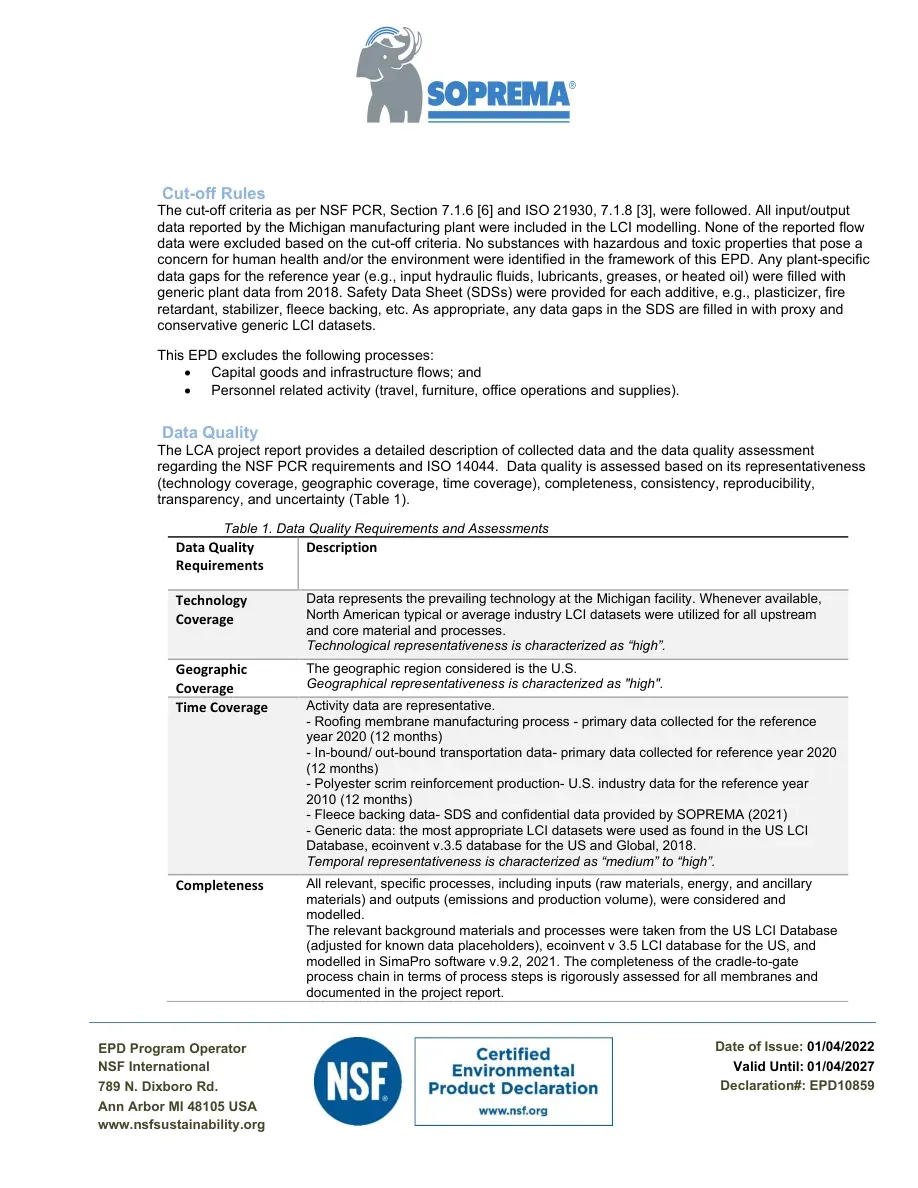
Date of Issue: 01/04/2022 Valid Until: 01/04/2027 Declaration#: EPD10859 EPD Program Operator NSF International 789 N. Dixboro Rd. Ann Arbor MI 48105 USA www.nsfsustainability.org Cut-off Rules The cut-off criteria as per NSF PCR, Section 7.1.6 [6] and ISO 21930, 7.1.8 [3], were followed. All input/output data reported by the Michigan manufacturing plant were included in the LCI modelling. None of the reported flow data were excluded based on the cut-off criteria. No substances with hazardous and toxic properties that pose a concern for human health and/or the environment were identified in the framework of this EPD. Any plant-specific data gaps for the reference year (e.g., input hydraulic fluids, lubricants, greases, or heated oil) were filled with generic plant data from 2018. Safety Data Sheet (SDSs) were provided for each additive, e.g., plasticizer, fire retardant, stabilizer, fleece backing, etc. As appropriate, any data gaps in the SDS are filled in with proxy and conservative generic LCI datasets. This EPD excludes the following processes: • Capital goods and infrastructure flows; and • Personnel related activity (travel, furniture, office operations and supplies). Data Quality The LCA project report provides a detailed description of collected data and the data quality assessment regarding the NSF PCR requirements and ISO 14044. Data quality is assessed based on its representativeness (technology coverage, geographic coverage, time coverage), completeness, consistency, reproducibility, transparency, and uncertainty (Table 1). Table 1. Data Quality Requirements and Assessments Data Quality Requirements Description Technology Coverage Data represents the prevailing technology at the Michigan facility. Whenever available, North American typical or average industry LCI datasets were utilized for all upstream and core material and processes. Technological representativeness is characterized as “high”. Geographic Coverage The geographic region considered is the U.S. Geographical representativeness is characterized as "high". Time Coverage Activity data are representative. - Roofing membrane manufacturing process - primary data collected for the reference year 2020 (12 months) - In-bound/ out-bound transportation data- primary data collected for reference year 2020 (12 months) - Polyester scrim reinforcement production- U.S. industry data for the reference year 2010 (12 months) - Fleece backing data- SDS and confidential data provided by SOPREMA (2021) - Generic data: the most appropriate LCI datasets were used as found in the US LCI Database, ecoinvent v.3.5 database for the US and Global, 2018. Temporal representativeness is characterized as “medium” to “high”. Completeness All relevant, specific processes, including inputs (raw materials, energy, and ancillary materials) and outputs (emissions and production volume), were considered and modelled. The relevant background materials and processes were taken from the US LCI Database (adjusted for known data placeholders), ecoinvent v 3.5 LCI database for the US, and modelled in SimaPro software v.9.2, 2021. The completeness of the cradle-to-gate process chain in terms of process steps is rigorously assessed for all membranes and documented in the project report.
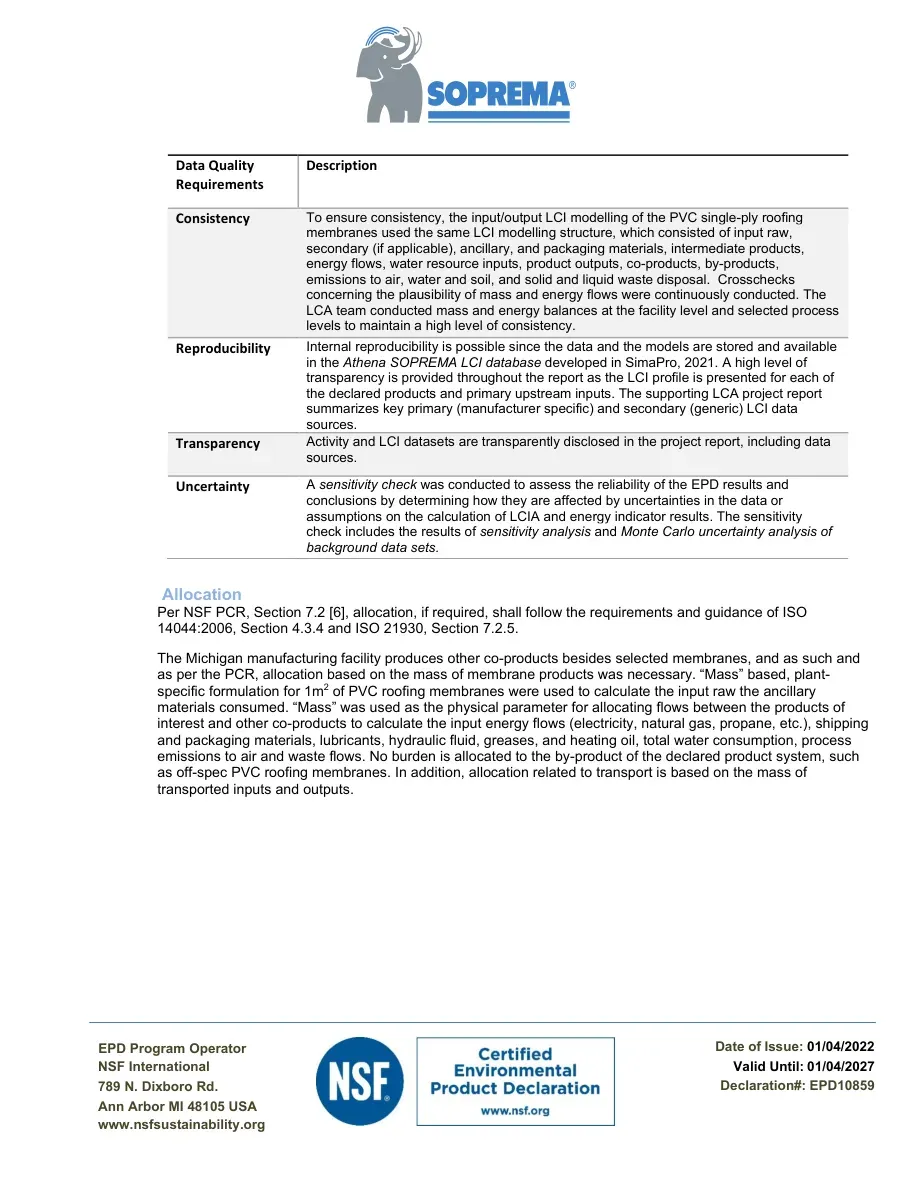
Date of Issue: 01/04/2022 Valid Until: 01/04/2027 Declaration#: EPD10859 EPD Program Operator NSF International 789 N. Dixboro Rd. Ann Arbor MI 48105 USA www.nsfsustainability.org Data Quality Requirements Description Consistency To ensure consistency, the input/output LCI modelling of the PVC single-ply roofing membranes used the same LCI modelling structure, which consisted of input raw, secondary (if applicable), ancillary, and packaging materials, intermediate products, energy flows, water resource inputs, product outputs, co-products, by-products, emissions to air, water and soil, and solid and liquid waste disposal. Crosschecks concerning the plausibility of mass and energy flows were continuously conducted. The LCA team conducted mass and energy balances at the facility level and selected process levels to maintain a high level of consistency. Reproducibility Internal reproducibility is possible since the data and the models are stored and available in the Athena SOPREMA LCI database developed in SimaPro, 2021. A high level of transparency is provided throughout the report as the LCI profile is presented for each of the declared products and primary upstream inputs. The supporting LCA project report summarizes key primary (manufacturer specific) and secondary (generic) LCI data sources. Transparency Activity and LCI datasets are transparently disclosed in the project report, including data sources. Uncertainty A sensitivity check was conducted to assess the reliability of the EPD results and conclusions by determining how they are affected by uncertainties in the data or assumptions on the calculation of LCIA and energy indicator results. The sensitivity check includes the results of sensitivity analysis and Monte Carlo uncertainty analysis of background data sets. Allocation Per NSF PCR, Section 7.2 [6], allocation, if required, shall follow the requirements and guidance of ISO 14044:2006, Section 4.3.4 and ISO 21930, Section 7.2.5. The Michigan manufacturing facility produces other co-products besides selected membranes, and as such and as per the PCR, allocation based on the mass of membrane products was necessary. “Mass” based, plant-specific formulation for 1m2 of PVC roofing membranes were used to calculate the input raw the ancillary materials consumed. “Mass” was used as the physical parameter for allocating flows between the products of interest and other co-products to calculate the input energy flows (electricity, natural gas, propane, etc.), shipping and packaging materials, lubricants, hydraulic fluid, greases, and heating oil, total water consumption, process emissions to air and waste flows. No burden is allocated to the by-product of the declared product system, such as off-spec PVC roofing membranes. In addition, allocation related to transport is based on the mass of transported inputs and outputs.
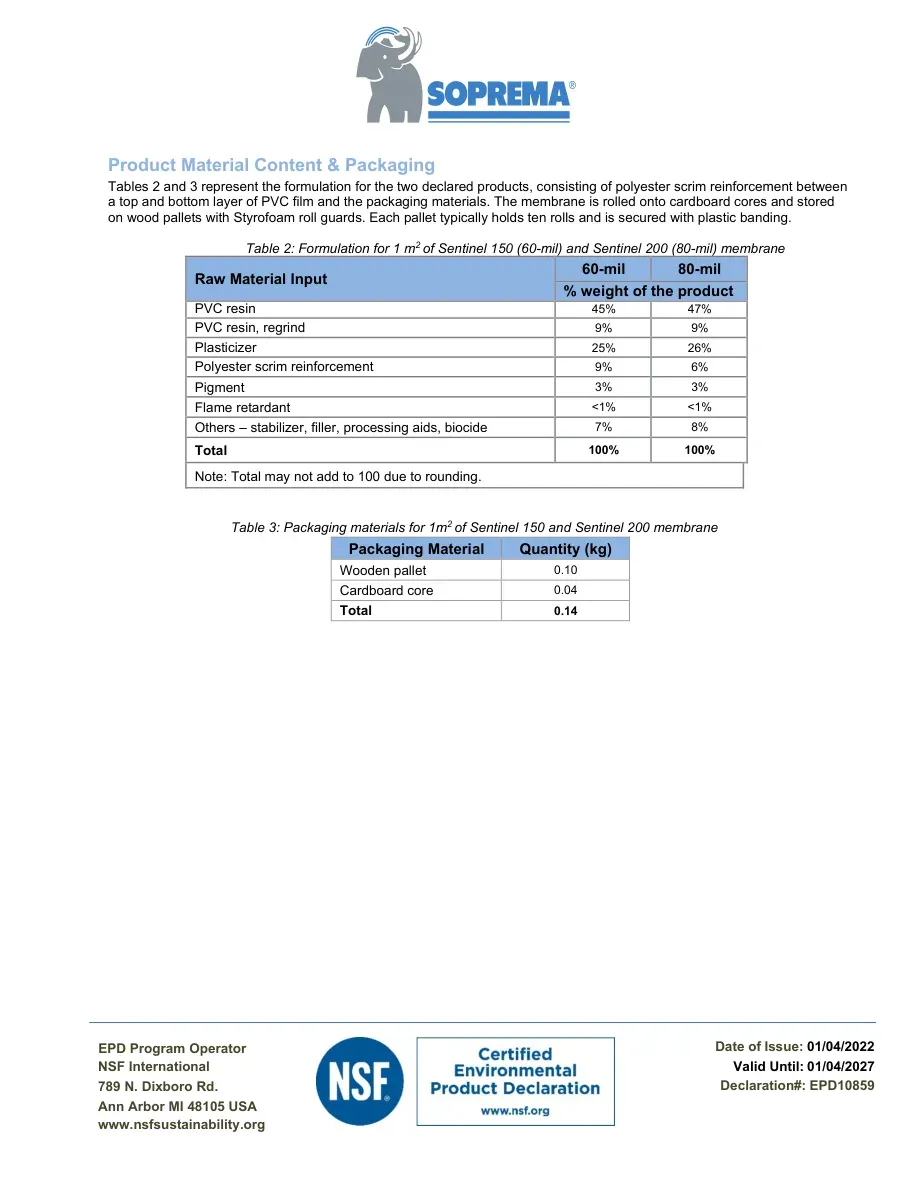
Date of Issue: 01/04/2022 Valid Until: 01/04/2027 Declaration#: EPD10859 EPD Program Operator NSF International 789 N. Dixboro Rd. Ann Arbor MI 48105 USA www.nsfsustainability.org Product Material Content & Packaging Tables 2 and 3 represent the formulation for the two declared products, consisting of polyester scrim reinforcement between a top and bottom layer of PVC film and the packaging materials. The membrane is rolled onto cardboard cores and stored on wood pallets with Styrofoam roll guards. Each pallet typically holds ten rolls and is secured with plastic banding. Table 2: Formulation for 1 m2 of Sentinel 150 (60-mil) and Sentinel 200 (80-mil) membrane Raw Material Input 60-mil 80-mil % weight of the product PVC resin 45% 47% PVC resin, regrind 9% 9% Plasticizer 25% 26% Polyester scrim reinforcement 9% 6% Pigment 3% 3% Flame retardant <1% <1% Others – stabilizer, filler, processing aids, biocide 7% 8% Total 100% 100% Note: Total may not add to 100 due to rounding. Table 3: Packaging materials for 1m2 of Sentinel 150 and Sentinel 200 membrane Packaging Material Quantity (kg) Wooden pallet 0.10 Cardboard core 0.04 Total 0.14
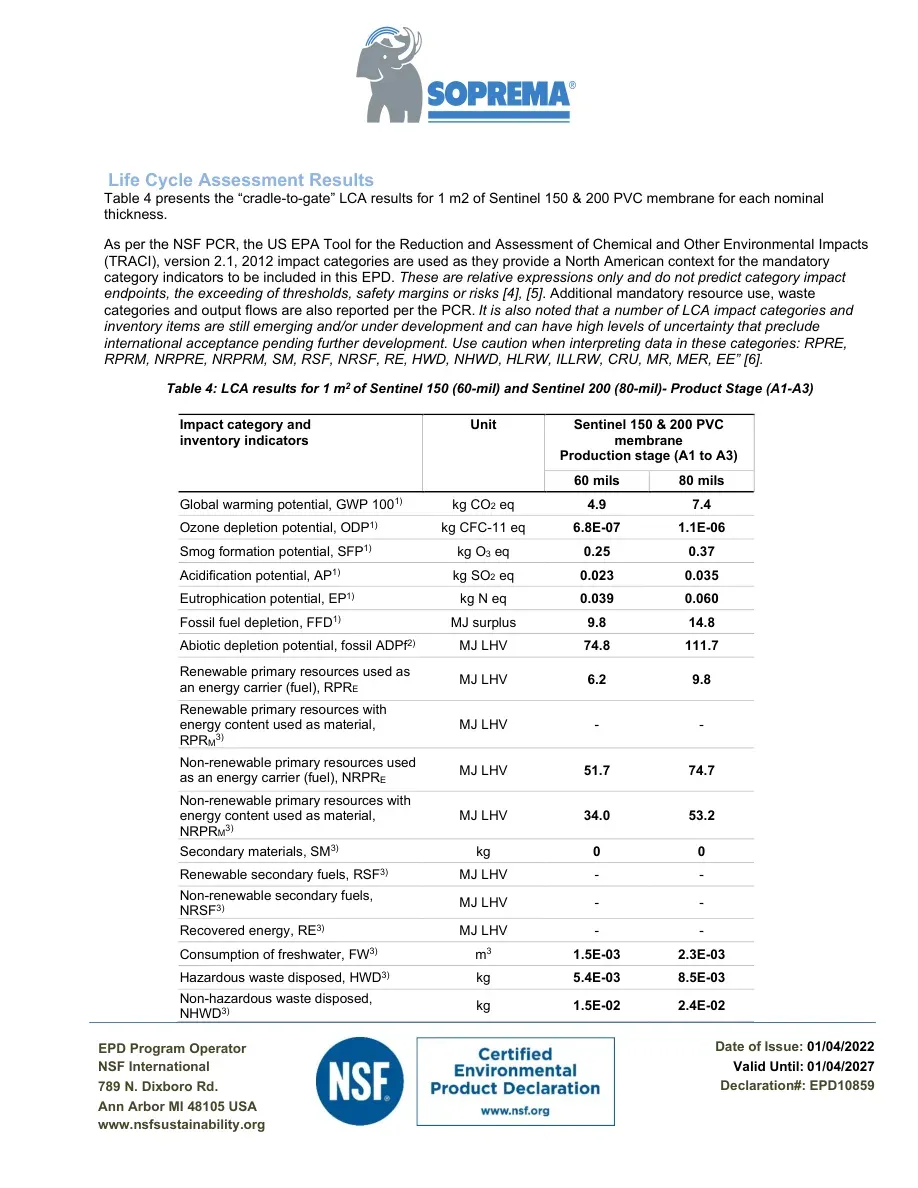
Date of Issue: 01/04/2022 Valid Until: 01/04/2027 Declaration#: EPD10859 EPD Program Operator NSF International 789 N. Dixboro Rd. Ann Arbor MI 48105 USA www.nsfsustainability.org Life Cycle Assessment Results Table 4 presents the “cradle-to-gate” LCA results for 1 m2 of Sentinel 150 & 200 PVC membrane for each nominal thickness. As per the NSF PCR, the US EPA Tool for the Reduction and Assessment of Chemical and Other Environmental Impacts (TRACI), version 2.1, 2012 impact categories are used as they provide a North American context for the mandatory category indicators to be included in this EPD. These are relative expressions only and do not predict category impact endpoints, the exceeding of thresholds, safety margins or risks [4], [5]. Additional mandatory resource use, waste categories and output flows are also reported per the PCR. It is also noted that a number of LCA impact categories and inventory items are still emerging and/or under development and can have high levels of uncertainty that preclude international acceptance pending further development. Use caution when interpreting data in these categories: RPRE, RPRM, NRPRE, NRPRM, SM, RSF, NRSF, RE, HWD, NHWD, HLRW, ILLRW, CRU, MR, MER, EE” [6]. Table 4: LCA results for 1 m2 of Sentinel 150 (60-mil) and Sentinel 200 (80-mil)- Product Stage (A1-A3) Impact category and inventory indicators Unit Sentinel 150 & 200 PVC membrane Production stage (A1 to A3) 60 mils 80 mils Global warming potential, GWP 1001) kg CO2 eq 4.9 7.4 Ozone depletion potential, ODP1) kg CFC-11 eq 6.8E-07 1.1E-06 Smog formation potential, SFP1) kg O3 eq 0.25 0.37 Acidification potential, AP1) kg SO2 eq 0.023 0.035 Eutrophication potential, EP1) kg N eq 0.039 0.060 Fossil fuel depletion, FFD1) MJ surplus 9.8 14.8 Abiotic depletion potential, fossil ADPf2) MJ LHV 74.8 111.7 Renewable primary resources used as an energy carrier (fuel), RPRE MJ LHV 6.2 9.8 Renewable primary resources with energy content used as material, RPRM3) MJ LHV - - Non-renewable primary resources used as an energy carrier (fuel), NRPRE MJ LHV 51.7 74.7 Non-renewable primary resources with energy content used as material, NRPRM3) MJ LHV 34.0 53.2 Secondary materials, SM3) kg 0 0 Renewable secondary fuels, RSF3) MJ LHV - - Non-renewable secondary fuels, NRSF3) MJ LHV - - Recovered energy, RE3) MJ LHV - - Consumption of freshwater, FW3) m3 1.5E-03 2.3E-03 Hazardous waste disposed, HWD3) kg 5.4E-03 8.5E-03 Non-hazardous waste disposed, NHWD3) kg 1.5E-02 2.4E-02
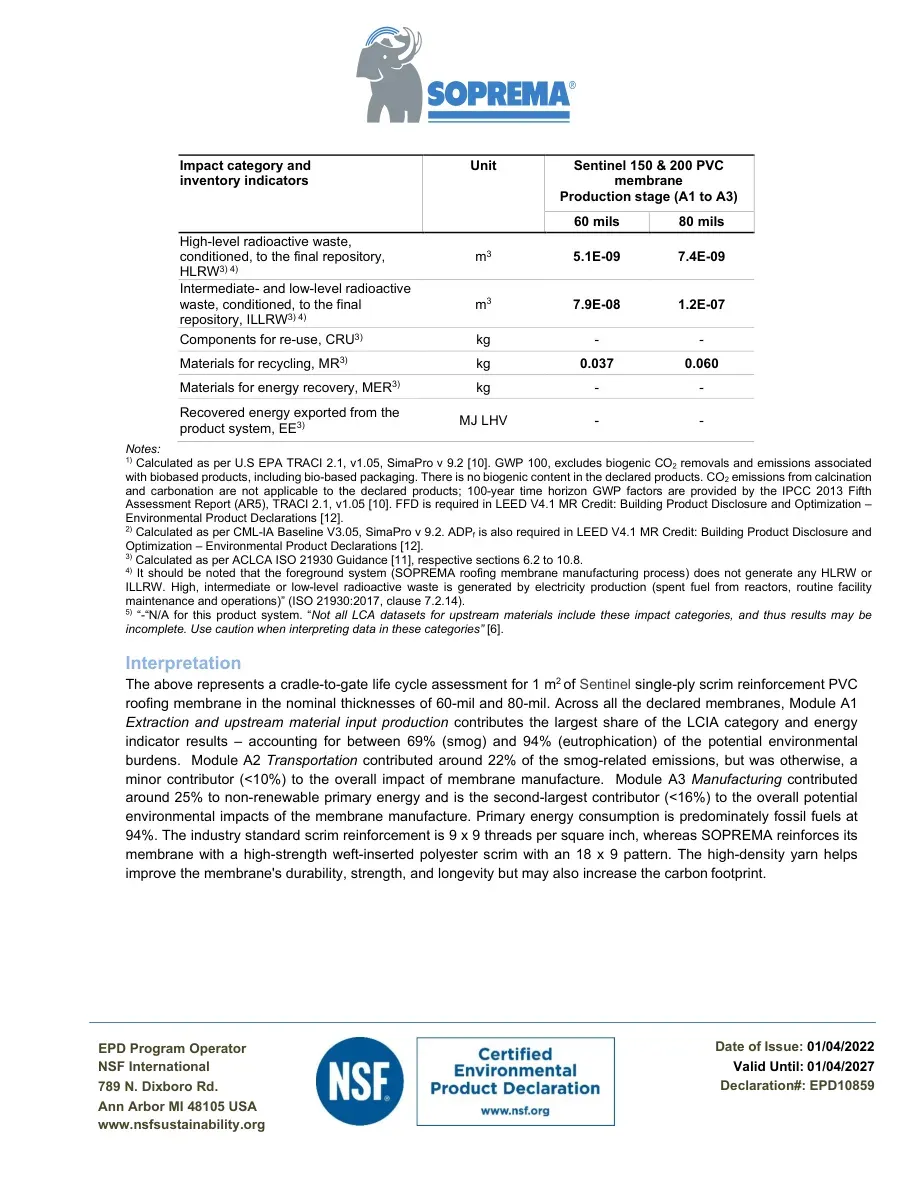
Date of Issue: 01/04/2022 Valid Until: 01/04/2027 Declaration#: EPD10859 EPD Program Operator NSF International 789 N. Dixboro Rd. Ann Arbor MI 48105 USA www.nsfsustainability.org Impact category and inventory indicators Unit Sentinel 150 & 200 PVC membrane Production stage (A1 to A3) 60 mils 80 mils High-level radioactive waste, conditioned, to the final repository, HLRW3) 4) m3 5.1E-09 7.4E-09 Intermediate- and low-level radioactive waste, conditioned, to the final repository, ILLRW3) 4) m3 7.9E-08 1.2E-07 Components for re-use, CRU3) kg - - Materials for recycling, MR3) kg 0.037 0.060 Materials for energy recovery, MER3) kg - - Recovered energy exported from the product system, EE3) MJ LHV - - Notes: 1) Calculated as per U.S EPA TRACI 2.1, v1.05, SimaPro v 9.2 [10]. GWP 100, excludes biogenic CO2 removals and emissions associated with biobased products, including bio-based packaging. There is no biogenic content in the declared products. CO2 emissions from calcination and carbonation are not applicable to the declared products; 100-year time horizon GWP factors are provided by the IPCC 2013 Fifth Assessment Report (AR5), TRACI 2.1, v1.05 [10]. FFD is required in LEED V4.1 MR Credit: Building Product Disclosure and Optimization – Environmental Product Declarations [12]. 2) Calculated as per CML-IA Baseline V3.05, SimaPro v 9.2. ADPf is also required in LEED V4.1 MR Credit: Building Product Disclosure and Optimization – Environmental Product Declarations [12]. 3) Calculated as per ACLCA ISO 21930 Guidance [11], respective sections 6.2 to 10.8. 4) It should be noted that the foreground system (SOPREMA roofing membrane manufacturing process) does not generate any HLRW or ILLRW. High, intermediate or low-level radioactive waste is generated by electricity production (spent fuel from reactors, routine facility maintenance and operations)” (ISO 21930:2017, clause 7.2.14). 5) “-“N/A for this product system. “Not all LCA datasets for upstream materials include these impact categories, and thus results may be incomplete. Use caution when interpreting data in these categories” [6]. Interpretation The above represents a cradle-to-gate life cycle assessment for 1 m2 of Sentinel single-ply scrim reinforcement PVC roofing membrane in the nominal thicknesses of 60-mil and 80-mil. Across all the declared membranes, Module A1 Extraction and upstream material input production contributes the largest share of the LCIA category and energy indicator results – accounting for between 69% (smog) and 94% (eutrophication) of the potential environmental burdens. Module A2 Transportation contributed around 22% of the smog-related emissions, but was otherwise, a minor contributor (<10%) to the overall impact of membrane manufacture. Module A3 Manufacturing contributed around 25% to non-renewable primary energy and is the second-largest contributor (<16%) to the overall potential environmental impacts of the membrane manufacture. Primary energy consumption is predominately fossil fuels at 94%. The industry standard scrim reinforcement is 9 x 9 threads per square inch, whereas SOPREMA reinforces its membrane with a high-strength weft-inserted polyester scrim with an 18 x 9 pattern. The high-density yarn helps improve the membrane's durability, strength, and longevity but may also increase the carbon footprint.
Date of Issue: 01/04/2022 Valid Until: 01/04/2027 Declaration#: EPD10859 EPD Program Operator NSF International 789 N. Dixboro Rd. Ann Arbor MI 48105 USA www.nsfsustainability.org Additional Environmental Information • The white and tan Sentinel membrane complies with efficiency programs requiring the use of a highly reflective roof like California Title 24, U.S. Green Building Council’s (USBGC) Leadership in Energy and Environmental Design (LEED) rating system, the International Green Construction Code (IgCC), IECC, and Green Building Institute’s Green Globes. It is also an ENERGY STAR® qualified product. • Sentinel membrane contains a maximum amount of around 10% secondary material. • The membrane is up to 100% recyclable. Post-industrial scrap from the manufacturing process is recycled into the new membrane, walk-way pads, concrete expansion joints and resilient flooring. • Sentinel white reflective roofs, when designed and installed properly, can help increase energy efficiency, especially the building’s peak energy demand. • Cool Roof Rating Council Product ID: 0610-0008. o Solar Reflective Index (initial value): 108 (White) and 88 (Tan). Declaration Type This “Cradle-to-gate” EPD applies to the Sentinel PVC roofing membranes (all colours) 60 and 80 mils nominal thicknesses. Production activities covered include the extraction and upstream production, transport to factory and manufacturing (modules A1 to A3). The declaration is intended for Business-to-Business (B-to-B) communication. This Sentinel PVC roofing membrane EPD falls under the description: - A product-specific EPD from a manufacturer’s plant. EPD Comparability Limitation Statement • Only EPDs prepared from cradle-to-grave life cycle results and based on the same function, RSL, quantified by the same functional unit, and meeting all the conditions for comparability listed in ISO 14025:2006 and ISO 21930:2017 can be used to make comparison between products. • Declarations based on the NSF Product category rules are not comparative assertions; that is, no claim of environmental superiority may be inferred or implied.
Date of Issue: 01/04/2022 Valid Until: 01/04/2027 Declaration#: EPD10859 EPD Program Operator NSF International 789 N. Dixboro Rd. Ann Arbor MI 48105 USA www.nsfsustainability.org References 1. ASTM D4434/ D4434M – 15 Standard Specification for Poly(Vinyl Chloride) Sheet Roofing. 2. ANSI NSF 347 Sustainability Assessment for Single Ply Roofing Membranes. 3. ISO 21930:2017 Sustainability in buildings and civil engineering works - Core rules for environmental product declarations of construction products and services. 4. ISO 14040:2006/Amd 1:2020 Environmental management - Life cycle assessment - Principles and framework. 5. ISO 14044:2006/Amd1:2017/Amd2:2020 Environmental management - Life cycle assessment - Requirements and guidelines. 6. NSF International, Product Category Rule Environmental Product Declarations, PCR for Single Ply Roofing Membrane, October 2019. https://www.spri.org/wpfb-file/pcr-single-ply-roofing-membrane-2019-pdf/, accessed 10-2021. 7. NSF Program Operator Rules. February 2015. https://www.nsf.org/newsroom_pdf/NSF_Program_Operator_Instructions-news.pdf, accessed 10-2021. 8. ISO 14025:2006 Environmental labeling and declarations - Type III environmental declarations - Principles and procedures. 9. ISO 14021:2016 Environmental labels and declarations -- Self-declared environmental claims (Type II environmental labelling). 10. PRé 2019.SimaPro LCA Software v9.2, 2021. https://simapro.com/, accessed 10-2021. 11. ACLCA 2019, Guidance to Calculating Non-LCIA Inventory Metrics in Accordance with ISO 21930:2017. The American Centre for Life Cycle Assessment. May 2019. https://aclca.org/aclca-iso-21930-guidance/, accessed 10-2021. 12. LEED v4.1 July 2019, Building Design and Construction Guide (BD+C), Getting started guide for beta participant, MR Credit: Building Product Disclosure and Optimization – Environmental Product Declarations, Option 2 Multi-attribute optimization (1 point), pg.170. https://leeduser.buildinggreen.com/credit/NC-v4.1/MRc2#tab-credit-language, accessed 10-2021. 13. Athena Sustainable Materials Institute, A Cradle-to-Gate Life Cycle Assessment of Private Label Manufacturer’s Single-Ply PVC Roofing Membranes, December 2021. (Revised May 2023)
