FLAGON® TPOEnvironmental Product Declaration in accordance with ISO 14025ENVIRONMENTALPRODUCTDECLARATIONUN CPC CODE:369REGISTRATION NUMBEREnvirondec: S-P-01603ECO Platform: 00000974REGISTRATION DATE22/07/2019REVISION DATE08/08/2019 (V. 5)REFERENCE YEAR2017VALID UNTIL04/07/2024
ENVIRONMENTAL PRODUCT DECLARATION | FLAGON® TPO2GENERALINFORMATIONCONTACTS EPD OWNERSoprema s.r.l.,Via industrale dell’Isola 3, 24040 Chignolo d’Isola (BG), ItalyPROGRAMME OPERATORThe International EPD® System, Valhallavägen 81, 114 27 Stockholm, SwedenREFERENCE DOCUMENTStandard EN 15804:2012+A1:2013PRODUCT CATEGORY RULES (PRCs)• PCR 2012:01 v 2.3FUNCTIONAL UNITThe functional unit is 1 m² of installed membrane (namely 1 m2 produced multiplied by the membrane installation overlapping factor 1.12 (mechanically-fixed), 1.08 (fully-adhered and loose-laid)) for all waterproofing systems with flexible sheets for roofing, divided by the reference building service lifetime (90 years).For additional information relative to the activities of the Soprema s.r.l. or in regards to this environmental declaration, please contact: Roberto Baronio – rbaronio@soprema.itTECHNICAL SUPPORT by Life Cycle Engineering (www.lcengineering.eu)
FLAGON® TPO | ENVIRONMENTAL PRODUCT DECLARATION3REFERENCES VERIFICATION G.L. Baldo, M. Marino, S. Rossi; “Analisi del ciclo di vita LCA – Nuova edizione aggiornata”; Edizioni Ambiente; 2008General Programme Instructions for the International EPD® System v. 2.5, 2015Product Category Rules PCR 2012:01 v 2.3 “Construction products and construction services”PCR 2014:12 v 1.0 “Flexible sheets for waterproofing - bitumen , plastic or rubber sheets for roof waterproofing”Product Category Rules PCR 2007:08 v 3.1 “Electricity, steam and hot/cold water generation and distribution”EN15804:2012 + A1:2013ISO 14040:2006ISO 14044:2017ISO 14025:2010Independent verification of the declaration and data, according to ISO 14025:2006EPD process certification for EPD verification Third party verifier: ICMQAccredited or approved by: ACCREDIA. For individual verifiers: “The International EPD® System” EPDs within the same product category but from different programmes may not be comparableEPD of construction products may not be comparable if they do not comply with EN 15804
ENVIRONMENTAL PRODUCT DECLARATION | FLAGON® TPO4THECOMPANYSoprema is an independent group established in 1908 and now present in 90 countries worldwide. Thanks to its 59 pro-duction plants, Soprema successfully satisfies the construc-tion sector needs, providing a wide range of waterproofing and insulation products. At present, Soprema is waterproofing membranes world leader. Soprema is present in Italy since 2007. Here, under the brand of FLAG, it produces synthetic waterproofing membranes in PVC or TPO. Such products are ready to be employed in most residential and domestic sectors: roofing, underground and hy-draulic works, both for internal and external purposes.Since the beginnings in 1963, FLAG had a central role in the waterproofing membranes sector, becoming over the years a key player in the European market. Being part of Soprema Group allowed FLAG to penetrate the worldwide market. On the basis of the end-use applications, many different wa-terproofing membranes typologies are available. Firstly, those products can be divided as reinforced and homogeneous membranes. The former, reinforced either with glass wool or polyester fleeces, is chiefly employed for industrial or domestic roofing. The latter instead are mainly used for hydraulic works and civil engineering.Secondly, membranes can be either PVC- or TPO-based, with the former being the standard material for synthetic membranes and the latter (namely Thermoplastic PolyOlefins) being introduced only since late ‘90s. In both cases, over the years Soprema achieved the experience to ensure the high standards of quality and laying time requested by modern constructions and works. Recently, FLAG changed name Soprema s.r.l.
FLAGON® TPO | ENVIRONMENTAL PRODUCT DECLARATION5
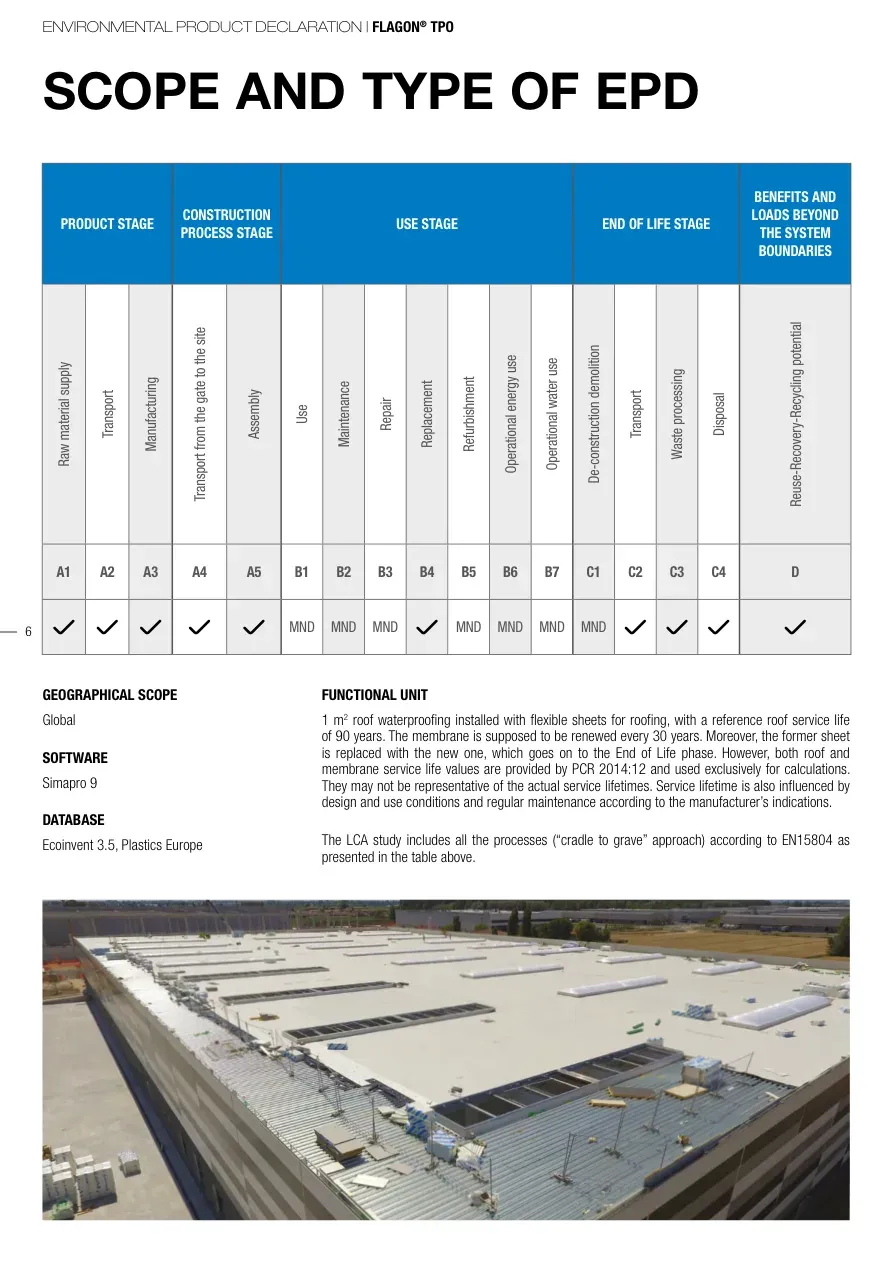
ENVIRONMENTAL PRODUCT DECLARATION | FLAGON® TPO6SCOPE AND TYPE OF EPDPRODUCT STAGECONSTRUCTION PROCESS STAGEUSE STAGEEND OF LIFE STAGEBENEFITS AND LOADS BEYOND THE SYSTEM BOUNDARIESRaw material supplyTransportManufacturingTransport from the gate to the siteAssemblyUseMaintenanceRepairReplacementRefurbishmentOperational energy useOperational water useDe-construction demolitionTransportWaste processingDisposalReuse-Recovery-Recycling potentialA1A2A3A4A5B1B2B3B4B5B6B7C1C2C3C4DMNDMNDMNDMNDMNDMNDMNDGEOGRAPHICAL SCOPEGlobalSOFTWARESimapro 9DATABASEEcoinvent 3.5, Plastics EuropeFUNCTIONAL UNIT1 m2 roof waterproofing installed with flexible sheets for roofing, with a reference roof service life of 90 years. The membrane is supposed to be renewed every 30 years. Moreover, the former sheet is replaced with the new one, which goes on to the End of Life phase. However, both roof and membrane service life values are provided by PCR 2014:12 and used exclusively for calculations. They may not be representative of the actual service lifetimes. Service lifetime is also influenced by design and use conditions and regular maintenance according to the manufacturer’s indications.The LCA study includes all the processes (“cradle to grave” approach) according to EN15804 as presented in the table above.
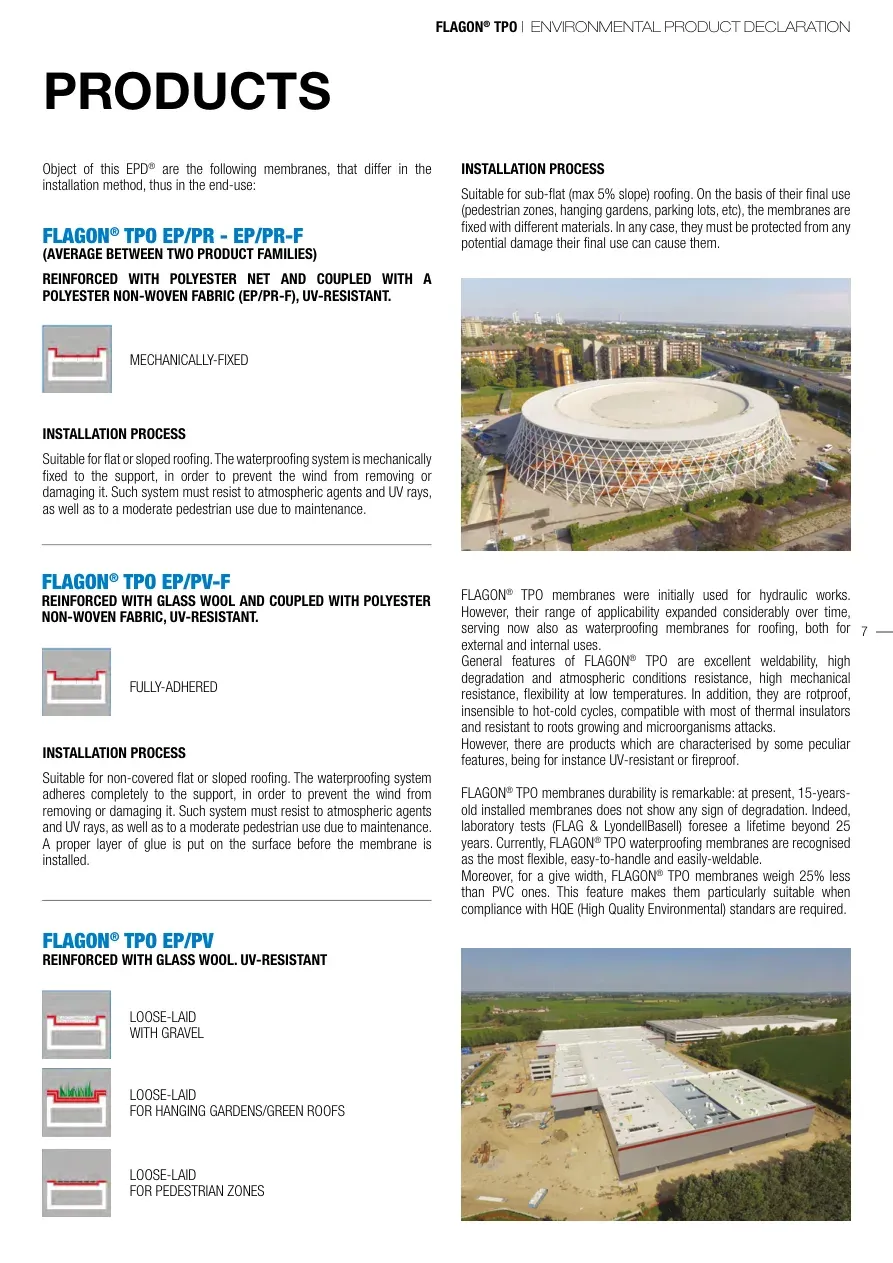
FLAGON® TPO | ENVIRONMENTAL PRODUCT DECLARATION7PRODUCTSMECHANICALLY-FIXEDFULLY-ADHEREDLOOSE-LAID WITH GRAVELLOOSE-LAIDFOR HANGING GARDENS/GREEN ROOFSLOOSE-LAID FOR PEDESTRIAN ZONESFLAGON® TPO membranes were initially used for hydraulic works. However, their range of applicability expanded considerably over time, serving now also as waterproofing membranes for roofing, both for external and internal uses.General features of FLAGON® TPO are excellent weldability, high degradation and atmospheric conditions resistance, high mechanical resistance, flexibility at low temperatures. In addition, they are rotproof, insensible to hot-cold cycles, compatible with most of thermal insulators and resistant to roots growing and microorganisms attacks. However, there are products which are characterised by some peculiar features, being for instance UV-resistant or fireproof.FLAGON® TPO membranes durability is remarkable: at present, 15-years-old installed membranes does not show any sign of degradation. Indeed, laboratory tests (FLAG & LyondellBasell) foresee a lifetime beyond 25 years. Currently, FLAGON® TPO waterproofing membranes are recognised as the most flexible, easy-to-handle and easily-weldable. Moreover, for a give width, FLAGON® TPO membranes weigh 25% less than PVC ones. This feature makes them particularly suitable when compliance with HQE (High Quality Environmental) standars are required.FLAGON® TPO EP/PV REINFORCED WITH GLASS WOOL. UV-RESISTANTFLAGON® TPO EP/PV-F REINFORCED WITH GLASS WOOL AND COUPLED WITH POLYESTER NON-WOVEN FABRIC, UV-RESISTANT.INSTALLATION PROCESSSuitable for flat or sloped roofing. The waterproofing system is mechanically fixed to the support, in order to prevent the wind from removing or damaging it. Such system must resist to atmospheric agents and UV rays, as well as to a moderate pedestrian use due to maintenance.INSTALLATION PROCESSSuitable for non-covered flat or sloped roofing. The waterproofing system adheres completely to the support, in order to prevent the wind from removing or damaging it. Such system must resist to atmospheric agents and UV rays, as well as to a moderate pedestrian use due to maintenance. A proper layer of glue is put on the surface before the membrane is installed.INSTALLATION PROCESSSuitable for sub-flat (max 5% slope) roofing. On the basis of their final use (pedestrian zones, hanging gardens, parking lots, etc), the membranes are fixed with different materials. In any case, they must be protected from any potential damage their final use can cause them.Object of this EPD® are the following membranes, that differ in the installation method, thus in the end-use:FLAGON® TPO EP/PR - EP/PR-F (AVERAGE BETWEEN TWO PRODUCT FAMILIES)REINFORCED WITH POLYESTER NET AND COUPLED WITH A POLYESTER NON-WOVEN FABRIC (EP/PR-F), UV-RESISTANT.
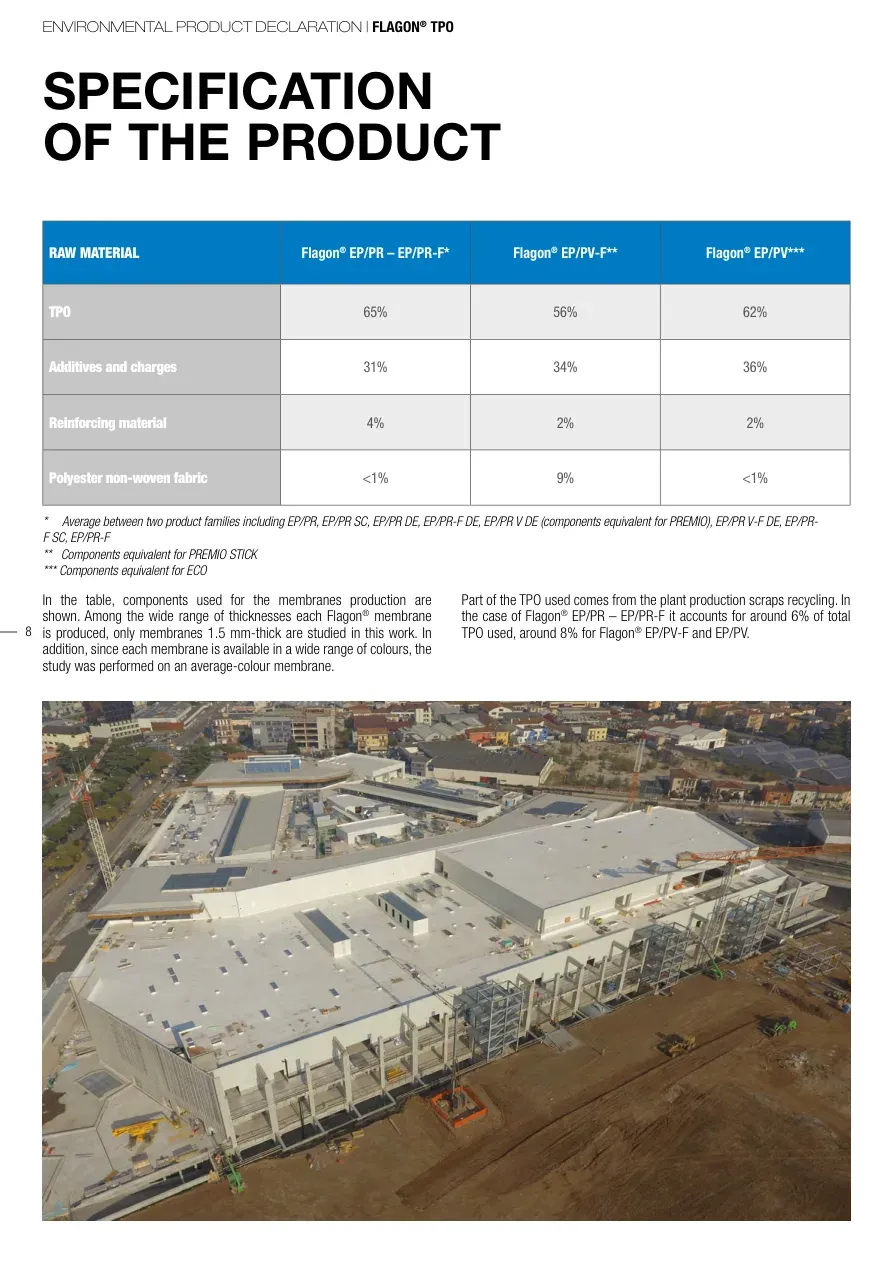
ENVIRONMENTAL PRODUCT DECLARATION | FLAGON® TPO8Part of the TPO used comes from the plant production scraps recycling. In the case of Flagon® EP/PR – EP/PR-F it accounts for around 6% of total TPO used, around 8% for Flagon® EP/PV-F and EP/PV.SPECIFICATIONOF THE PRODUCTRAW MATERIALFlagon® EP/PR – EP/PR-F*Flagon® EP/PV-F**Flagon® EP/PV***TPO65%56%62%Additives and charges31%34%36%Reinforcing material4%2%2%Polyester non-woven fabric<1%9%<1%* Average between two product families including EP/PR, EP/PR SC, EP/PR DE, EP/PR-F DE, EP/PR V DE (components equivalent for PREMIO), EP/PR V-F DE, EP/PR-F SC, EP/PR-F ** Components equivalent for PREMIO STICK*** Components equivalent for ECOIn the table, components used for the membranes production are shown. Among the wide range of thicknesses each Flagon® membrane is produced, only membranes 1.5 mm-thick are studied in this work. In addition, since each membrane is available in a wide range of colours, the study was performed on an average-colour membrane.
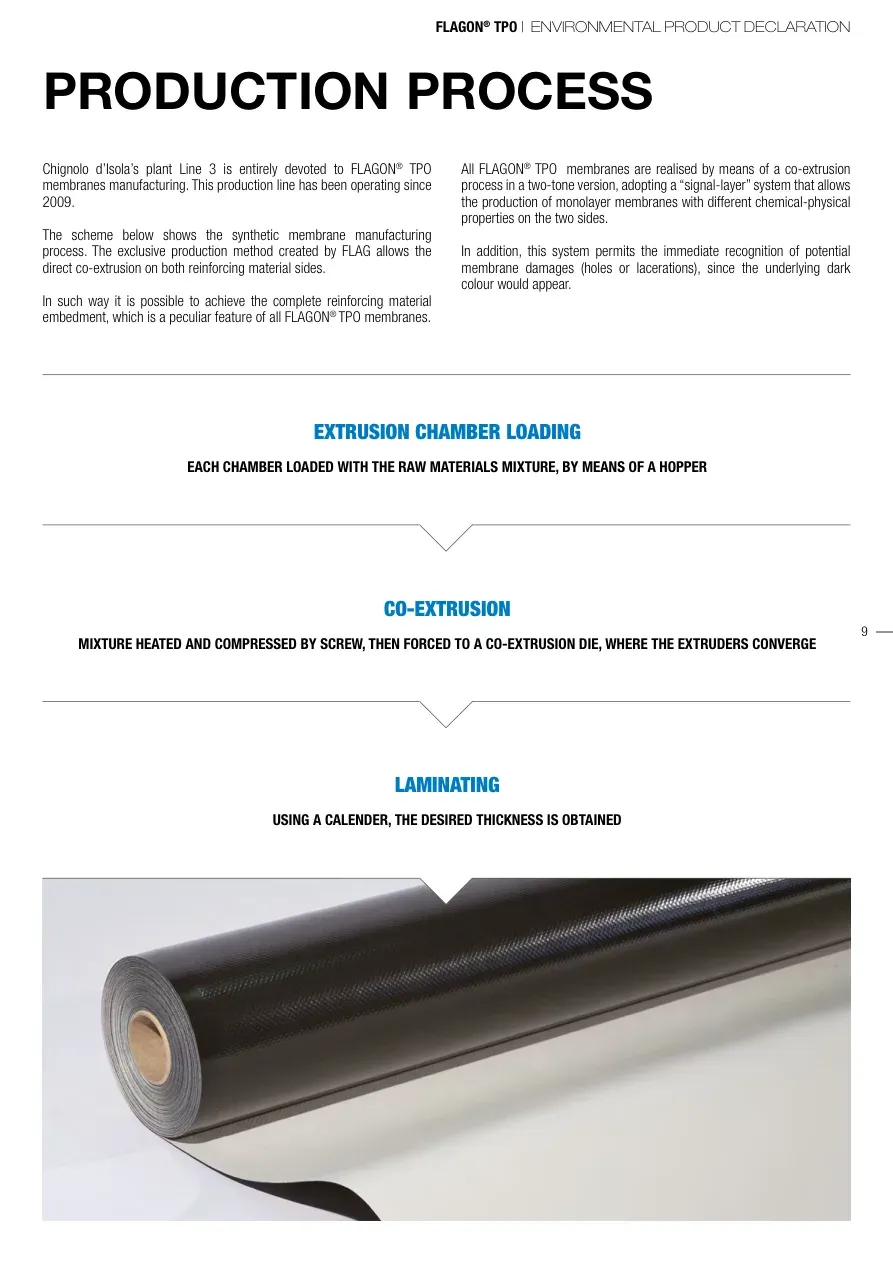
FLAGON® TPO | ENVIRONMENTAL PRODUCT DECLARATION9PRODUCTION PROCESSChignolo d’Isola’s plant Line 3 is entirely devoted to FLAGON® TPO membranes manufacturing. This production line has been operating since 2009.The scheme below shows the synthetic membrane manufacturing process. The exclusive production method created by FLAG allows the direct co-extrusion on both reinforcing material sides.In such way it is possible to achieve the complete reinforcing material embedment, which is a peculiar feature of all FLAGON® TPO membranes.All FLAGON® TPO membranes are realised by means of a co-extrusion process in a two-tone version, adopting a “signal-layer” system that allows the production of monolayer membranes with different chemical-physical properties on the two sides.In addition, this system permits the immediate recognition of potential membrane damages (holes or lacerations), since the underlying dark colour would appear.EXTRUSION CHAMBER LOADING EACH CHAMBER LOADED WITH THE RAW MATERIALS MIXTURE, BY MEANS OF A HOPPERCO-EXTRUSION MIXTURE HEATED AND COMPRESSED BY SCREW, THEN FORCED TO A CO-EXTRUSION DIE, WHERE THE EXTRUDERS CONVERGELAMINATING USING A CALENDER, THE DESIRED THICKNESS IS OBTAINED
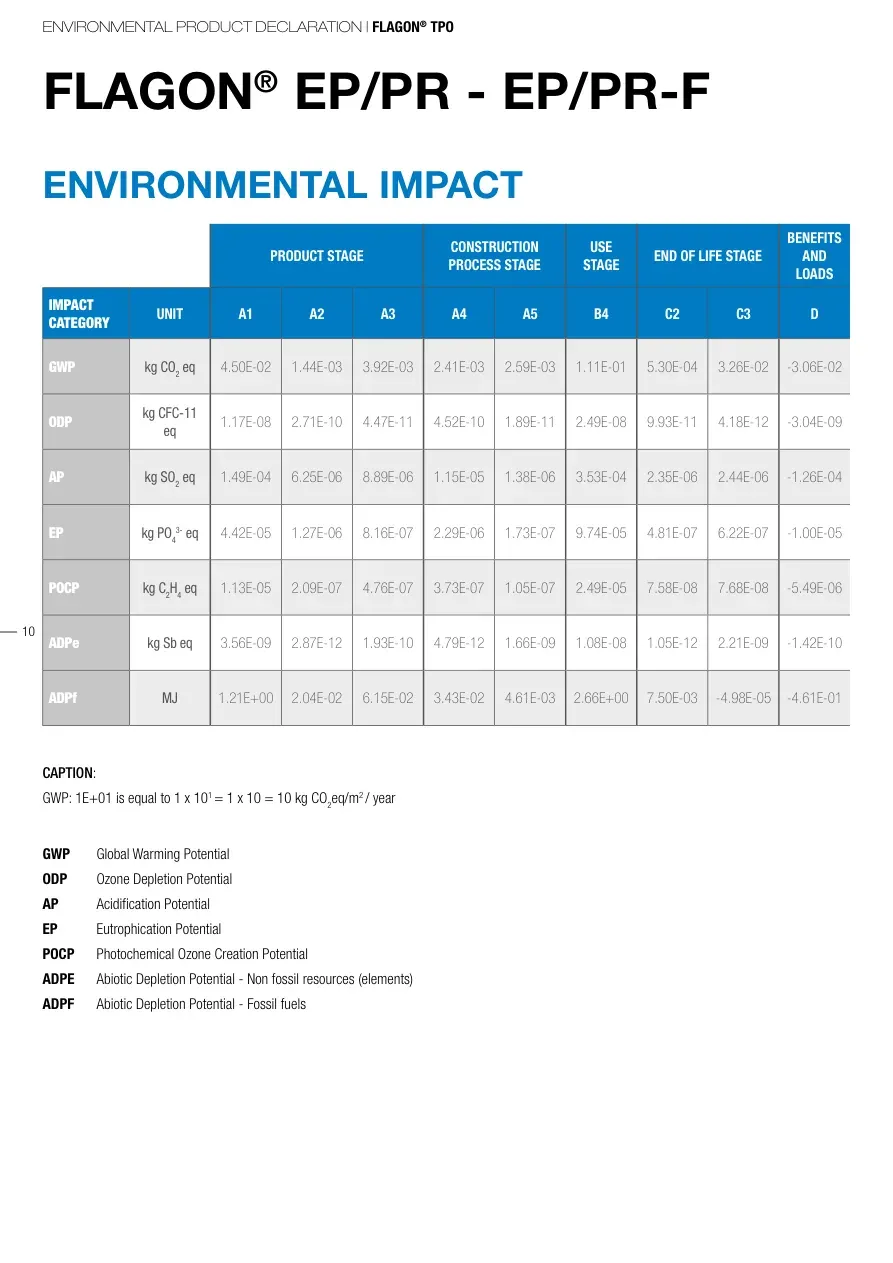
ENVIRONMENTAL PRODUCT DECLARATION | FLAGON® TPO10FLAGON® EP/PR - EP/PR-FENVIRONMENTAL IMPACTPRODUCT STAGECONSTRUCTION PROCESS STAGEUSE STAGEEND OF LIFE STAGEBENEFITS AND LOADSIMPACT CATEGORYUNITA1 A2A3A4A5B4C2C3DGWPkg CO2 eq4.50E-021.44E-033.92E-032.41E-032.59E-031.11E-015.30E-043.26E-02-3.06E-02ODPkg CFC-11 eq1.17E-082.71E-104.47E-114.52E-101.89E-112.49E-089.93E-114.18E-12-3.04E-09APkg SO2 eq1.49E-046.25E-068.89E-061.15E-051.38E-063.53E-042.35E-062.44E-06-1.26E-04EPkg PO43- eq4.42E-051.27E-068.16E-072.29E-061.73E-079.74E-054.81E-076.22E-07-1.00E-05POCPkg C2H4 eq1.13E-052.09E-074.76E-073.73E-071.05E-072.49E-057.58E-087.68E-08-5.49E-06ADPekg Sb eq3.56E-092.87E-121.93E-104.79E-121.66E-091.08E-081.05E-122.21E-09-1.42E-10ADPfMJ1.21E+002.04E-026.15E-023.43E-024.61E-032.66E+007.50E-03-4.98E-05-4.61E-01GWP Global Warming PotentialODP Ozone Depletion Potential AP Acidification Potential EP Eutrophication Potential POCP Photochemical Ozone Creation PotentialADPE Abiotic Depletion Potential - Non fossil resources (elements)ADPF Abiotic Depletion Potential - Fossil fuelsCAPTION: GWP: 1E+01 is equal to 1 x 101 = 1 x 10 = 10 kg CO2eq/m2 / year
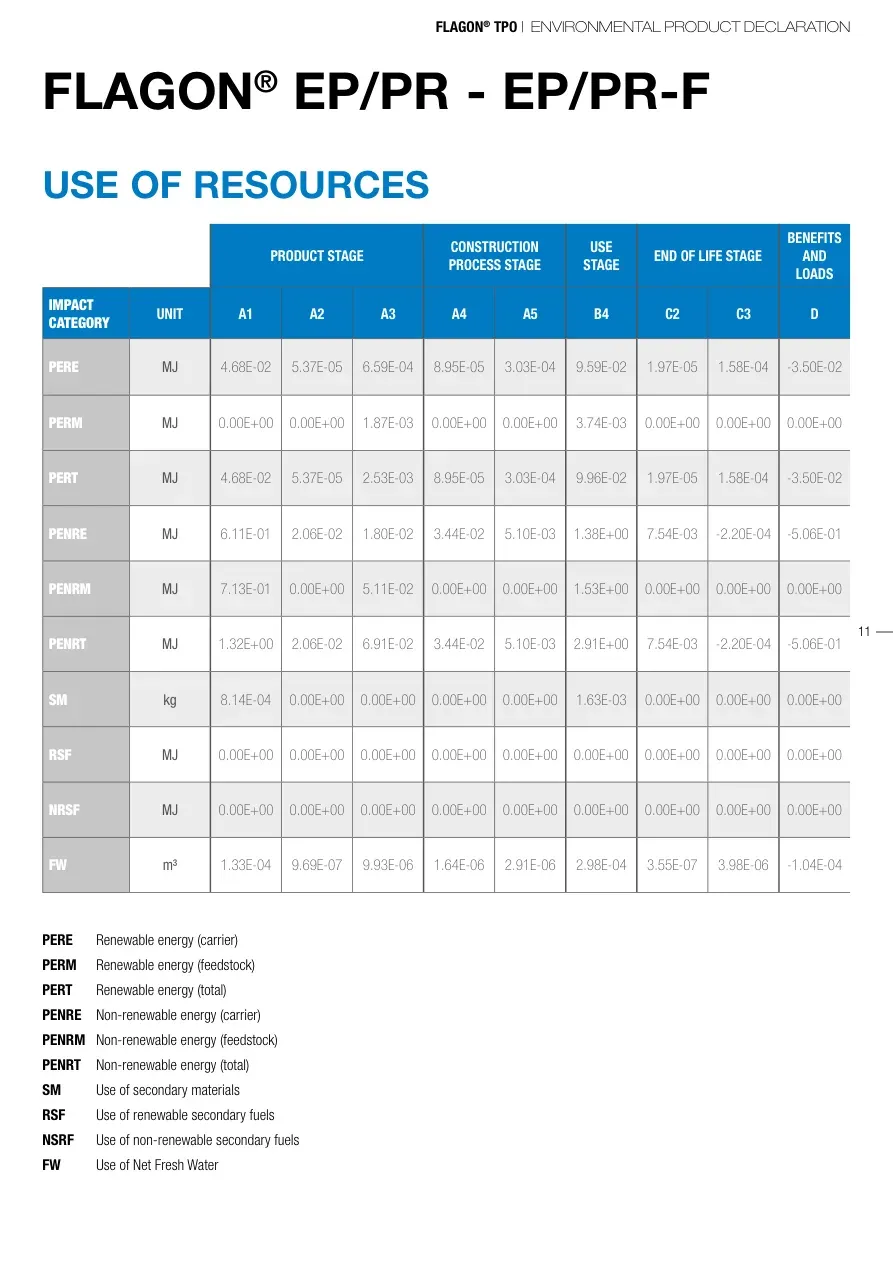
FLAGON® TPO | ENVIRONMENTAL PRODUCT DECLARATION11FLAGON® EP/PR - EP/PR-FUSE OF RESOURCESPRODUCT STAGECONSTRUCTION PROCESS STAGEUSE STAGEEND OF LIFE STAGEBENEFITS AND LOADSIMPACT CATEGORYUNITA1 A2A3A4A5B4C2C3DPEREMJ4.68E-025.37E-056.59E-048.95E-053.03E-049.59E-021.97E-051.58E-04-3.50E-02PERMMJ0.00E+000.00E+001.87E-030.00E+000.00E+003.74E-030.00E+000.00E+000.00E+00PERTMJ4.68E-025.37E-052.53E-038.95E-053.03E-049.96E-021.97E-051.58E-04-3.50E-02PENREMJ6.11E-012.06E-021.80E-023.44E-025.10E-031.38E+007.54E-03-2.20E-04-5.06E-01PENRMMJ7.13E-010.00E+005.11E-020.00E+000.00E+001.53E+000.00E+000.00E+000.00E+00PENRTMJ1.32E+002.06E-026.91E-023.44E-025.10E-032.91E+007.54E-03-2.20E-04-5.06E-01SMkg8.14E-040.00E+000.00E+000.00E+000.00E+001.63E-030.00E+000.00E+000.00E+00RSFMJ0.00E+000.00E+000.00E+000.00E+000.00E+000.00E+000.00E+000.00E+000.00E+00NRSFMJ0.00E+000.00E+000.00E+000.00E+000.00E+000.00E+000.00E+000.00E+000.00E+00FWm³1.33E-049.69E-079.93E-061.64E-062.91E-062.98E-043.55E-073.98E-06-1.04E-04PERE Renewable energy (carrier) PERM Renewable energy (feedstock)PERT Renewable energy (total) PENRE Non-renewable energy (carrier)PENRM Non-renewable energy (feedstock)PENRT Non-renewable energy (total)SM Use of secondary materials RSF Use of renewable secondary fuelsNSRF Use of non-renewable secondary fuels FW Use of Net Fresh Water
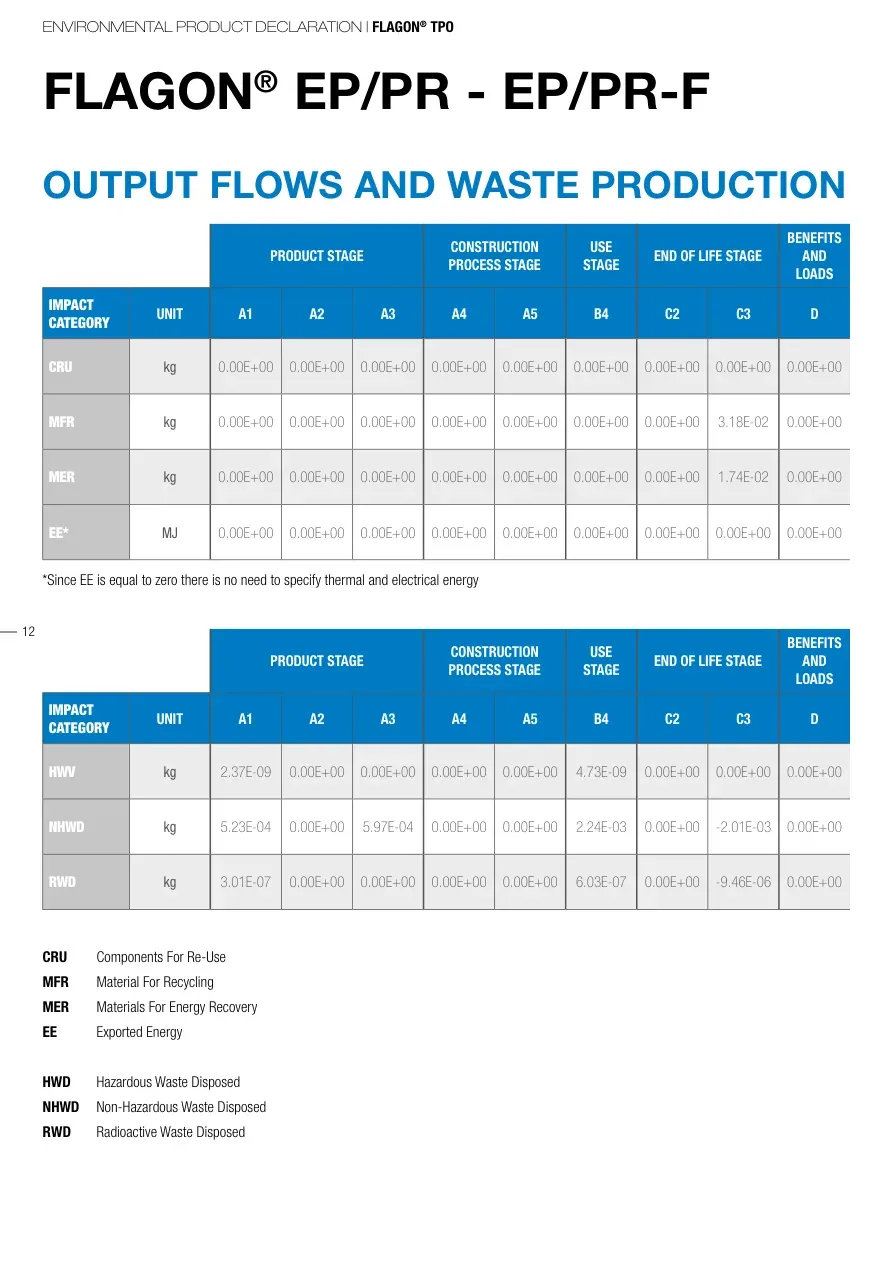
ENVIRONMENTAL PRODUCT DECLARATION | FLAGON® TPO12FLAGON® EP/PR - EP/PR-FOUTPUT FLOWS AND WASTE PRODUCTION CRU Components For Re-Use MFR Material For Recycling MER Materials For Energy Recovery EE Exported Energy HWD Hazardous Waste DisposedNHWD Non-Hazardous Waste Disposed RWD Radioactive Waste DisposedPRODUCT STAGECONSTRUCTION PROCESS STAGEUSE STAGEEND OF LIFE STAGEBENEFITS AND LOADSIMPACT CATEGORYUNITA1 A2A3A4A5B4C2C3DCRUkg0.00E+000.00E+000.00E+000.00E+000.00E+000.00E+000.00E+000.00E+000.00E+00MFRkg0.00E+000.00E+000.00E+000.00E+000.00E+000.00E+000.00E+003.18E-020.00E+00MERkg0.00E+000.00E+000.00E+000.00E+000.00E+000.00E+000.00E+001.74E-020.00E+00EE*MJ0.00E+000.00E+000.00E+000.00E+000.00E+000.00E+000.00E+000.00E+000.00E+00PRODUCT STAGECONSTRUCTION PROCESS STAGEUSE STAGEEND OF LIFE STAGEBENEFITS AND LOADSIMPACT CATEGORYUNITA1 A2A3A4A5B4C2C3DHWVkg2.37E-090.00E+000.00E+000.00E+000.00E+004.73E-090.00E+000.00E+000.00E+00NHWDkg5.23E-040.00E+005.97E-040.00E+000.00E+002.24E-030.00E+00-2.01E-030.00E+00RWDkg3.01E-070.00E+000.00E+000.00E+000.00E+006.03E-070.00E+00-9.46E-060.00E+00*Since EE is equal to zero there is no need to specify thermal and electrical energy
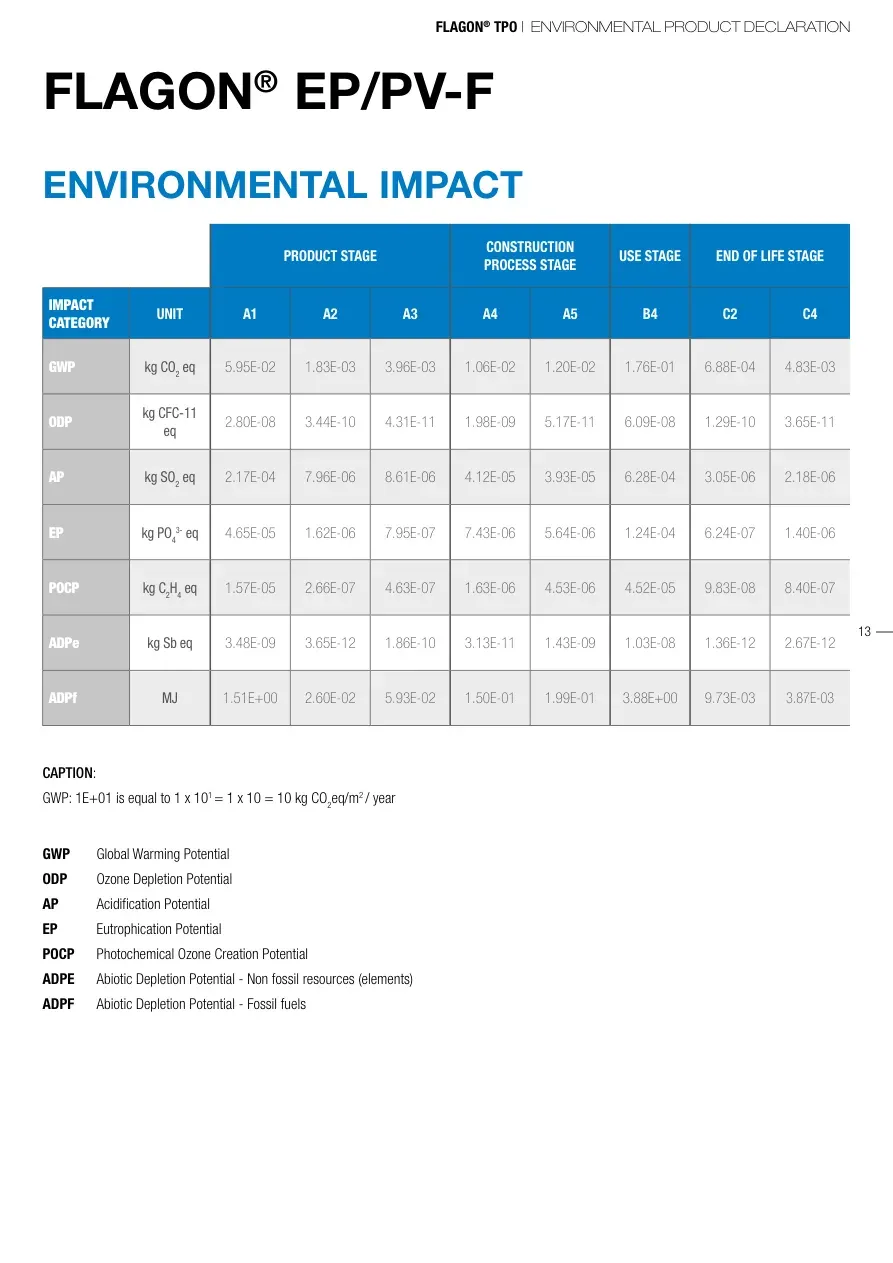
FLAGON® TPO | ENVIRONMENTAL PRODUCT DECLARATION13FLAGON® EP/PV-FENVIRONMENTAL IMPACTPRODUCT STAGECONSTRUCTION PROCESS STAGEUSE STAGEEND OF LIFE STAGEIMPACT CATEGORYUNITA1 A2A3A4A5B4C2C4GWPkg CO2 eq5.95E-021.83E-033.96E-031.06E-021.20E-021.76E-016.88E-044.83E-03ODPkg CFC-11 eq2.80E-083.44E-104.31E-111.98E-095.17E-116.09E-081.29E-103.65E-11APkg SO2 eq2.17E-047.96E-068.61E-064.12E-053.93E-056.28E-043.05E-062.18E-06EPkg PO43- eq4.65E-051.62E-067.95E-077.43E-065.64E-061.24E-046.24E-071.40E-06POCPkg C2H4 eq1.57E-052.66E-074.63E-071.63E-064.53E-064.52E-059.83E-088.40E-07ADPekg Sb eq3.48E-093.65E-121.86E-103.13E-111.43E-091.03E-081.36E-122.67E-12ADPfMJ1.51E+002.60E-025.93E-021.50E-011.99E-013.88E+009.73E-033.87E-03GWP Global Warming PotentialODP Ozone Depletion Potential AP Acidification Potential EP Eutrophication Potential POCP Photochemical Ozone Creation PotentialADPE Abiotic Depletion Potential - Non fossil resources (elements)ADPF Abiotic Depletion Potential - Fossil fuelsCAPTION: GWP: 1E+01 is equal to 1 x 101 = 1 x 10 = 10 kg CO2eq/m2 / year
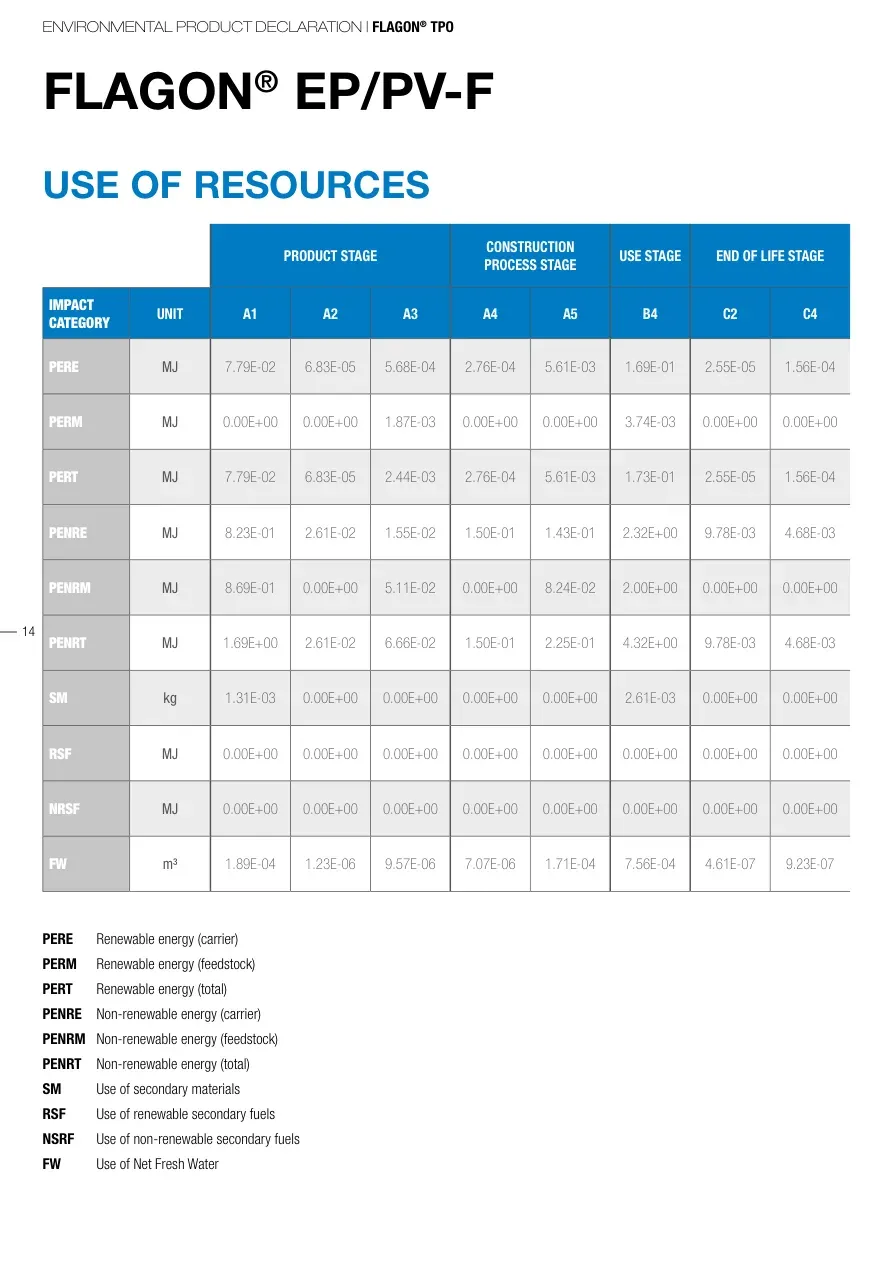
ENVIRONMENTAL PRODUCT DECLARATION | FLAGON® TPO14FLAGON® EP/PV-FUSE OF RESOURCESPRODUCT STAGECONSTRUCTION PROCESS STAGEUSE STAGEEND OF LIFE STAGEIMPACT CATEGORYUNITA1 A2A3A4A5B4C2C4PEREMJ7.79E-026.83E-055.68E-042.76E-045.61E-031.69E-012.55E-051.56E-04PERMMJ0.00E+000.00E+001.87E-030.00E+000.00E+003.74E-030.00E+000.00E+00PERTMJ7.79E-026.83E-052.44E-032.76E-045.61E-031.73E-012.55E-051.56E-04PENREMJ8.23E-012.61E-021.55E-021.50E-011.43E-012.32E+009.78E-034.68E-03PENRMMJ8.69E-010.00E+005.11E-020.00E+008.24E-022.00E+000.00E+000.00E+00PENRTMJ1.69E+002.61E-026.66E-021.50E-012.25E-014.32E+009.78E-034.68E-03SMkg1.31E-030.00E+000.00E+000.00E+000.00E+002.61E-030.00E+000.00E+00RSFMJ0.00E+000.00E+000.00E+000.00E+000.00E+000.00E+000.00E+000.00E+00NRSFMJ0.00E+000.00E+000.00E+000.00E+000.00E+000.00E+000.00E+000.00E+00FWm³1.89E-041.23E-069.57E-067.07E-061.71E-047.56E-044.61E-079.23E-07PERE Renewable energy (carrier) PERM Renewable energy (feedstock)PERT Renewable energy (total) PENRE Non-renewable energy (carrier)PENRM Non-renewable energy (feedstock)PENRT Non-renewable energy (total)SM Use of secondary materials RSF Use of renewable secondary fuelsNSRF Use of non-renewable secondary fuels FW Use of Net Fresh Water
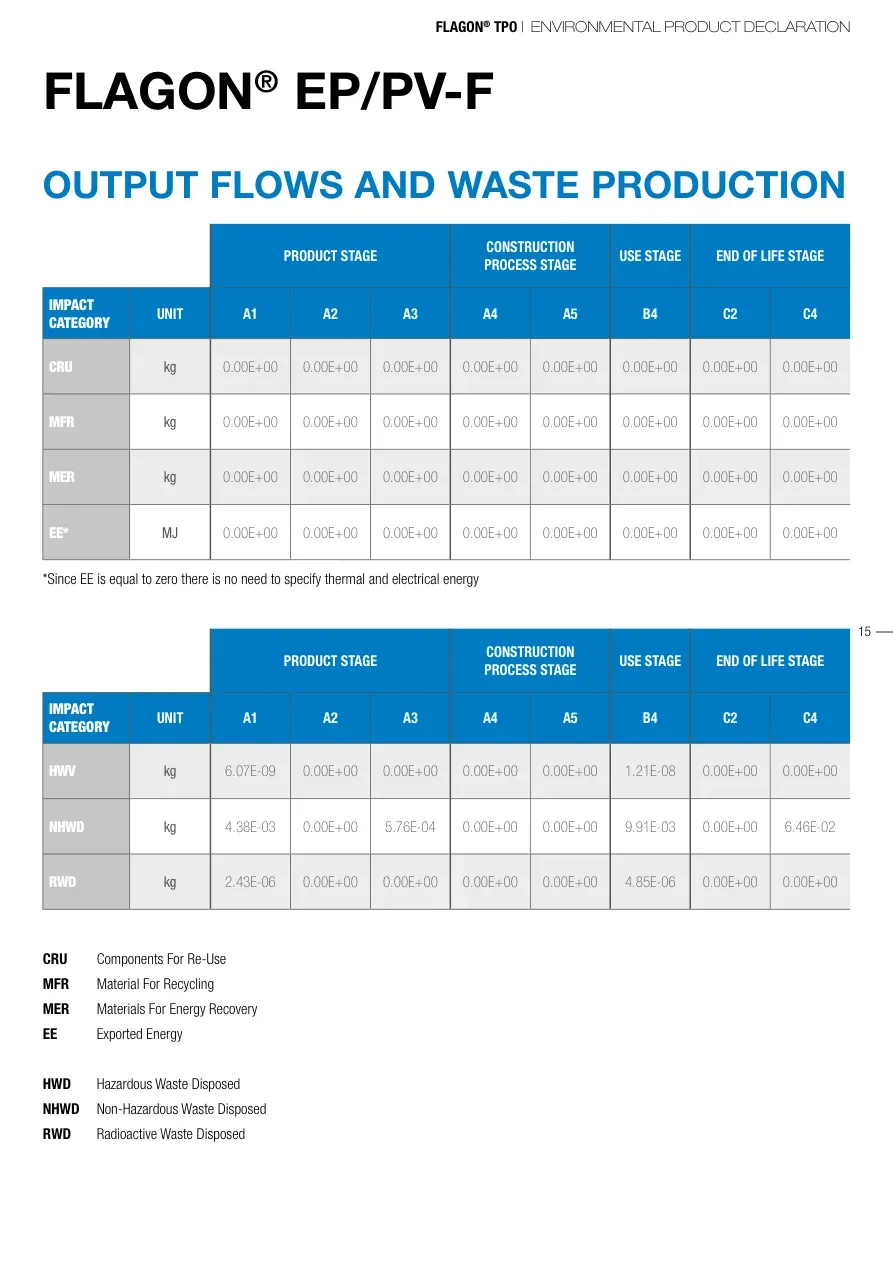
FLAGON® TPO | ENVIRONMENTAL PRODUCT DECLARATION15FLAGON® EP/PV-FOUTPUT FLOWS AND WASTE PRODUCTION PRODUCT STAGECONSTRUCTION PROCESS STAGEUSE STAGEEND OF LIFE STAGEIMPACT CATEGORYUNITA1 A2A3A4A5B4C2C4CRUkg0.00E+000.00E+000.00E+000.00E+000.00E+000.00E+000.00E+000.00E+00MFRkg0.00E+000.00E+000.00E+000.00E+000.00E+000.00E+000.00E+000.00E+00MERkg0.00E+000.00E+000.00E+000.00E+000.00E+000.00E+000.00E+000.00E+00EE*MJ0.00E+000.00E+000.00E+000.00E+000.00E+000.00E+000.00E+000.00E+00PRODUCT STAGECONSTRUCTION PROCESS STAGEUSE STAGEEND OF LIFE STAGEIMPACT CATEGORYUNITA1 A2A3A4A5B4C2C4HWVkg6.07E-090.00E+000.00E+000.00E+000.00E+001.21E-080.00E+000.00E+00NHWDkg4.38E-030.00E+005.76E-040.00E+000.00E+009.91E-030.00E+006.46E-02RWDkg2.43E-060.00E+000.00E+000.00E+000.00E+004.85E-060.00E+000.00E+00CRU Components For Re-Use MFR Material For Recycling MER Materials For Energy Recovery EE Exported Energy HWD Hazardous Waste DisposedNHWD Non-Hazardous Waste Disposed RWD Radioactive Waste Disposed*Since EE is equal to zero there is no need to specify thermal and electrical energy
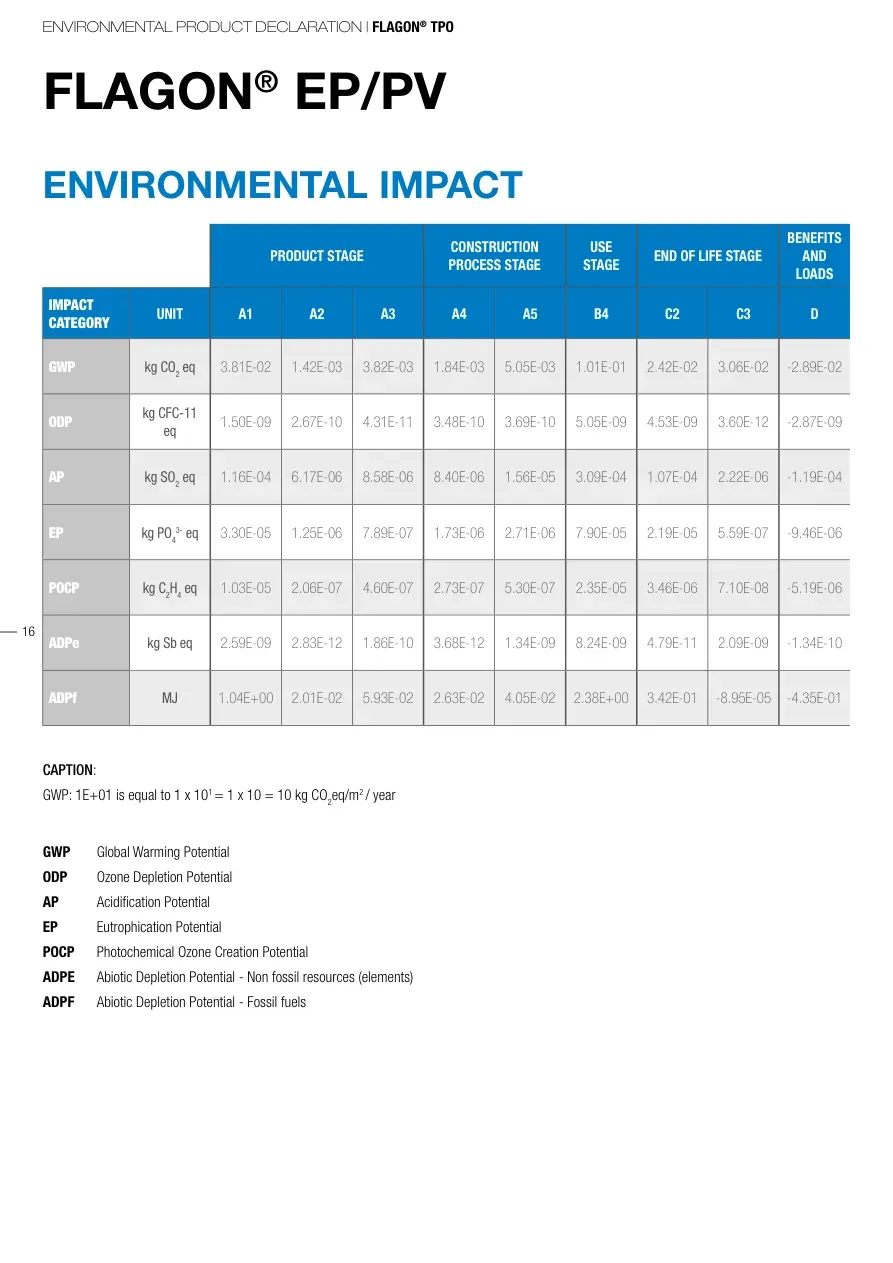
ENVIRONMENTAL PRODUCT DECLARATION | FLAGON® TPO16FLAGON® EP/PVENVIRONMENTAL IMPACTGWP Global Warming PotentialODP Ozone Depletion Potential AP Acidification Potential EP Eutrophication Potential POCP Photochemical Ozone Creation PotentialADPE Abiotic Depletion Potential - Non fossil resources (elements)ADPF Abiotic Depletion Potential - Fossil fuelsCAPTION: GWP: 1E+01 is equal to 1 x 101 = 1 x 10 = 10 kg CO2eq/m2 / yearPRODUCT STAGECONSTRUCTION PROCESS STAGEUSE STAGEEND OF LIFE STAGEBENEFITS AND LOADSIMPACT CATEGORYUNITA1 A2A3A4A5B4C2C3DGWPkg CO2 eq3.81E-021.42E-033.82E-031.84E-035.05E-031.01E-012.42E-023.06E-02-2.89E-02ODPkg CFC-11 eq1.50E-092.67E-104.31E-113.48E-103.69E-105.05E-094.53E-093.60E-12-2.87E-09APkg SO2 eq1.16E-046.17E-068.58E-068.40E-061.56E-053.09E-041.07E-042.22E-06-1.19E-04EPkg PO43- eq3.30E-051.25E-067.89E-071.73E-062.71E-067.90E-052.19E-055.59E-07-9.46E-06POCPkg C2H4 eq1.03E-052.06E-074.60E-072.73E-075.30E-072.35E-053.46E-067.10E-08-5.19E-06ADPekg Sb eq2.59E-092.83E-121.86E-103.68E-121.34E-098.24E-094.79E-112.09E-09-1.34E-10ADPfMJ1.04E+002.01E-025.93E-022.63E-024.05E-022.38E+003.42E-01-8.95E-05-4.35E-01
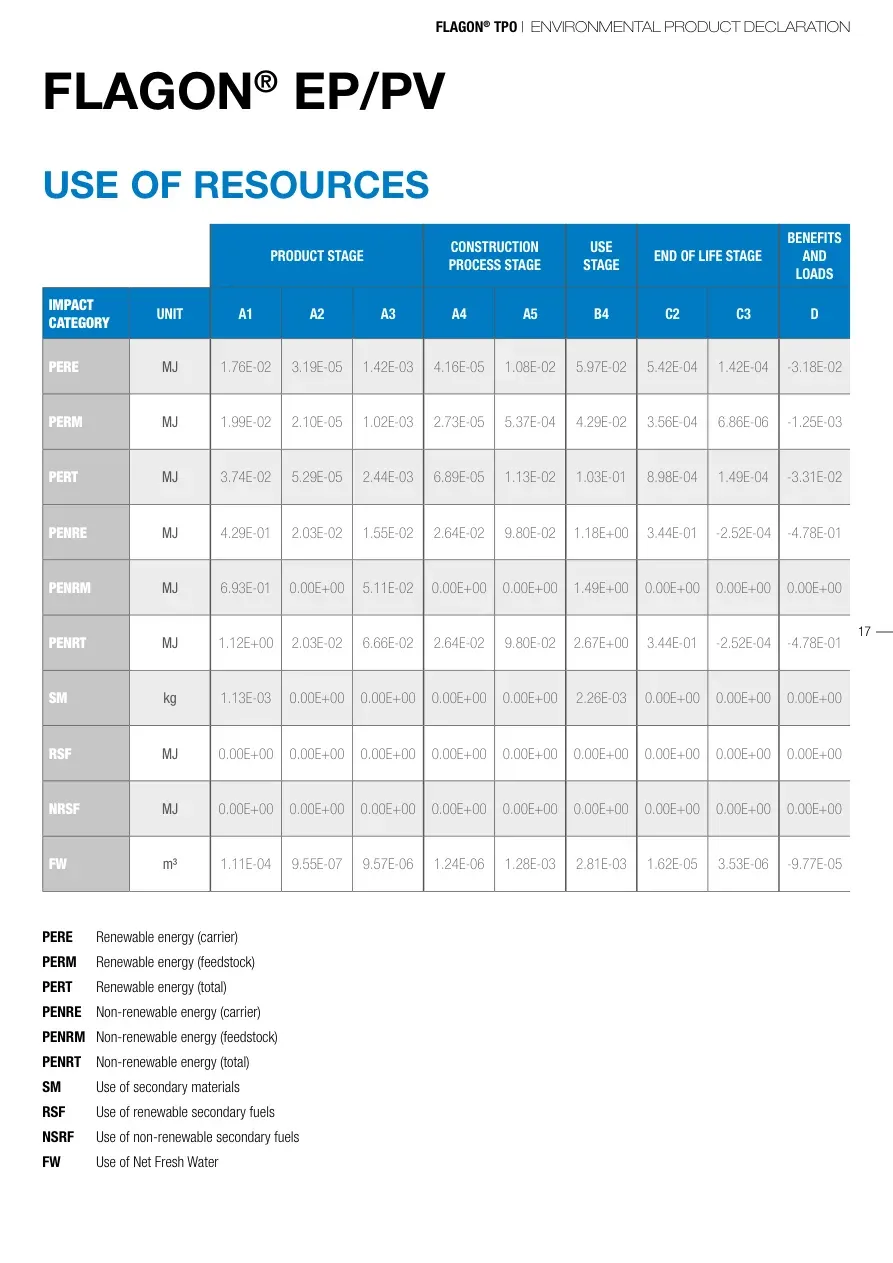
FLAGON® TPO | ENVIRONMENTAL PRODUCT DECLARATION17FLAGON® EP/PVUSE OF RESOURCESPERE Renewable energy (carrier) PERM Renewable energy (feedstock)PERT Renewable energy (total) PENRE Non-renewable energy (carrier)PENRM Non-renewable energy (feedstock)PENRT Non-renewable energy (total)SM Use of secondary materials RSF Use of renewable secondary fuelsNSRF Use of non-renewable secondary fuels FW Use of Net Fresh WaterPRODUCT STAGECONSTRUCTION PROCESS STAGEUSE STAGEEND OF LIFE STAGEBENEFITS AND LOADSIMPACT CATEGORYUNITA1 A2A3A4A5B4C2C3DPEREMJ1.76E-023.19E-051.42E-034.16E-051.08E-025.97E-025.42E-041.42E-04-3.18E-02PERMMJ1.99E-022.10E-051.02E-032.73E-055.37E-044.29E-023.56E-046.86E-06-1.25E-03PERTMJ3.74E-025.29E-052.44E-036.89E-051.13E-021.03E-018.98E-041.49E-04-3.31E-02PENREMJ4.29E-012.03E-021.55E-022.64E-029.80E-021.18E+003.44E-01-2.52E-04-4.78E-01PENRMMJ6.93E-010.00E+005.11E-020.00E+000.00E+001.49E+000.00E+000.00E+000.00E+00PENRTMJ1.12E+002.03E-026.66E-022.64E-029.80E-022.67E+003.44E-01-2.52E-04-4.78E-01SMkg1.13E-030.00E+000.00E+000.00E+000.00E+002.26E-030.00E+000.00E+000.00E+00RSFMJ0.00E+000.00E+000.00E+000.00E+000.00E+000.00E+000.00E+000.00E+000.00E+00NRSFMJ0.00E+000.00E+000.00E+000.00E+000.00E+000.00E+000.00E+000.00E+000.00E+00FWm³1.11E-049.55E-079.57E-061.24E-061.28E-032.81E-031.62E-053.53E-06-9.77E-05
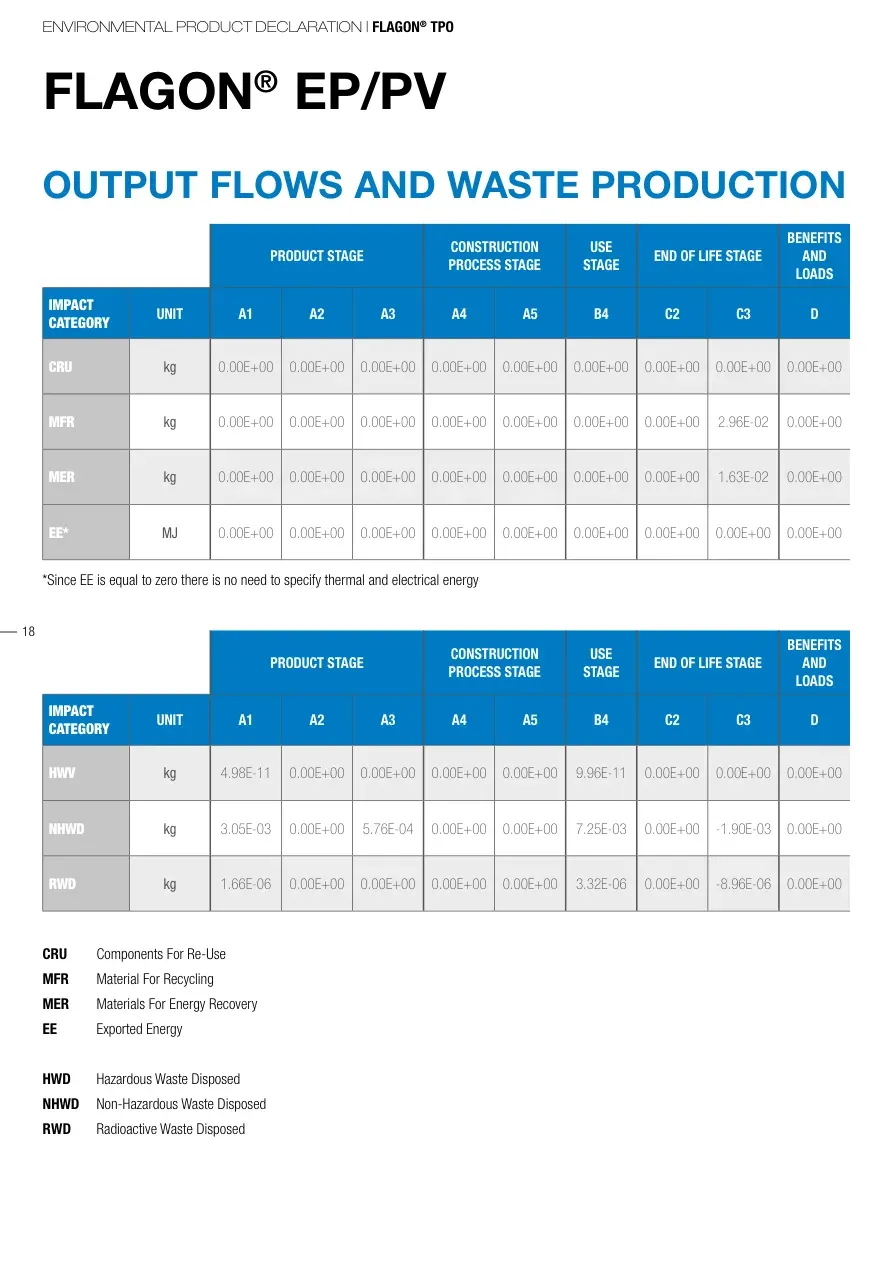
ENVIRONMENTAL PRODUCT DECLARATION | FLAGON® TPO18FLAGON® EP/PVOUTPUT FLOWS AND WASTE PRODUCTION CRU Components For Re-Use MFR Material For Recycling MER Materials For Energy Recovery EE Exported Energy HWD Hazardous Waste DisposedNHWD Non-Hazardous Waste Disposed RWD Radioactive Waste DisposedPRODUCT STAGECONSTRUCTION PROCESS STAGEUSE STAGEEND OF LIFE STAGEBENEFITS AND LOADSIMPACT CATEGORYUNITA1 A2A3A4A5B4C2C3DCRUkg0.00E+000.00E+000.00E+000.00E+000.00E+000.00E+000.00E+000.00E+000.00E+00MFRkg0.00E+000.00E+000.00E+000.00E+000.00E+000.00E+000.00E+002.96E-020.00E+00MERkg0.00E+000.00E+000.00E+000.00E+000.00E+000.00E+000.00E+001.63E-020.00E+00EE*MJ0.00E+000.00E+000.00E+000.00E+000.00E+000.00E+000.00E+000.00E+000.00E+00PRODUCT STAGECONSTRUCTION PROCESS STAGEUSE STAGEEND OF LIFE STAGEBENEFITS AND LOADSIMPACT CATEGORYUNITA1 A2A3A4A5B4C2C3DHWVkg4.98E-110.00E+000.00E+000.00E+000.00E+009.96E-110.00E+000.00E+000.00E+00NHWDkg3.05E-030.00E+005.76E-040.00E+000.00E+007.25E-030.00E+00-1.90E-030.00E+00RWDkg1.66E-060.00E+000.00E+000.00E+000.00E+003.32E-060.00E+00-8.96E-060.00E+00*Since EE is equal to zero there is no need to specify thermal and electrical energy
FLAGON® TPO | ENVIRONMENTAL PRODUCT DECLARATION19
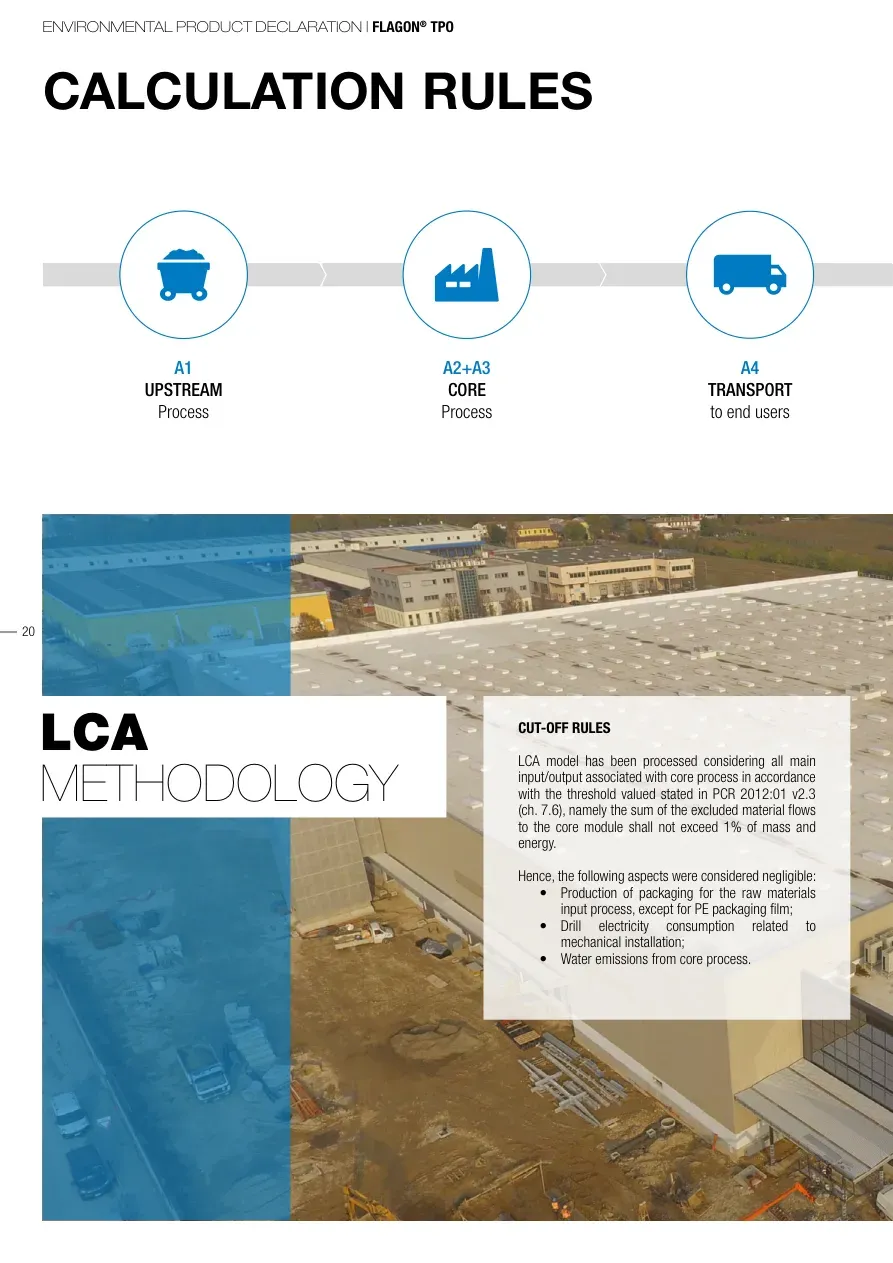
ENVIRONMENTAL PRODUCT DECLARATION | FLAGON® TPO20CALCULATION RULESCUT-OFF RULESLCA model has been processed considering all main input/output associated with core process in accordance with the threshold valued stated in PCR 2012:01 v2.3 (ch. 7.6), namely the sum of the excluded material flows to the core module shall not exceed 1% of mass and energy. Hence, the following aspects were considered negligible:• Production of packaging for the raw materials input process, except for PE packaging film;• Drill electricity consumption related to mechanical installation;• Water emissions from core process.A1UPSTREAM ProcessA2+A3CORE ProcessA4TRANSPORTto end usersLCAMETHODOLOGY
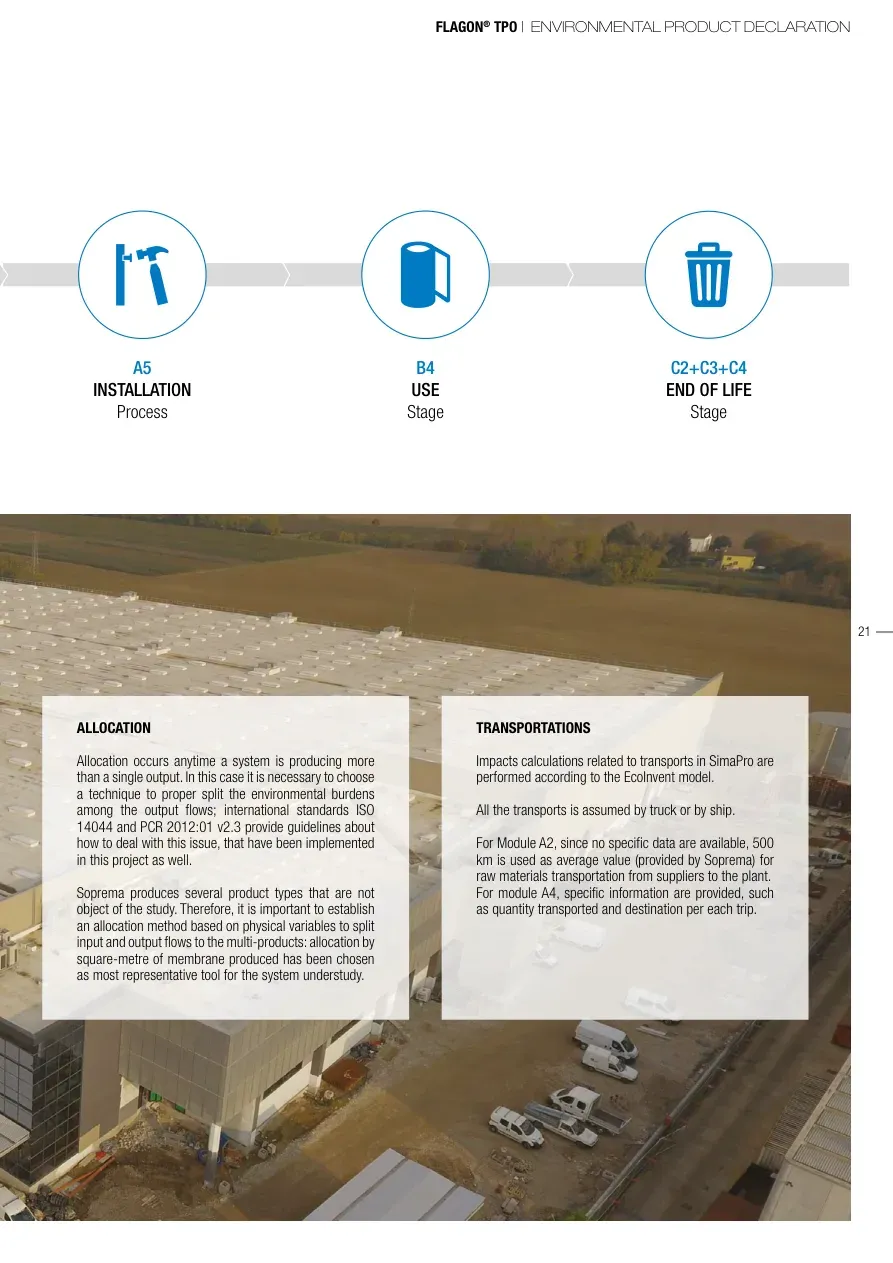
FLAGON® TPO | ENVIRONMENTAL PRODUCT DECLARATION21ALLOCATIONAllocation occurs anytime a system is producing more than a single output. In this case it is necessary to choose a technique to proper split the environmental burdens among the output flows; international standards ISO 14044 and PCR 2012:01 v2.3 provide guidelines about how to deal with this issue, that have been implemented in this project as well.Soprema produces several product types that are not object of the study. Therefore, it is important to establish an allocation method based on physical variables to split input and output flows to the multi-products: allocation by square-metre of membrane produced has been chosen as most representative tool for the system understudy.TRANSPORTATIONSImpacts calculations related to transports in SimaPro are performed according to the EcoInvent model.All the transports is assumed by truck or by ship. For Module A2, since no specific data are available, 500 km is used as average value (provided by Soprema) for raw materials transportation from suppliers to the plant. For module A4, specific information are provided, such as quantity transported and destination per each trip.A5INSTALLATION ProcessB4USE StageC2+C3+C4END OF LIFEStage
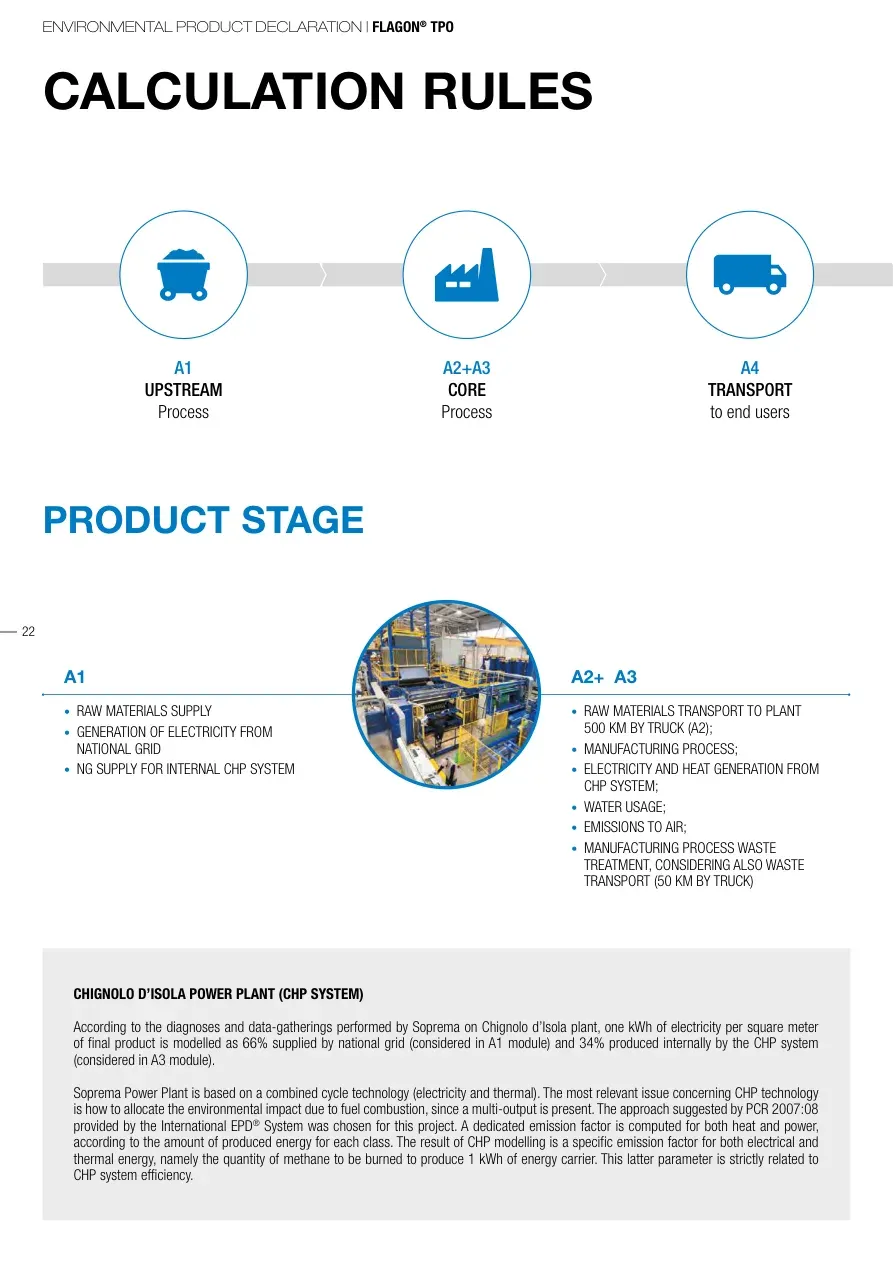
ENVIRONMENTAL PRODUCT DECLARATION | FLAGON® TPO22CALCULATION RULESCHIGNOLO D’ISOLA POWER PLANT (CHP SYSTEM)According to the diagnoses and data-gatherings performed by Soprema on Chignolo d’Isola plant, one kWh of electricity per square meter of final product is modelled as 66% supplied by national grid (considered in A1 module) and 34% produced internally by the CHP system (considered in A3 module).Soprema Power Plant is based on a combined cycle technology (electricity and thermal). The most relevant issue concerning CHP technology is how to allocate the environmental impact due to fuel combustion, since a multi-output is present. The approach suggested by PCR 2007:08 provided by the International EPD® System was chosen for this project. A dedicated emission factor is computed for both heat and power, according to the amount of produced energy for each class. The result of CHP modelling is a specific emission factor for both electrical and thermal energy, namely the quantity of methane to be burned to produce 1 kWh of energy carrier. This latter parameter is strictly related to CHP system efficiency. PRODUCT STAGEA1• RAW MATERIALS SUPPLY• GENERATION OF ELECTRICITY FROM NATIONAL GRID• NG SUPPLY FOR INTERNAL CHP SYSTEM A2+ A3 • RAW MATERIALS TRANSPORT TO PLANT 500 KM BY TRUCK (A2); • MANUFACTURING PROCESS; • ELECTRICITY AND HEAT GENERATION FROM CHP SYSTEM; • WATER USAGE; • EMISSIONS TO AIR; • MANUFACTURING PROCESS WASTE TREATMENT, CONSIDERING ALSO WASTE TRANSPORT (50 KM BY TRUCK)A1UPSTREAM ProcessA2+A3CORE ProcessA4TRANSPORTto end users
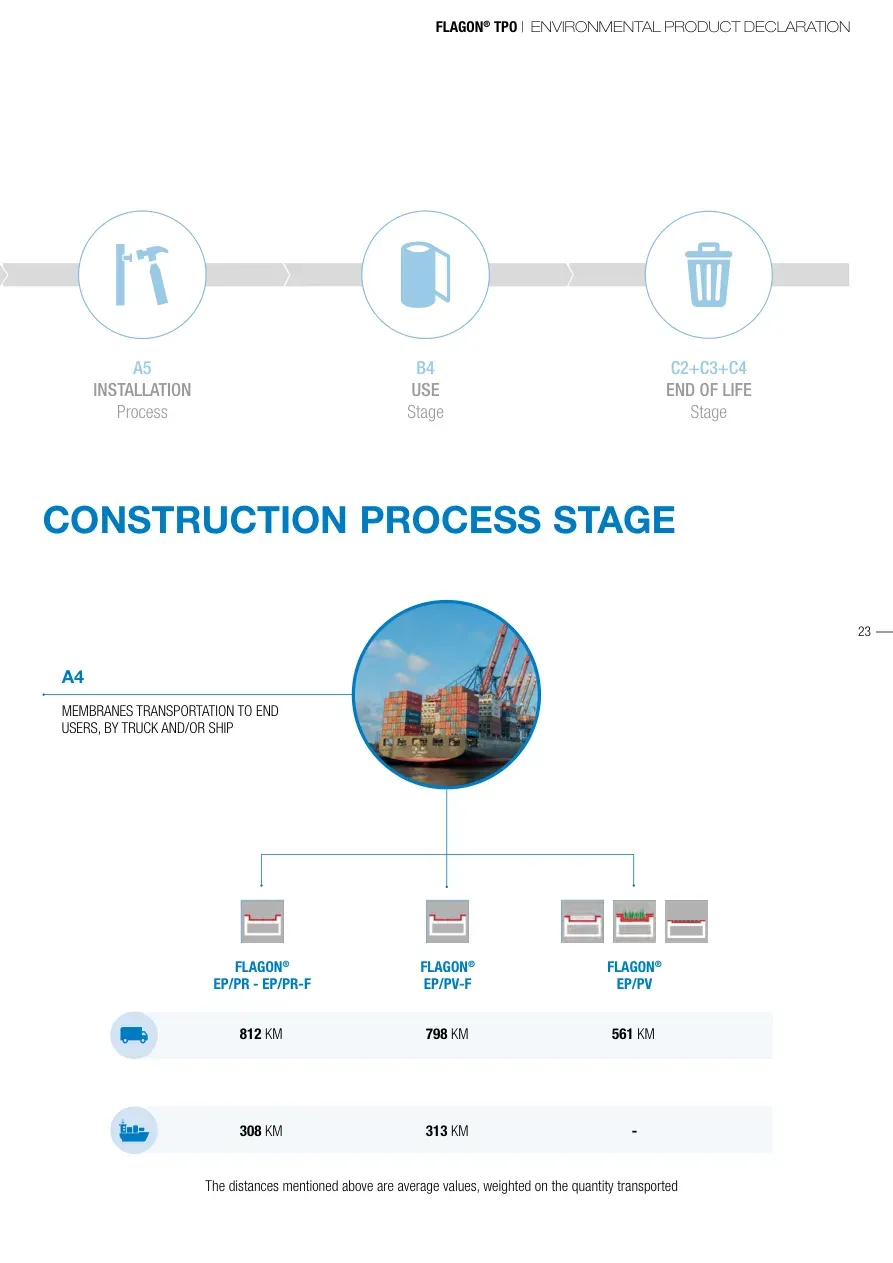
FLAGON® TPO | ENVIRONMENTAL PRODUCT DECLARATION23CONSTRUCTION PROCESS STAGEA4MEMBRANES TRANSPORTATION TO END USERS, BY TRUCK AND/OR SHIPA5INSTALLATION ProcessB4USE StageC2+C3+C4END OF LIFEStageFLAGON® EP/PR - EP/PR-FFLAGON® EP/PV-FFLAGON® EP/PV812 KM308 KM798 KM313 KM-561 KMThe distances mentioned above are average values, weighted on the quantity transported
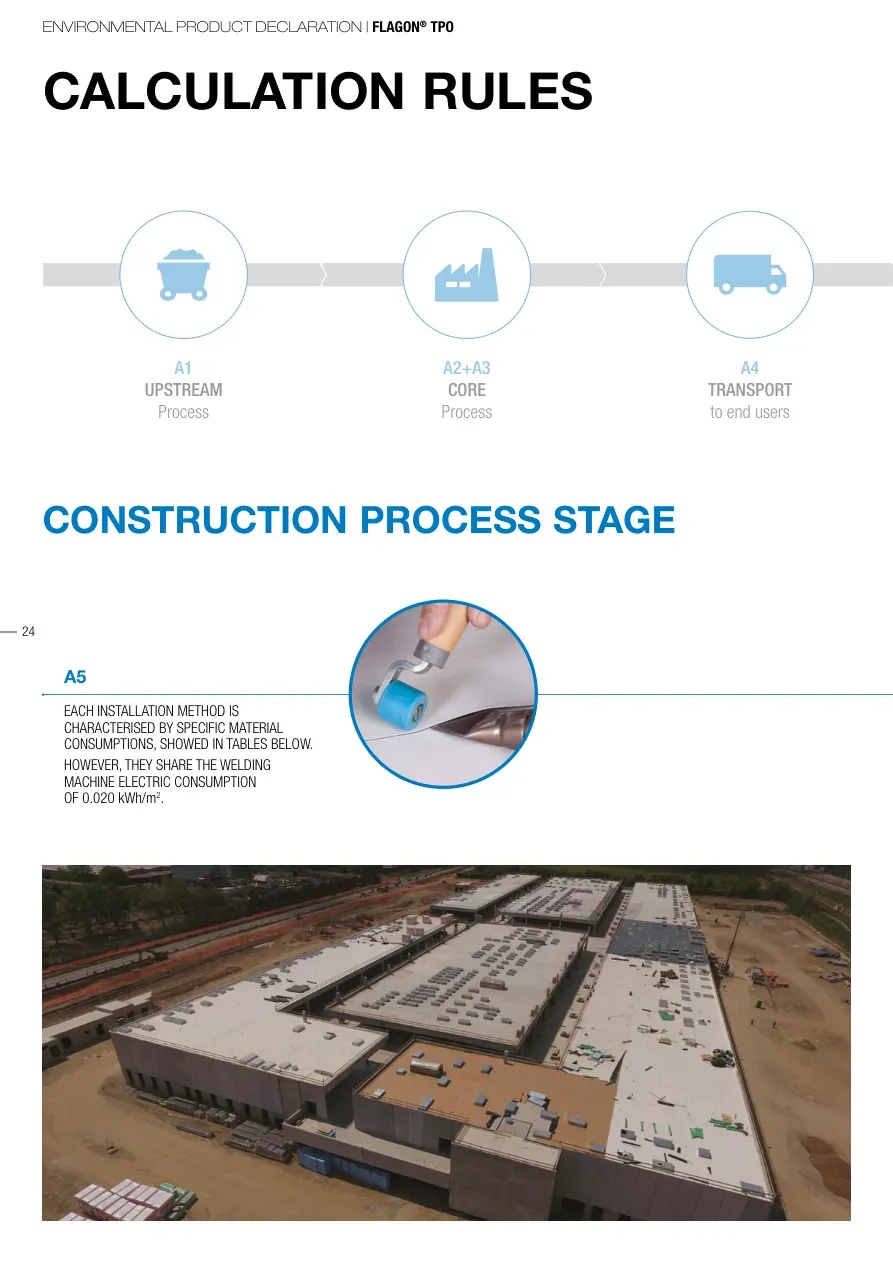
ENVIRONMENTAL PRODUCT DECLARATION | FLAGON® TPO24CALCULATION RULESA1UPSTREAM ProcessA2+A3CORE ProcessA4TRANSPORTto end usersCONSTRUCTION PROCESS STAGEA5EACH INSTALLATION METHOD IS CHARACTERISED BY SPECIFIC MATERIAL CONSUMPTIONS, SHOWED IN TABLES BELOW. HOWEVER, THEY SHARE THE WELDING MACHINE ELECTRIC CONSUMPTION OF 0.020 kWh/m2.
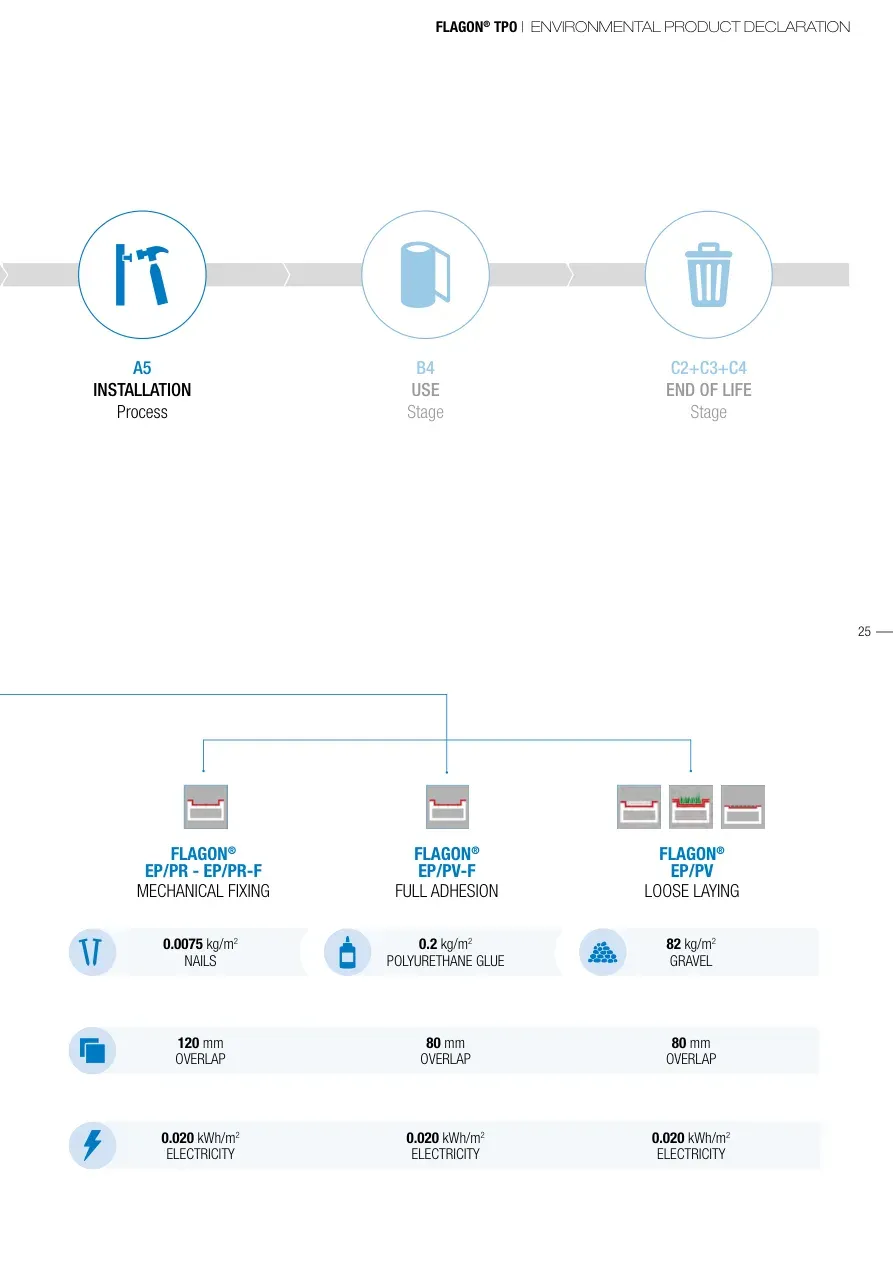
FLAGON® TPO | ENVIRONMENTAL PRODUCT DECLARATION25A5INSTALLATION ProcessB4USE StageC2+C3+C4END OF LIFEStageFLAGON®EP/PR - EP/PR-FMECHANICAL FIXINGFLAGON®EP/PV-FFULL ADHESIONFLAGON®EP/PVLOOSE LAYING0.0075 kg/m2NAILS120 mmOVERLAP0.020 kWh/m2ELECTRICITY0.2 kg/m2POLYURETHANE GLUE80 mmOVERLAP0.020 kWh/m2ELECTRICITY82 kg/m2GRAVEL80 mmOVERLAP0.020 kWh/m2ELECTRICITY
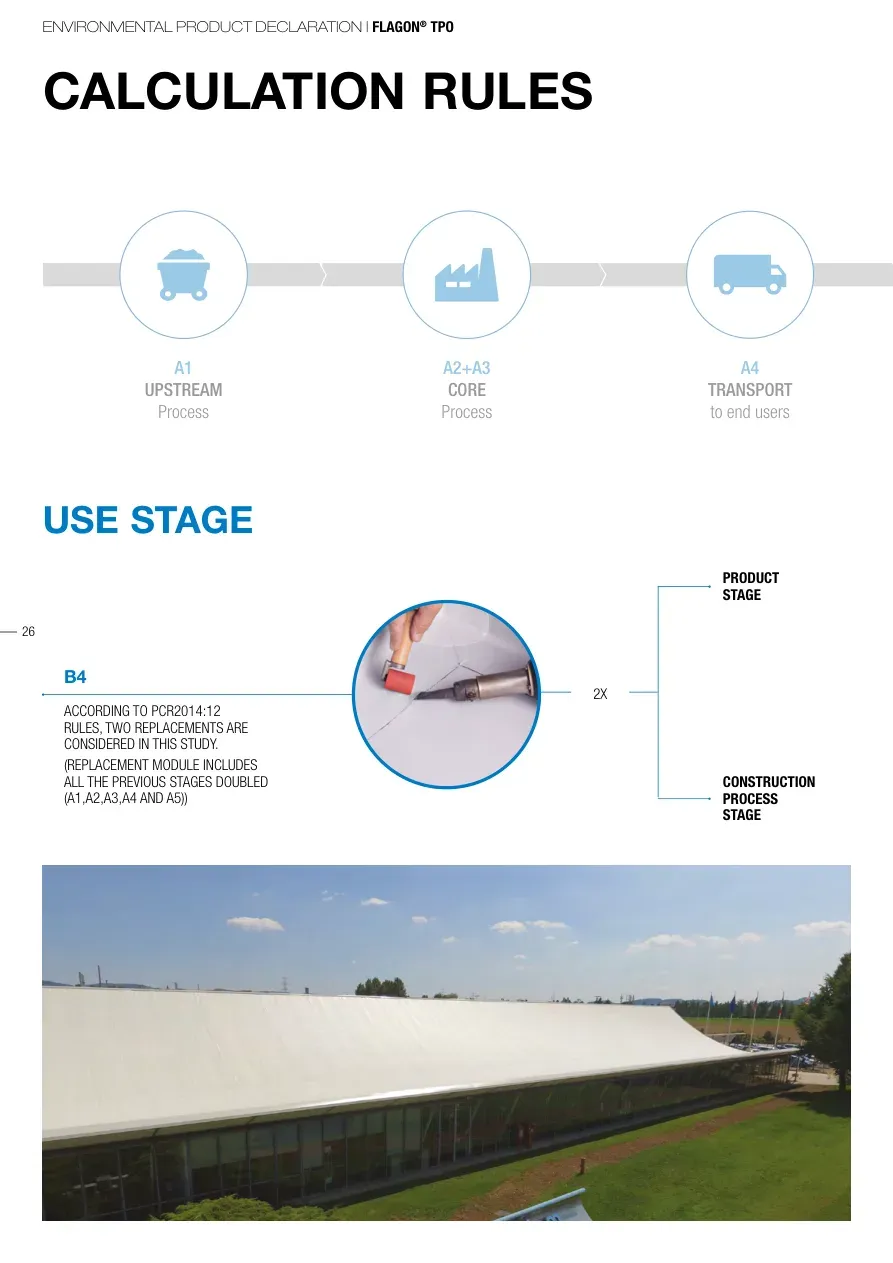
ENVIRONMENTAL PRODUCT DECLARATION | FLAGON® TPO26CALCULATION RULESUSE STAGEB4ACCORDING TO PCR2014:12 RULES, TWO REPLACEMENTS ARE CONSIDERED IN THIS STUDY.(REPLACEMENT MODULE INCLUDES ALL THE PREVIOUS STAGES DOUBLED (A1,A2,A3,A4 AND A5))A1UPSTREAM ProcessA2+A3CORE ProcessA4TRANSPORTto end usersPRODUCTSTAGECONSTRUCTION PROCESSSTAGE2X
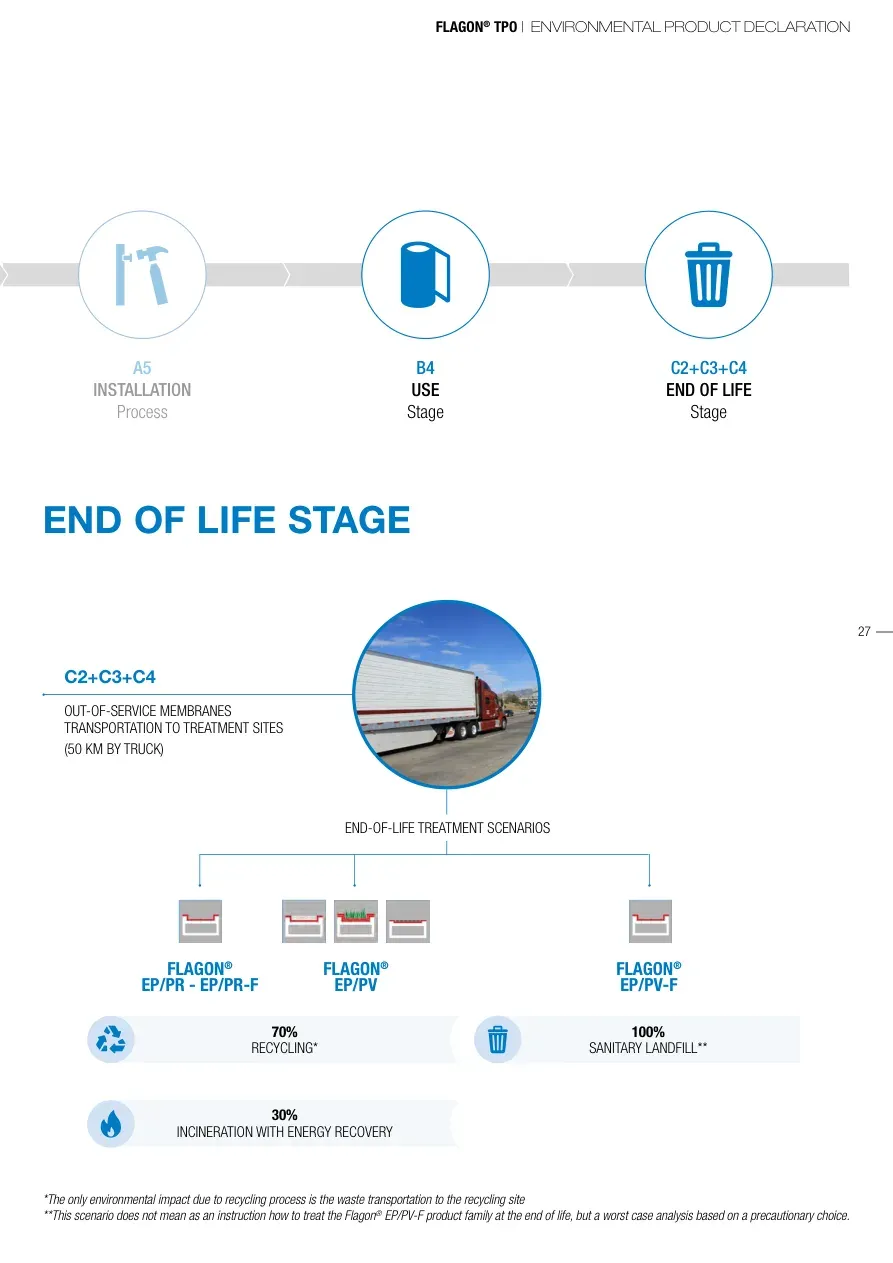
FLAGON® TPO | ENVIRONMENTAL PRODUCT DECLARATION27A5INSTALLATION ProcessB4USE StageC2+C3+C4END OF LIFEStageEND OF LIFE STAGEC2+C3+C4OUT-OF-SERVICE MEMBRANES TRANSPORTATION TO TREATMENT SITES (50 KM BY TRUCK)FLAGON®EP/PV-F70% RECYCLING*30%INCINERATION WITH ENERGY RECOVERY100% SANITARY LANDFILL**FLAGON®EP/PR - EP/PR-FFLAGON®EP/PVEND-OF-LIFE TREATMENT SCENARIOS*The only environmental impact due to recycling process is the waste transportation to the recycling site**This scenario does not mean as an instruction how to treat the Flagon® EP/PV-F product family at the end of life, but a worst case analysis based on a precautionary choice.
ENVIRONMENTAL PRODUCT DECLARATION | FLAGON® TPO28SOPREMA at your disposalSOPREMA SRLDivisione Manti Sintetici Flagvia Industriale dell’Isola, 3 - 24040 Chignolo d’Isola (Bergamo)Tel. +39 035.095.10.11Fax +39 035.494.06.49 Mail info@soprema.it For all commercial informationcontact our officesYou will find all the information onwww.soprema.itDC 2019-09- IT-Rev 0 - Febbraio 2019-1000
